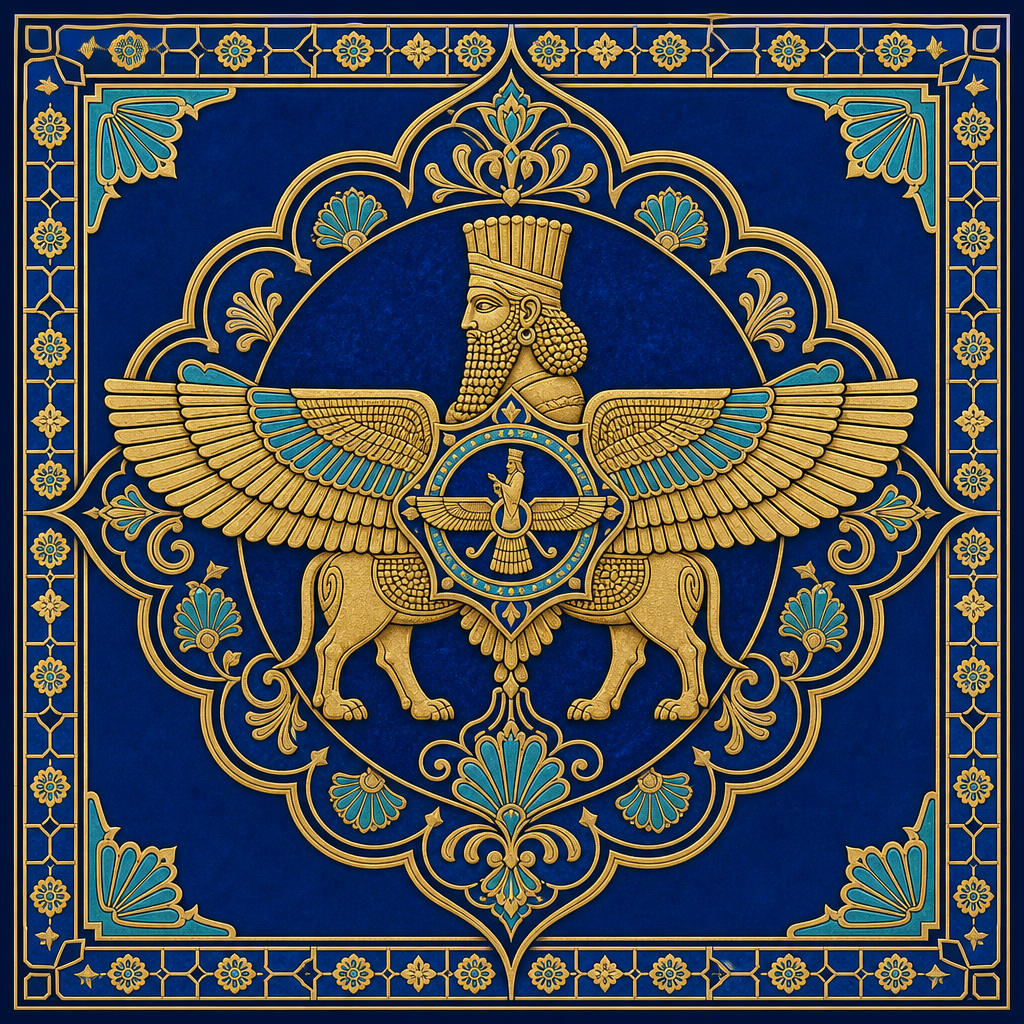

Dynasties of Persia
From Cyrus the Great's first transcontinental polity to the modern republic — the dynasties whose courts, codes and capitals defined the political grammar of the Iranian world for two and a half millennia.
The First World Empire
Founded by Cyrus II in 550 BCE and consolidated by Darius I, the Achaemenid Empire was the largest ancient state in history both by share of world population (~44%) and by territorial extent before the Mongols. It stretched from the Indus to the Aegean and from the Caucasus to Egypt's first cataract. Twenty satrapies, the Royal Road, the gold daric, the trilingual chancery (Old Persian, Elamite, Akkadian), the Behistun inscription, and the four ceremonial capitals — Pasargadae, Susa, Ecbatana, Persepolis — formed an administrative system whose imprint is still visible in the modern Iranian state.
The dynasty's tolerance of local cults and laws was famous in antiquity. The biblical books of Ezra and Nehemiah credit Cyrus and Darius with the rebuilding of the Jerusalem Temple; an Egyptian inscription of Darius's vizier Udjahorresnet praises him as restorer of the medical school of Saïs.

The Hellenistic Interlude
When Alexander died in Babylon in 323 BCE, his eastern domains passed to his general Seleucus I Nicator. The Seleucid Empire, capitaled at Seleucia-on-the-Tigris and later Antioch, was the greatest of the Hellenistic successor states. It founded dozens of Greek-style cities across Iran and Central Asia (including Ai Khanoum on the Oxus), introduced the Greek dating era — the first continuous numbered calendar in history — and minted the silver tetradrachm that became the standard coin from the Mediterranean to Bactria.
But the Seleucids never fully Hellenized the Iranian uplands. By 247 BCE the Parthians had broken away in the northeast, and by the mid-second century the Iranian heartland was lost.
The Arsacid Counter-Empire
The Arsacids ruled for nearly five centuries — longer than the Roman Empire ruled the western Mediterranean — and held Rome at the Euphrates. Their capital at Ctesiphon was sacked four times by Roman armies and rebuilt every time. At Carrhae (53 BCE), the cataphract-and-horse-archer combination annihilated Crassus's seven legions, and the "Parthian shot" entered the military vocabulary of every later empire.
Parthian rule was deliberately decentralized: a "king of kings" presided over a federation of vassal kingdoms (Elymais, Persis, Characene, Hatra, Armenia) that retained their own coinages and dynasties. This federalism, and the family quarrels it bred, would also be the dynasty's undoing.

The Second Persian Empire
The Sasanians revived the Achaemenid imperial idea with deliberate self-consciousness — even commissioning rock reliefs at Naqsh-e Rostam directly above the tombs of Darius and Xerxes. Shapur I defeated three Roman emperors (Gordian III, Philip the Arab, and Valerian, whom he captured alive). Khosrow I Anushirvan reformed taxation, codified law, founded the Academy of Gundishapur, and gave asylum to Greek philosophers expelled from Athens by Justinian.
"The Persians were the most refined of all peoples, and Khosrow Anushirvan the most just of all kings."
The empire's last decades were a perfect storm: a 26-year war of mutual exhaustion with Byzantium (602–628), the Justinianic plague's recurrent waves, and a succession crisis that put twelve rulers on the throne in four years. The Arab conquest in 636–651 ended the dynasty but transmitted Sasanian administrative practice — coin, tax, postal system, court ceremonial — directly to the Umayyad and Abbasid caliphates.

The Persian Renaissance from Bukhara
A Persian-Sunni dynasty of dehqān (landed nobility) origin, the Samanids ruled Khorasan and Transoxiana from Bukhara. Under their patronage New Persian — written in the Arabic script with a vastly enlarged Arabic vocabulary — replaced Pahlavi as the literary language of the Iranian world. The Samanid library at Bukhara was, in the words of the young Avicenna who used it, "such as I had never seen before nor since."
The court patronized Rudaki, the first major poet of New Persian; sponsored the historical works that would feed Ferdowsi's Shahnameh; and oversaw the early careers of al-Bīrūnī and Avicenna. The Samanid Mausoleum in Bukhara (c. 914) is the oldest surviving monument of Islamic Iranian architecture.
Turkic Sword, Persian Pen
The Seljuks were Oghuz Turks from the steppes who in three generations conquered Iran, Iraq, the Caucasus, and most of Anatolia. Yet their administration, language of culture, and architectural taste were almost entirely Persian. The vizier Nizam al-Mulk's Siyāsatnāma ("Book of Government") remains a classic of Persian political theory; his network of Nizāmiyya madrasas standardized Sunni higher education across the Islamic world.
Under Seljuk patronage Omar Khayyam reformed the Persian calendar to an accuracy of one day in 5,000 years (the Gregorian managed one in 3,300 nearly 500 years later), and the four-iwan plan — which would dominate Iranian mosque, madrasa, and caravanserai design for the next 800 years — reached maturity in the Friday Mosque of Isfahan.
Mongol Iran and the Pax Mongolica
The Mongol invasions of 1219–1221 destroyed the cities of Khorasan, but the dynasty that emerged — the Ilkhanate, descended from Hulegu Khan, brother of Kublai — quickly converted to Islam, adopted Persian as the court language, and presided over one of the great ages of Iranian historiography, science, and the book arts. Rashid al-Din's Jāmi' al-Tawārīkh ("Compendium of Chronicles") is arguably the first world history. The Maragha observatory of Nasir al-Din al-Tusi (founded 1259) introduced the "Tusi couple" mathematical device that would later appear, unattributed, in Copernicus's De revolutionibus.
Shi'i Iran and the Splendor of Isfahan
Shah Ismail I's establishment of Twelver Shi'ism as the state religion in 1501 reshaped the religious geography of the Middle East and gave modern Iran much of its distinctive character. Shah Abbas the Great (r. 1588–1629) moved the capital to Isfahan, built the Naqsh-e Jahan square — at over 89,000 m² one of the largest urban squares in the world — and welcomed Armenian merchants, Carmelite friars, and English East India Company envoys. The Sheikh Lotfollah Mosque on the eastern side of the square is, in the judgment of Robert Byron's Road to Oxiana, "one of the loveliest creations of human hand."

Nader's Conquests and Karim Khan's Justice
Nader Shah Afshar reunified Iran after the Safavid collapse and in 1739 sacked Mughal Delhi, returning with the Peacock Throne and the Koh-i-Noor diamond — booty so vast he suspended Iranian taxes for three years. His assassination in 1747 plunged the country into civil war, ended by the gentle rule of Karim Khan Zand from Shiraz (1751–1779), who modestly refused the title of shah and called himself only Vakil al-Ra'āyā, "Deputy of the People."
Iran Confronts Modernity
The Qajars presided over a long defensive contraction. Two Russo-Persian Wars cost Iran the entire Caucasus; the Anglo-Russian Convention of 1907 divided the country into spheres of influence; the D'Arcy concession of 1901 began the foreign exploitation of Iranian oil. Yet the same century also produced the first Iranian newspapers, the first telegraph and railway lines, the first modern university (the Dar al-Funun, 1851), and the Constitutional Revolution of 1905–1911 — the first popular constitutional movement in Asia.
Modernization from Above
Reza Shah built the Trans-Iranian Railway, secular law courts, the National Bank, and the University of Tehran. His son Mohammad Reza Shah oversaw the 1953 Anglo-American coup against Prime Minister Mosaddegh (who had nationalized the Anglo-Iranian Oil Company), the 1963 White Revolution land reforms, and the spectacular but unequal oil boom of the 1970s. The dynasty ended with the Islamic Revolution of 1979.
Territorial extent of major Iranian empires
Approximate maximum territorial extent in thousands of square kilometers. Sources: Taagepera (1978, 1997), Cambridge History of Iran.
2,500 years on a single timeline
Each bar plots the duration (in years on the throne) of a major Iranian dynasty against its start year. Hover for exact ranges. Source: Cambridge History of Iran, vols. 2–7.
Where the kings of kings sat
Click through the four great imperial capitals — each was, in its day, among the most populous cities on earth.

Four ceremonial capitals: Pasargadae (Cyrus's foundation, 546 BCE), Susa (administrative, Elamite winter capital), Ecbatana (summer, in the Median highlands), Persepolis (ceremonial, begun by Darius I). The court was peripatetic — it followed the seasons.
Six monarchs who changed the world
The Satrapy as a Software Pattern
The Achaemenid satrapy was not just a province. It was a modular template for governing populations whose languages, gods and laws the empire had no intention of changing. Each satrap reported simultaneously to a separate military commander and an independent royal scribe — a deliberate three-way split (governor, general, auditor) reinvented twenty-three centuries later in Madison's Federalist 51 as the separation of powers. Aramaic, not Persian, was the chancery language; Egyptian temples kept their priesthoods; Babylonian merchants kept their cuneiform contracts; Jewish exiles were given imperial subsidies to rebuild the Jerusalem temple. The empire ran on translation, not assimilation.
The Daric, the Royal Road, and World's First Postal Service
Darius I's gold daric (8.4 g, 95.83% pure) was the first imperial currency accepted from the Aegean to the Indus and remained the international gold standard for two hundred years until eclipsed by Alexander's tetradrachms. The 2,500-kilometre Royal Road from Sardis to Susa had 111 staging posts spaced one day's ride apart; a courier ('āngarós') could cover the distance in seven days, against three months on foot. The same network would later carry Mongol khan-ballighs, Safavid royal couriers and — improbably — the British Indian "Indo-European Telegraph" of 1870.
Stirrups, Cataphracts and the Heavy-Cavalry Revolution
The Parthian and Sasanian cataphract — a fully armoured horseman on a fully armoured horse, charging with a two-handed kontos lance — was the prototype of the medieval European knight. The horse breeds (Nisaean, Caspian, Persian Arab) and the iron lamellar armour were Iranian. The stirrup, first attested archaeologically in seventh-century Iran, made the heavy charge possible at all; from the steppe, via the Avars, it reached the Carolingian Franks by the eighth century and underwrote the entire feudal social order of medieval Europe.
Embassies, Treaties, and the Idea of Sovereignty
The Sasanian–Byzantine "Eternal Peace" of 532 CE and the 562 fifty-year treaty between Khosrow I and Justinian are among the earliest extant texts of fixed-term inter-state diplomacy, complete with bilingual ratification, embassy protocol and demilitarised border zones (the Gates of Derbend and the Caucasus passes). Sasanian court ritual — the formal audience, the prostration, the embroidered diplomatic gift, the credential-bearing ambassador — was inherited by the Abbasid caliphate, the Byzantine emperors, and, through Byzantium, the Carolingian and Ottoman courts. The English word divan (council of state, then sofa) comes from Pahlavi dīvān through Arabic and Italian.
Why the Persian Throne Outlived Every Other Ancient Monarchy
Of the great Iron Age monarchies — Egyptian, Assyrian, Babylonian, Lydian, Macedonian — only the Iranian survived continuously, in one form or another, from Cyrus II in 559 BCE to Mohammad Reza Pahlavi's abdication on 16 January 1979: 2,538 years. The continuity owed less to any one dynasty than to a remarkably stable governing ideology, expressed in the New Year audience, the bestowal of robes of honour (khalʿat), the throne-name (laqab), and the divine right of the just king (farr-e īzadī) — a Zoroastrian concept of royal charisma that every later dynasty, Muslim or Mongol, adopted intact.
Seven empires in stone
Live Wikimedia Commons photographs of the surviving monuments from each Iranian dynasty discussed above — Achaemenid to Qajar.


Photographs and museum plates reproduced from Wikimedia Commons and public-domain collections.
References
- ↗ Taagepera, R. — 'Size and duration of empires' (Social Science Research, 1978)
- ↗ Encyclopædia Iranica — Achaemenid Dynasty
- ↗ Encyclopædia Iranica — Sasanian Dynasty
- ↗ Encyclopædia Iranica — Safavids
- ↗ UNESCO — Naqsh-e Jahan Square, Isfahan
- ↗ UNESCO — Pasargadae
- ↗ Met Museum — Art of the Ilkhanid period
All imagery is sourced from Wikimedia Commons, public-domain museum collections (British Museum, Louvre, Metropolitan Museum of Art, National Museum of Iran), or UNESCO World Heritage records. No AI-generated images are used. Scholarly text is synthesized from Encyclopædia Iranica, the Cambridge History of Iran, and peer-reviewed publications.
Tolerance, Law and the Freed Exile: How Persia Ruled Differently
It is often said that all empires behaved alike — that conquest everywhere meant massacre, enslavement, forced religion and erased languages. The Achaemenid record contradicts that generalisation in writing. Between 550 and 330 BCE the Persian kings governed perhaps forty peoples across three continents, and the documents they left behind — the Cyrus Cylinder, the trilingual rock inscriptions, the Egyptian and Judean archives, thirty thousand administrative tablets from Persepolis — describe repatriation instead of deportation, subsidised local temples instead of imposed cults, and a paid workforce instead of a chattel-slave economy.
The evidence is not Persian propaganda alone. The Hebrew Bible, written by the beneficiaries and not by the court, calls Cyrus 'the Lord's anointed' — the only foreign king so named. The Babylonian priesthood, whose own city had just been taken, welcomed him in its temple chronicle. Greek writers who fought Persia, from Xenophon to Aeschylus, still portrayed its kings as bound by justice. Independent, sometimes hostile, sources converge.
| Practice | Assyria / Babylonia | Athens & Rome | Achaemenid Persia |
|---|---|---|---|
| Conquered populations | Mass deportation as standard policy; whole communities resettled to break identity | Cities razed and populations sold — Melos 416 BCE, Carthage 146 BCE, Jerusalem 70 CE | Repatriation of earlier deportees; peoples returned to ancestral lands (Cyrus Cylinder, lines 30–34) |
| Local religion | Cult statues carried off to Assur or Babylon as trophies | Roman triumph paraded captured gods; Jewish Temple treasure taken to Rome | Statues returned to their own shrines; temple rebuilding funded from the treasury (Ezra 6:8–10) |
| Language & law | Akkadian imposed as administrative language | Latin and Greek as the language of courts and citizenship | Trilingual inscriptions; Aramaic chancery; Egyptian, Babylonian and Judean law codified locally |
| Labour | War captives as forced labour on state building projects | Chattel slavery central: c. 20,000 in the Laurion mines; up to a third of Italy enslaved | Paid kurtaš workforce on rations; no large slave-worked estates recorded in the Persepolis archive |
| Women's standing | Property rights limited and largely dynastic | Athenian women legally minors under a male guardian for life | Women hold estates, run workshops, receive maternity rations, seal their own administrative orders |
| Rulers' self-presentation | Reliefs of flayings, impalements and heaped heads | Triumphs displaying chained captives | Bisotun and Persepolis show subject nations carrying the throne, in their own dress, unbound |
Two details are worth pausing on, because they are documentary rather than literary. The first is the Persepolis Fortification Archive, discovered in 1933 and comprising tens of thousands of Elamite and Aramaic tablets recording rations paid out between 509 and 493 BCE. It is an accounting record — nobody wrote it to be admired — and it shows women drawing wine and grain in their own names, mothers receiving a bonus ration after childbirth, and skilled female supervisors paid more than unskilled men. The second is the Elephantine papyri from a Judean garrison in Upper Egypt, whose soldiers wrote to the Persian satrap for permission to rebuild their temple and got it.
539 BCE
Babylon taken without a sack; the Cyrus Cylinder records the return of gods and peoples to their own cities.
538 BCE
Judean exiles permitted to return to Jerusalem; the Second Temple is completed in 516 BCE with Persian funding.
c. 518 BCE
Darius I commissions the codification of Egyptian law, in Egyptian and Aramaic, by Egyptian priests.
30,000+ tablets
The Persepolis Fortification Archive: a paid, rationed workforce — women included — not a slave register.
None of this makes the Achaemenid Empire a modern democracy. It was a monarchy that taxed hard, punished rebellion severely — Bisotun says so plainly — and knew household servitude and war captivity. Honest history does not need the myth. What it does show is that a large multi-ethnic state could be run, deliberately and for two centuries, on the principle that subject peoples keep their gods, their courts, their language and their homes. That principle was a choice, and other empires of the same centuries chose otherwise.
- Cyrus Cylinder (British Museum, BM 90920): the returned cult statues and the rebuilt sanctuaries of Ashur, Susa, Akkad and the cities of the Zagros.
- Ezra 6:8–10: Darius orders the cost of the Jerusalem Temple paid from the royal revenue of Beyond-the-River, with animals supplied for sacrifice.
- Isaiah 45:1: Cyrus called 'anointed' — the sole non-Jewish figure given that title in the Hebrew Bible.
- The Udjahorresnet inscription: Cambyses and Darius restore the temple of Neith at Sais and re-endow its priesthood after wartime damage.
- Elephantine papyri (5th century BCE): a Judean garrison in Egypt petitions the satrap Bagavahya and receives authorisation to rebuild its temple.
- Irdabama and Artystone: royal women with their own estates, seals, workshops and letter-carriers in the Persepolis tablets.
- Bisotun and the Apadana reliefs: twenty-three subject nations depicted upright, armed, in their own national dress — not chained, not kneeling.
Read alongside the Cyrus Cylinder, the Persepolis archive and the Judean and Egyptian documents, the conclusion is narrow but firm: not all empires were the same, and the difference was visible to the people who lived under them.
Persian empires FAQ
Related reading
From Elam and the Medes to the modern era — a continuous 5,000-year story.
Parsa, the ceremonial capital of the Achaemenid Empire — Apadana, Gate of All Nations, 23 satrapies, and Alexander's fire of 330 BCE.
First Achaemenid capital and burial place of Cyrus the Great — the world's earliest chahar-bagh garden. UNESCO 2004.
The 539 BCE clay barrel from Babylon — often called the world's first charter of human rights.
Persepolis, Isfahan, Yazd — domes, gardens, badgirs and caravanserais.
How Persia shaped the modern world — quotes from Hegel, Nietzsche, Goethe.