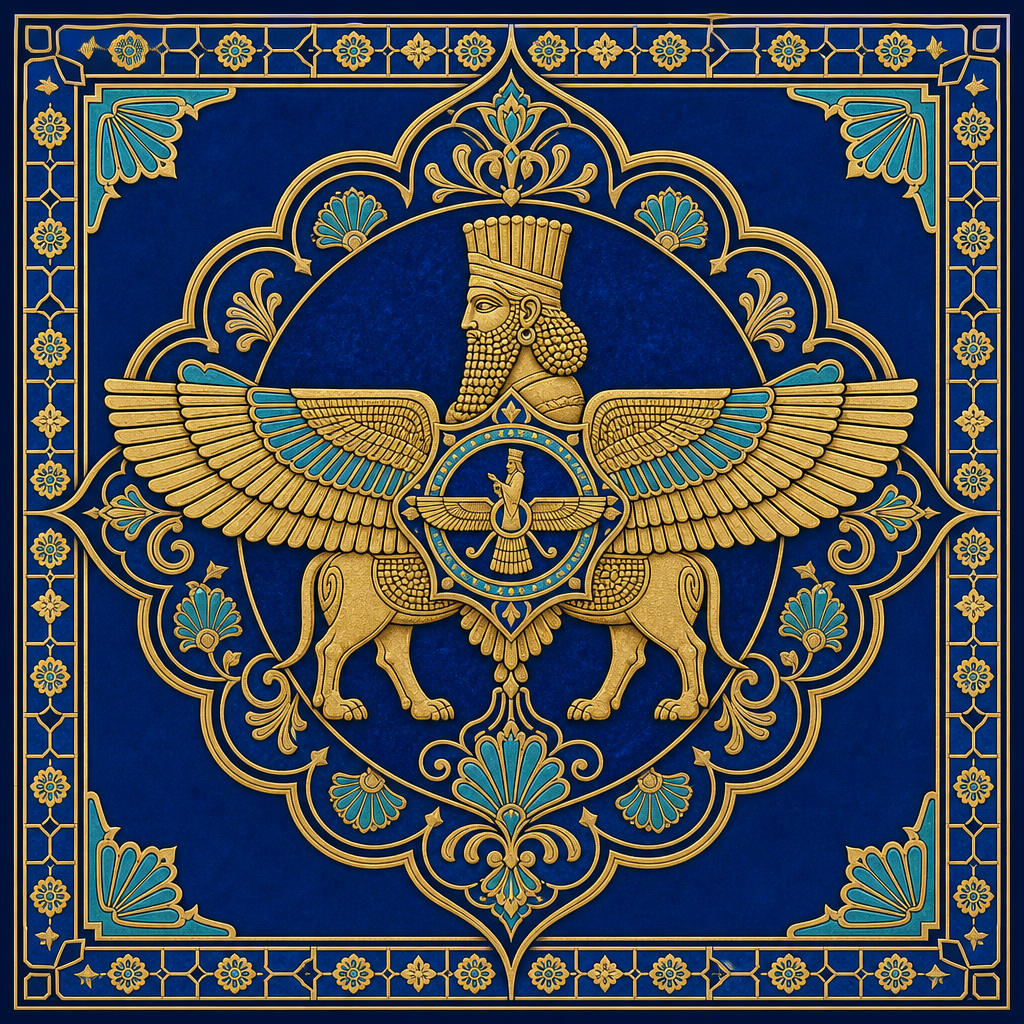


c. 600 – 530 BCE
Cyrus the Great
Founder of the Achaemenid Empire
Conqueror of Media, Lydia, and Babylon. His Cylinder, declaring religious tolerance and the right of return for displaced peoples, is read at the United Nations.
Read the full articleOne of the world's oldest civilizations — birthplace of the first multicultural empire, of algebra and algorithm, of the garden as paradise, of the ghazal and the gnomon.
Mohammad Reza Shah leaves Iran, ending the Pahlavi dynasty and opening the way to the Islamic Revolution.
Few civilizations have so consistently shaped the world while remaining themselves. For five thousand years, the Iranian plateau — that high, arid quadrilateral bounded by the Caspian, the Persian Gulf, the Hindu Kush, and the Tigris — has been a maker and remaker of empires, religions, sciences, and arts. The very word paradise comes to us from Old Persian pairi-daeza, the walled garden of a king. The word algorithm derives from al-Khwarizmi, the 9th-century mathematician of Khwarazm. The chess piece we call rook is the Persian rokh; the game itself, refined in Sasanian Iran, was called chatrang before it was chess.
Iranian civilization is exceptional not only for its longevity but for its continuity. The same plateau that nurtured the proto-Elamite scribes of Susa around 3200 BCE was, three thousand years later, the heartland of Cyrus the Great's empire — the first political entity in history to govern peoples of dozens of languages and faiths under a single, tolerant law. Half a millennium after Cyrus, the Sasanians presided over a court so opulent that Byzantine ambassadors compared it to a vision of paradise. After the 7th-century Arab conquest, when many other ancient cultures were absorbed into Islamic civilization without trace, Iran did the opposite: it absorbed Islam, gave it back to the world enriched by Persian language, science, and aesthetics, and emerged with its identity not diminished but redefined.
The story this site tells is not a triumphalist one. Iran has been conquered by Greeks, Arabs, Turks, Mongols, and Afghans; it has lost provinces to Russia and territory to Britain; it has suffered famines, revolutions, and an eight-year war that defined a generation. What endures, across every disruption, is a civilizational signature — in the four-fold garden, in the iwan vault, in the ghazal of Hafez, in the calendar that Omar Khayyam calculated to within seconds of the tropical year, in the qanat that brings cold water from a mountain to a desert town. To understand modern Iran — its ninety million people, its scientific output, its cinema, its diaspora — one must first understand the depth of the inheritance they carry.
The pages that follow are organized to make this inheritance accessible. History sets out the chronological narrative; Empires profiles the dynasties that gave each era its character; Civilization traces the contributions of Iranian scholars to mathematics, medicine, astronomy, and law; Culture turns to the living inheritance of festival, poetry, music, and cuisine; Arts & Architecture surveys the built and painted heritage; and Modern Iran brings the story into the present. The Timeline and Gallery offer a chronological and visual companion.
It is often said that all empires behaved alike — that conquest everywhere meant massacre, enslavement, forced religion and erased languages. The Achaemenid record contradicts that generalisation in writing. Between 550 and 330 BCE the Persian kings governed perhaps forty peoples across three continents, and the documents they left behind — the Cyrus Cylinder, the trilingual rock inscriptions, the Egyptian and Judean archives, thirty thousand administrative tablets from Persepolis — describe repatriation instead of deportation, subsidised local temples instead of imposed cults, and a paid workforce instead of a chattel-slave economy.
The evidence is not Persian propaganda alone. The Hebrew Bible, written by the beneficiaries and not by the court, calls Cyrus 'the Lord's anointed' — the only foreign king so named. The Babylonian priesthood, whose own city had just been taken, welcomed him in its temple chronicle. Greek writers who fought Persia, from Xenophon to Aeschylus, still portrayed its kings as bound by justice. Independent, sometimes hostile, sources converge.
| Practice | Assyria / Babylonia | Athens & Rome | Achaemenid Persia |
|---|---|---|---|
| Conquered populations | Mass deportation as standard policy; whole communities resettled to break identity | Cities razed and populations sold — Melos 416 BCE, Carthage 146 BCE, Jerusalem 70 CE | Repatriation of earlier deportees; peoples returned to ancestral lands (Cyrus Cylinder, lines 30–34) |
| Local religion | Cult statues carried off to Assur or Babylon as trophies | Roman triumph paraded captured gods; Jewish Temple treasure taken to Rome | Statues returned to their own shrines; temple rebuilding funded from the treasury (Ezra 6:8–10) |
| Language & law | Akkadian imposed as administrative language | Latin and Greek as the language of courts and citizenship | Trilingual inscriptions; Aramaic chancery; Egyptian, Babylonian and Judean law codified locally |
| Labour | War captives as forced labour on state building projects | Chattel slavery central: c. 20,000 in the Laurion mines; up to a third of Italy enslaved | Paid kurtaš workforce on rations; no large slave-worked estates recorded in the Persepolis archive |
| Women's standing | Property rights limited and largely dynastic | Athenian women legally minors under a male guardian for life | Women hold estates, run workshops, receive maternity rations, seal their own administrative orders |
| Rulers' self-presentation | Reliefs of flayings, impalements and heaped heads | Triumphs displaying chained captives | Bisotun and Persepolis show subject nations carrying the throne, in their own dress, unbound |
Two details are worth pausing on, because they are documentary rather than literary. The first is the Persepolis Fortification Archive, discovered in 1933 and comprising tens of thousands of Elamite and Aramaic tablets recording rations paid out between 509 and 493 BCE. It is an accounting record — nobody wrote it to be admired — and it shows women drawing wine and grain in their own names, mothers receiving a bonus ration after childbirth, and skilled female supervisors paid more than unskilled men. The second is the Elephantine papyri from a Judean garrison in Upper Egypt, whose soldiers wrote to the Persian satrap for permission to rebuild their temple and got it.
Babylon taken without a sack; the Cyrus Cylinder records the return of gods and peoples to their own cities.
Judean exiles permitted to return to Jerusalem; the Second Temple is completed in 516 BCE with Persian funding.
Darius I commissions the codification of Egyptian law, in Egyptian and Aramaic, by Egyptian priests.
The Persepolis Fortification Archive: a paid, rationed workforce — women included — not a slave register.
None of this makes the Achaemenid Empire a modern democracy. It was a monarchy that taxed hard, punished rebellion severely — Bisotun says so plainly — and knew household servitude and war captivity. Honest history does not need the myth. What it does show is that a large multi-ethnic state could be run, deliberately and for two centuries, on the principle that subject peoples keep their gods, their courts, their language and their homes. That principle was a choice, and other empires of the same centuries chose otherwise.
Read alongside the Cyrus Cylinder, the Persepolis archive and the Judean and Egyptian documents, the conclusion is narrow but firm: not all empires were the same, and the difference was visible to the people who lived under them.
Iranian history unfolds in distinct chapters, each leaving a layer of art, language, and statecraft beneath the next. Select an era to begin.

Cyrus the Great's empire, stretching from the Aegean to the Indus, was the first political entity in history to govern a multi-ethnic, multi-religious population on a continental scale. Darius I divided it into twenty satrapies linked by the 2,500-km Royal Road, established standardized coinage, dug a canal between the Nile and the Red Sea, and inscribed his deeds in three languages on the cliff of Behistun — the Rosetta Stone of cuneiform decipherment.
The Iranian plateau — bounded by the Caspian Sea and Alborz mountains in the north, the Zagros range in the west, the Persian Gulf in the south, and the deserts of the Lut and Kavir at its heart — has for five millennia been the great hinge between Mesopotamia, the Mediterranean, the steppe, and India. Trade caravans, armies, and ideas all crossed it. Its geography produced a civilization at once cosmopolitan and intensely particular: Iranian in language and aesthetic, yet endlessly absorbing and transforming the contributions of those who passed through.
The plateau's harshness also forged its most distinctive inventions — the qanat underground aqueduct, the yakhchal ice house, and the badgir windcatcher — technologies that made permanent settlement possible in landscapes that received less rainfall than the Sahara.

Two charts that situate Iran in world history: the territorial reach of its empires, and the disciplines in which its scholars left a lasting mark.
Approximate area at peak, in millions of km². Source: Rein Taagepera, "Size and Duration of Empires" (Social Science Research, 1979) and Cambridge History of Iran.
Indexed intensity of major Iranian contributions across centuries (qualitative, normalized 0–5). Compiled from George Sarton, Introduction to the History of Science, and Encyclopædia Iranica entries.

Bas-relief of the royal guard on the Apadana stairway, Persepolis (c. 515 BCE).

Shah Abbas's congregational mosque on Naqsh-e Jahan Square (1611–1629) — Safavid tile architecture at its zenith.

The 'Pink Mosque' of Shiraz, built 1876–1888 in the late Qajar era, famous for its stained-glass interior.

Royal investiture carved into living rock — late antique imperial iconography (c. 3rd–6th c. CE).
The 6th-century BCE tomb of Cyrus the Great at Pasargadae, founder of the Achaemenid Empire.

Laid out by Shah Abbas in 1598, the second-largest square on Earth and a UNESCO site.

Inscribed clay cylinder of 539 BCE — often called the first declaration of human rights. British Museum.

The seven-S setting prepared each Nowruz — UNESCO Intangible Cultural Heritage since 2009.
Conqueror of Media, Lydia, and Babylon. His Cylinder, declaring religious tolerance and the right of return for displaced peoples, is read at the United Nations.
Read the full article
His 50,000-couplet epic, the 'Book of Kings,' single-handedly preserved the Persian language and shaped Iranian national identity for a millennium.

His Canon of Medicine was the standard medical textbook in European universities until 1650. Also a foundational figure in medieval philosophy.

Solved cubic equations geometrically, designed the Jalali calendar (more accurate than the Gregorian), and wrote the Rubaiyat — perhaps the most-translated poetry in history.

His Masnavi-ye Ma'navi has been called 'the Quran in Persian.' Translated worldwide, he is among the best-selling poets in the United States.

His Divan is consulted by ordinary Iranians as an oracle (faal-e Hafez). Goethe's West-östlicher Divan was written in homage to him.
Eight scholarly works — from primary-source corpora to single-volume narratives — for the reader who wishes to go deeper. All are widely available in print and through major academic libraries.
The standard scholarly reference work.
Modern narrative of the Achaemenid Empire from Persian sources.
The epic of pre-Islamic Iran.
Primary sources translated and annotated.
Single-volume narrative from antiquity to the present.
Catalogue of the landmark BM exhibition.
12th-century Sufi allegory.
iranicaonline.org — open-access scholarly encyclopedia.
History Channel documentary on Achaemenid infrastructure.
BBC documentary featuring the British Museum collection.
Khan Academy / Smarthistory video series on Persepolis, Sasanian silver, Safavid Isfahan.
Award-winning documentary by Mostafa Sarvar Foruzan, 2009.
Browse the British Museum, Smarthistory, and Khan Academy YouTube channels for hundreds of free expert lectures on Persian art, history, and archaeology.
From Elam through the Islamic conquest, Mongol invasions, Safavid renaissance, and Qajar reforms.
Achaemenid, Parthian, Sasanian, Samanid, Safavid, Afsharid, Qajar.
Algebra, optics, medicine, astronomy, irrigation, the postal system, the first declaration of human rights.
Nowruz, Yalda, the poetry of Hafez and Rumi, Persian cuisine, music, carpets, miniatures.
Persepolis, Isfahan's Naqsh-e Jahan, the gardens of Shiraz, tilework, calligraphy, the qanat.
Constitutional Revolution, Pahlavi modernization, the 1979 Revolution, and Iran today.
This site uses no AI-generated imagery. All photographs, manuscript reproductions, and maps are drawn from open-access institutional collections and Wikimedia Commons under their respective licenses, with attribution provided alongside each image.