
Persian Art Gallery
A growing archive of more than twenty-five images from museums and the public-domain Wikimedia Commons collection — every photograph used elsewhere on this site, gathered into one room.

Lion-and-Bull, Persepolis
Lion attacking a bull — Apadana staircase relief, ceremonial capital of the Achaemenid Empire (c. 515 BCE).
Credit: Wikimedia Commons

Tomb of Cyrus the Great
Pasargadae, c. 530 BCE. UNESCO World Heritage Site.
Credit: Wikimedia Commons

Pasargadae
Panoramic view of the plain of Pasargadae — Cyrus the Great's first capital and the original heartland of the Achaemenid Empire.
Credit: Wikimedia Commons

Naqsh-e Rostam
Tombs of the Achaemenid kings — Darius I, Xerxes I, Artaxerxes I and Darius II — cut into the cliff near Persepolis (c. 5th century BCE).
Credit: Wikimedia Commons

Behistun Inscription
Trilingual cliff inscription of Darius I (c. 520 BCE) — the 'Rosetta Stone of cuneiform'. UNESCO World Heritage Site.
Credit: Wikimedia Commons

Faravahar
Carved Faravahar relief at Persepolis — the most famous symbol of Zoroastrianism and ancient Iranian identity.
Credit: Wikimedia Commons

Chogha Zanbil
The Elamite ziggurat of Untash-Napirisha (c. 1250 BCE), Khuzestan. The best-preserved ziggurat outside Mesopotamia. UNESCO World Heritage Site.
Credit: Wikimedia Commons

Cyrus Cylinder
Akkadian cuneiform proclamation of 539 BCE. British Museum, London.
Credit: British Museum / Wikimedia Commons

Frieze of Royal Guards
Glazed bricks from Darius I's palace at Susa, now in the Louvre.
Credit: Louvre Museum / Wikimedia Commons

Parthian Nobleman of Shami
Bronze statue, 1st century CE. National Museum of Iran.
Credit: National Museum of Iran / Wikimedia Commons

Taq Kasra
Sasanian iwan at Ctesiphon (c. 540 CE), the largest unreinforced brick vault of antiquity.
Credit: Wikimedia Commons

Achaemenid Empire at its greatest extent
Map showing the satrapies, c. 500 BCE.
Credit: Wikimedia Commons

Baysunghur Shahnameh
Frontispiece miniature from the Baysunghur Shahnameh (Herat, 1430) — masterwork of Timurid book painting. Golestan Palace Library.
Credit: Wikimedia Commons

Ardabil Carpet
The largest and finest classical Persian carpet known, woven 1539–40 for the shrine of Sheikh Safi al-Din. Victoria & Albert Museum, London.
Credit: Wikimedia Commons

Naqsh-e Jahan Square
Isfahan, designed under Shah Abbas I (c. 1602). UNESCO World Heritage Site.
Credit: Wikimedia Commons

Sheikh Lotfollah Mosque
Interior dome, Isfahan (1603–1619).
Credit: Wikimedia Commons

Nasir al-Mulk Mosque
Shiraz (1888) — the 'Pink Mosque' in early-morning light.
Credit: Wikimedia Commons

Fin Garden, Kashan
A classical Persian garden with its central watercourse (origin c. 1590), part of the UNESCO 'Persian Garden' serial inscription.
Credit: Wikimedia Commons

Historic City of Yazd
The mud-brick old city of Yazd with its windcatchers and the Roknedin mausoleum — UNESCO World Heritage Site since 2017.
Credit: Wikimedia Commons

Golestan Palace
The Marble Throne hall of the Qajar royal residence in Tehran. UNESCO World Heritage Site.
Credit: Wikimedia Commons

Reza Shah Pahlavi
Coronation portrait, 1926. In March 1935 he asked foreign governments to use 'Iran' in place of 'Persia' in official correspondence.
Credit: Wikimedia Commons

Nowruz Celebration
Spring-equinox celebration of Nowruz, the Iranian New Year — UNESCO Intangible Cultural Heritage since 2009.
Credit: Wikimedia Commons

Tomb of Hafez
Hafezieh, Shiraz, rebuilt by André Godard in 1935.
Credit: Wikimedia Commons

Ferdowsi
Statue of the author of the Shahnameh, at his mausoleum in Tus.
Credit: Wikimedia Commons

Omar Khayyam
Statue at Khayyam's mausoleum, Nishapur.
Credit: Wikimedia Commons

al-Khwārizmī
Statue of the founder of algebra, Khiva.
Credit: Wikimedia Commons

Avicenna
Soviet commemorative stamp (1980) for the millennium of Ibn Sīnā's birth.
Credit: Wikimedia Commons

Rumi
Manuscript portrait of Mawlānā Jalāl al-Dīn Rūmī (1207–1273).
Credit: Wikimedia Commons

Haft-Sin Table
Traditional Nowruz spread of seven symbolic items beginning with the letter sīn.
Credit: Wikimedia Commons

Tehran Skyline
The capital beneath the Alborz, with the Milad Tower (435 m).
Credit: Wikimedia Commons

Imam Reza Holy Shrine
Mashhad — the largest mosque complex in the world by area; over 20 million pilgrims a year.
Credit: Wikimedia Commons

Imam Reza Shrine at night
The illuminated golden dome above the courtyards of the Mashhad complex.
Credit: Wikimedia Commons

Goharshad Mosque
The 1418 Timurid mosque inside the Imam Reza complex, Mashhad.
Credit: Wikimedia Commons

Fatima Masumeh Shrine
Qom — second-holiest pilgrimage city in Iran.
Credit: Wikimedia Commons

Shah Cheragh Shrine
Mirrored interior of the great Sufi shrine in Shiraz.
Credit: Wikimedia Commons

Shah Abdol Azim Shrine
Rey — the oldest standing pilgrimage complex south of Tehran.
Credit: Wikimedia Commons

Imamzadeh Saleh
The great turquoise dome of Tajrish, north Tehran.
Credit: Wikimedia Commons

Vank Cathedral
Lavishly frescoed Armenian cathedral in New Julfa, Isfahan.
Credit: Wikimedia Commons

Jameh Mosque of Isfahan
Brick vaulting in the great Friday mosque — UNESCO 2012.
Credit: Wikimedia Commons

Imam Mosque, Isfahan
Naqsh-e Jahan Square at sunset — Safavid summit.
Credit: Wikimedia Commons

Vakil Mosque, Shiraz
Hypostyle hall built under Karim Khan Zand (1773).
Credit: Wikimedia Commons

Tomb of Hafez
The tiled cupola of the Hafezieh in Shiraz.
Credit: Wikimedia Commons

Tomb of Saadi
Pilgrimage for readers of the Gulistan — Shiraz.
Credit: Wikimedia Commons

Taq-e Bostan
Sasanian rock reliefs of Ardashir II's investiture — Kermanshah.
Credit: Wikimedia Commons

Tabriz Bazaar
The Grand Bazaar of Tabriz — UNESCO 2010.
Credit: Wikimedia Commons

Apadana Staircase Relief
Tribute delegations carved in the Apadana stairway, Persepolis.
Credit: Wikimedia Commons

Milad Tower
Tehran's 435-m telecommunications tower against the Alborz.
Credit: Wikimedia Commons

Mount Damavand
At 5,610 m, Asia's highest volcano and a Persian mythological cradle.
Credit: Wikimedia Commons

Mount Sabalan
The 4,811-m volcanic massif of Ardabil province.
Credit: Wikimedia Commons

Tochal Cable Car
Tehran from the Tochal ridge — one of the longest gondola rides in the world.
Credit: Wikimedia Commons

Naqsh-e Jahan at Dusk
The Safavid imperial square of Isfahan, lit at sunset.
Credit: Wikimedia Commons / UNESCO

Chehel Sotoun
The 'Forty Columns' garden-pavilion of Shah Abbas II, Isfahan.
Credit: Wikimedia Commons

Ali Qapu Palace
Safavid royal palace overlooking Naqsh-e Jahan Square.
Credit: Wikimedia Commons

Khaju Bridge
Safavid arched bridge–dam on the Zayandeh River, Isfahan (1650).
Credit: Wikimedia Commons

Nasir al-Mulk Detail
Stained-glass corridor of the 'Pink Mosque', Shiraz.
Credit: Wikimedia Commons

Tomb of Cyrus, Pasargadae
The stepped tomb of Cyrus the Great (c. 530 BCE).
Credit: Wikimedia Commons / UNESCO

Blue Mosque of Tabriz
Fifteenth-century 'Turquoise of Islam' — Masjed-e Kabud.
Credit: Wikimedia Commons

Takht-e Soleyman
Sasanian fire-temple complex around a thermal lake (UNESCO, 2003).
Credit: Wikimedia Commons / UNESCO

Dome of Soltaniyeh
Mongol-Ilkhanid mausoleum of Öljaitü (1312) — third-largest brick dome on earth.
Credit: Wikimedia Commons / UNESCO

Arg-e Bam
The world's largest adobe citadel, restored after the 2003 earthquake.
Credit: Wikimedia Commons / UNESCO

Meymand Cave Village
Inhabited rock-cut dwellings of Kerman province (UNESCO, 2015).
Credit: Wikimedia Commons / UNESCO

Shahr-e Sukhteh
The Bronze-Age 'Burnt City' of Sistan, c. 3200 BCE.
Credit: Wikimedia Commons / UNESCO

Susa
Six millennia of continuous occupation on the Khuzestan plain.
Credit: Wikimedia Commons

Tomb of Omar Khayyam
The latticed canopy at Neyshabur (Hooshang Seyhoun, 1963).
Credit: Wikimedia Commons

Tomb of Ferdowsi
Marble mausoleum of the Shahnameh's author at Tus.
Credit: Wikimedia Commons

Kish Island
The Persian Gulf's duty-free leisure island with snorkeling reefs.
Credit: Wikimedia Commons

Bandar Abbas
The historic gateway to the Strait of Hormuz.
Credit: Wikimedia Commons

Old Bushehr
Nineteenth-century coral-stone merchant houses on the Persian Gulf.
Credit: Wikimedia Commons

Bandar-e Anzali
The Caspian lagoon-port of Gilan province.
Credit: Wikimedia Commons

Qazvin
Briefly a Safavid capital under Shah Tahmasp (1548–1598).
Credit: Wikimedia Commons

Apadana Staircase
The eastern staircase of the Apadana — tribute delegations from twenty-three nations.
Credit: Wikimedia Commons

Gate of All Nations
Xerxes' ceremonial gateway, Persepolis — guarded by twin lamassu.
Credit: Wikimedia Commons

Persepolis Columns
Surviving columns of the audience hall against the Marvdasht plain.
Credit: Wikimedia Commons

Darius I
Achaemenid rock relief at Bisotun.
Credit: Wikimedia Commons

Achaemenid Immortal
Glazed brick frieze from the palace of Darius at Susa.
Credit: Wikimedia Commons

Lut Desert
Wind-carved yardangs — UNESCO 2016. Hottest surface temperature on Earth: 70.7 °C.
Credit: Wikimedia Commons

Hyrcanian Forests
Caspian temperate broadleaf forests — UNESCO 2019.
Credit: Wikimedia Commons

Badab-e Surt
Terraced travertine springs of Mazandaran province.
Credit: Wikimedia Commons

Filband
Cloud-covered alpine pastures above the Caspian coast.
Credit: Wikimedia Commons

Kandovan
Inhabited troglodytic village in East Azerbaijan — Iran's Cappadocia.
Credit: Wikimedia Commons

Masuleh
Stepped-roof village in the Alborz, where one house's roof is another's terrace.
Credit: Wikimedia Commons

Hormuz Island
Iron-oxide red beaches of the Strait of Hormuz.
Credit: Wikimedia Commons

Qeshm — Chahkooh Canyon
Wind-eroded slot canyon on Iran's largest island.
Credit: Wikimedia Commons

Ramsar
Caspian shoreline of Mazandaran — origin of the Ramsar Convention on Wetlands.
Credit: Wikimedia Commons

Lahijan Tea Gardens
Iran's tea capital in the foothills of Gilan.
Credit: Wikimedia Commons

Babak Castle
Sasanian-era fortress in the Arasbaran mountains.
Credit: Wikimedia Commons

Alamut
The 'Eagle's Nest' — fortress of the Nizari Ismailis, destroyed by Hülegü 1256.
Credit: Wikimedia Commons

Rudkhan Castle
Sasanian-Seljuk forest-citadel of Gilan.
Credit: Wikimedia Commons

Yazd Windcatchers
Badgirs of Yazd — passive cooling perfected over a millennium.
Credit: Wikimedia Commons
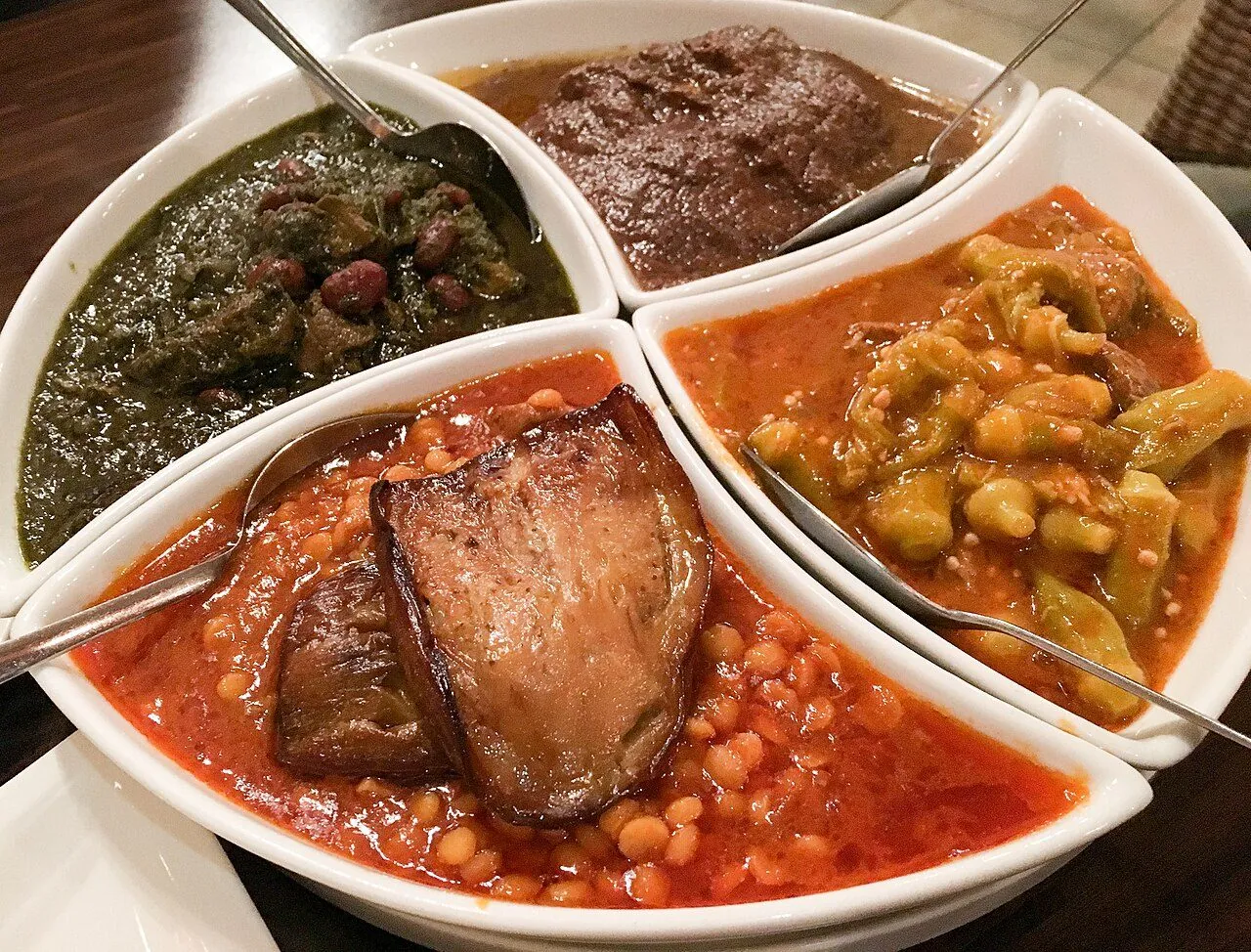
Persian Sofreh
A full Iranian table — rice, stews, kebabs, herbs, pickles and bread.
Credit: Wikimedia Commons
References
- ↗ Wikimedia Commons — Category: Iran
- ↗ British Museum — Iran collection
- ↗ Louvre — Near Eastern Antiquities collection
- ↗ Met Museum — Iranian art
- ↗ National Museum of Iran (Wikipedia)
All imagery is sourced from Wikimedia Commons, public-domain museum collections (British Museum, Louvre, Metropolitan Museum of Art, National Museum of Iran), or UNESCO World Heritage records. No AI-generated images are used. Scholarly text is synthesized from Encyclopædia Iranica, the Cambridge History of Iran, and peer-reviewed publications.
About this gallery
Related reading
Miniature painting, calligraphy, carpet weaving and the decorative arts.
Persepolis, Isfahan, Yazd — domes, gardens, badgirs and caravanserais.
Iran's 29 UNESCO World Heritage Sites — map, dates, photographs.
Iran's earliest photographers, Sevruguin and the 40,000-plate Golestan Palace archive.
Chahar bagh geometry and the nine UNESCO gardens.
Shah Abbas's Safavid capital — Naqsh-e Jahan square, the Shah and Sheikh Lotfollah mosques, and the bridges of the Zayanderud. UNESCO 1979.