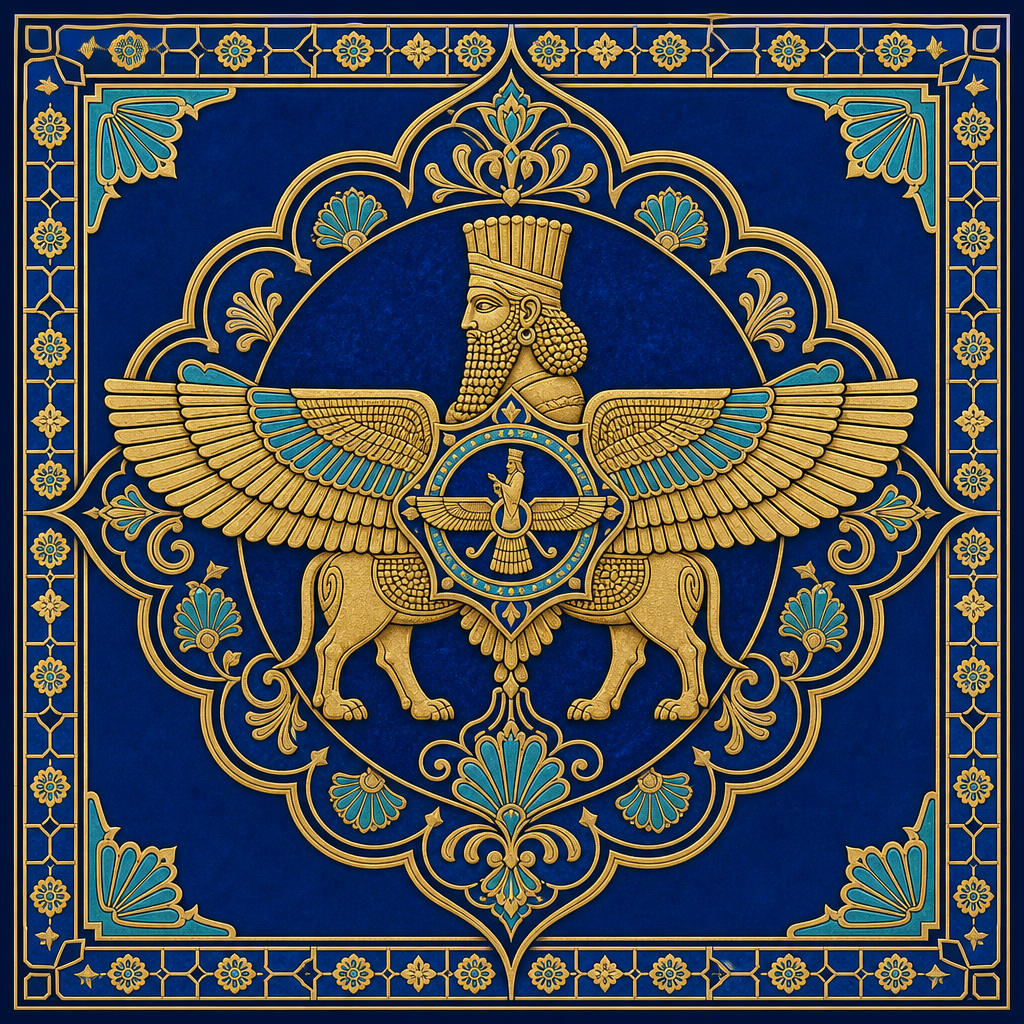
History of Iran
From the proto-Elamite tablets of Susa to the Islamic Republic — a continuous thread of statehood, language, and identity across the Iranian plateau, told through ten chapters and the empires that shaped a quarter of recorded human history.
What is the history of Iran, in short?
Iran has one of the world's longest continuous civilisations. Urban life on the plateau begins with Elam around 3200 BCE; Cyrus the Great founds the first Persian Empire in 550 BCE; Parthian and Sasanian Iran rival Rome for nine centuries; the Arab conquest of 651 CE brings Islam but not the end of Persian identity, which is rebuilt through language and poetry; the Safavids restore a unified Iranian state in 1501, and the modern republic dates from 1979.
- Longest-lived phase: Parthian and Sasanian Iran, together almost 900 years.
- Turning point: 651 CE — the Sasanian collapse, followed by a Persian literary revival.
- Continuity: the Persian language links Darius's inscriptions to today's Tehran.
Five thousand years in numbers


Prehistory and the Elamites (c. 7000 – 539 BCE)
Long before the name Iran entered the historical record, the high plateau between Mesopotamia and the Indus was already a hearth of urban civilization. By the seventh millennium BCE, painted-pottery villages clustered around the Zagros foothills at sites such as Tepe Sialk, Ganj Dareh and Chogha Mish. Domesticated goats, the earliest known woven textiles, and copper smelting all appear here within a few centuries of one another — a quiet revolution that would feed the cities of Sumer and Akkad downstream.
From these villages emerged the Elamite kingdom, centered on Susa in modern Khuzestan. Elamite scribes wrote in the still partly-undeciphered proto-Elamite script as early as 3100 BCE — making it, alongside Sumerian and Egyptian, one of the three independent inventions of writing. For more than two thousand years Elam fought, traded, and intermarried with the Sumerian, Akkadian, and Babylonian dynasties of the lowlands; the great ziggurat of Chogha Zanbil (c. 1250 BCE), now a UNESCO World Heritage site, remains the best-preserved ziggurat outside Mesopotamia.
To the east, the Bronze Age Jiroft culture of Kerman produced exquisitely carved chlorite vessels found as far away as the royal tombs of Ur. In the salt deserts of Sistan, the planned city of Shahr-e Sukhteh — the "Burnt City" — has yielded the world's earliest known animated sequence (a goat leaping toward a tree, painted on a pottery goblet c. 3200 BCE), the earliest artificial eyeball, and one of the earliest known backgammon-style board games.


The Medes and the Birth of Persia (c. 700 – 550 BCE)

The Iranian peoples — speakers of an Indo-European language family that includes Avestan, Old Persian, Sogdian, Bactrian and Scythian — entered the plateau in a slow migration during the second millennium BCE. By the early seventh century BCE their westernmost branch, the Medes, had organized a confederation under Deioces, with a capital at Ecbatana (modern Hamadan). In 612 BCE the Median king Cyaxares, allied with the Babylonians, sacked the Assyrian capital of Nineveh and brought down the cruelest empire of the ancient world.
South of the Medes, in the province of Pars (Persis), a junior dynasty — the Achaemenids — quietly grew. In 550 BCE the Persian prince Cyrus II, raised in the Median court, revolted against his grandfather Astyages, took Ecbatana, and inherited a state that already controlled half of the Iranian plateau. Within twenty years he had also defeated Croesus of Lydia and the Neo-Babylonian Empire — and the world had its first transcontinental polity.
"I am Cyrus, king of the world, great king, mighty king… I freed all the people of Babylon from the yoke imposed upon them. I returned the gods who had been brought to Babylon to their sacred cities."
The Achaemenid Empire (550 – 330 BCE)
The empire that Cyrus founded and that Darius I (r. 522–486 BCE) consolidated was the largest the world had yet seen — over 5.5 million square kilometers, governing perhaps 44 percent of the global population. Twenty satrapies, each headed by a Persian governor and audited by independent royal inspectors known as the "King's Eyes and Ears," replaced the patchwork of city-state diplomacy that had ruled the Near East for two millennia.
Darius standardized weights, coined the gold daric, and built the 2,500-kilometer Royal Road from Sardis to Susa with relay stations every 25 kilometers — the postal system Herodotus admired with the line "neither snow nor rain nor heat nor gloom of night stays these couriers." A canal between the Nile and the Red Sea, four monumental capitals (Pasargadae, Susa, Ecbatana and Persepolis), and the trilingual cliff inscription at Behistun — the Rosetta Stone of cuneiform — round out a single reign.


The empire's tolerance was deliberate policy. The Cyrus Cylinder, often called the world's first declaration of human rights, restored deported peoples and their gods to their homelands — the Hebrew Bible records the same edict in Ezra 1, crediting Cyrus with the rebuilding of the Jerusalem Temple. Yet this was no Pax Persica without limits: the Greco-Persian Wars (499–449 BCE), the burning of the Athenian Acropolis by Xerxes in 480 BCE, and ultimately the conquest by Alexander of Macedon in 330 BCE form the western chapters of a story that the Persian sources tell rather differently.
| Capital | Founded by | Role | Status today |
|---|---|---|---|
| Pasargadae | Cyrus II, c. 546 BCE | Dynastic foundation; tomb of Cyrus | UNESCO 2004 — Fars province |
| Susa | Inherited from the Elamites | Administrative & winter capital | Apadana of Darius — Susa archaeological park |
| Ecbatana | Median capital adopted by Achaemenids | Summer capital in the highlands | Hidden beneath modern Hamadan |
| Persepolis | Darius I, 518 BCE | Ceremonial capital — Nowruz audiences | UNESCO 1979 — best-preserved Achaemenid city |
Seleucids and Parthians (312 BCE – 224 CE)
Alexander's empire fragmented at his death; Iran fell to his general Seleucus and his successors. Hellenistic governance lasted barely a century before the Arsacid Parthians, a nomadic Iranian people from the steppes northeast of the Caspian, took back the plateau under Arsaces I in 247 BCE. Their loose feudal confederation — derided by Roman writers as decentralized — would contain Rome at the Euphrates for nearly five centuries, longer than the Roman Empire itself ruled the western Mediterranean.
At the Battle of Carrhae in 53 BCE, Parthian cataphracts and horse-archers annihilated seven Roman legions under Crassus, capturing the only Roman eagles ever lost in the East. The "Parthian shot" — turning in the saddle to fire arrows backward at full gallop — entered every European language as a metaphor for the devastating final word.

The Sasanian Empire (224 – 651 CE)
In 224 CE Ardashir I, a vassal lord from Persis, defeated the last Parthian king and consciously revived the Achaemenid imperial idea. The Sasanian Empire would be the last of the great Iranian empires of antiquity and the chief rival of Rome and Byzantium for over four centuries.
Shapur I (r. 240–270 CE) twice defeated Roman armies and captured the emperor Valerian — an event commemorated in the great rock relief at Naqsh-e Rostam. Khosrow I Anushirvan ("the Just," r. 531–579 CE) reformed taxation, codified law, and gave asylum to the Greek Neoplatonist philosophers expelled by Justinian, who carried the works of Aristotle to Gundishapur. The Academy of Gundishapur — combining Greek, Indian, Persian and Syriac learning — was the world's first teaching hospital and the bridge across which classical scholarship reached the Islamic world.
The Sasanian state collapsed with shocking speed. Two decades of plague and a ruinous final war with Byzantium left the empire exhausted; in 636 CE Arab armies under the second caliph Umar broke the Sasanian field army at Qadisiyyah, and by 651 the last Sasanian king, Yazdgerd III, was killed in flight near Merv.
Islamic Iran and the Persian Renaissance (651 – 1219)
The Arab conquest brought Islam, but it did not erase Persia. Within two centuries Iranian administrators, secretaries (kuttāb), and viziers had become indispensable to the Abbasid caliphate in Baghdad, itself founded on the site of an old Sasanian village and modeled on Sasanian court protocol. Translators of Iranian descent rendered Pahlavi, Sanskrit, and Greek works into Arabic; the very word algorithm derives from the Khwarazmian mathematician al-Khwārizmī.
Politically, Iran reasserted itself almost immediately. The Samanids of Bukhara (819–999) revived New Persian as a literary language, patronized the poet Rudaki, and produced a generation of polymaths — among them Avicenna (Ibn Sīnā), whose Canon of Medicine would be the standard medical text in European universities until the seventeenth century. The Buyids of western Iran ruled the caliph himself from 945 to 1055, while in the east Mahmud of Ghazna commissioned Ferdowsi's 50,000-couplet Shahnameh, the national epic that single-handedly preserved a thousand-year tradition of Iranian myth and history.

Seljuks, Mongols and Timurids (1037 – 1501)
The eleventh century brought a new wave of Turkic migration. The Seljuks ruled an empire from the Mediterranean to Central Asia, but their administration was almost entirely Persian: the great vizier Nizam al-Mulk's Siyāsatnāma ("Book of Government") remains a classic of statecraft, and the network of Nizāmiyya madrasas he founded shaped Sunni education for centuries. Under Seljuk patronage Omar Khayyam reformed the Persian calendar to an accuracy unmatched until the Gregorian reform 500 years later.
Then came catastrophe. Between 1219 and 1221 the armies of Genghis Khan destroyed the cities of Khorasan — Merv, Nishapur, Herat, Balkh — with such thoroughness that some never recovered. Estimates of the death toll vary from one to ten million; whole irrigation systems collapsed and were not rebuilt until the twentieth century. Yet within two generations the Ilkhanate Mongols had converted to Islam, adopted Persian as their court language, and presided over one of the great ages of Persian historiography (Rashid al-Din's Jāmi' al-Tawārīkh) and astronomy (the Maragha observatory of Nasir al-Din al-Tusi).
The fourteenth-century conqueror Timur (Tamerlane) inflicted a second wave of destruction, but his Timurid descendants in Herat and Samarkand would become some of history's most refined patrons of the book arts, miniature painting, and astronomy — the observatory of Ulugh Beg in Samarkand produced the most accurate star catalogue of the pre-telescopic era.

The Safavid Empire (1501 – 1736)
In 1501 the fifteen-year-old Shah Ismail I, leader of a militant Sufi order from Ardabil, took Tabriz and proclaimed Twelver Shi'ism the state religion of Iran — a decision that re-shaped the religious geography of the entire Middle East and persists to this day. His successor Tahmasp I moved the capital inland to Qazvin to escape Ottoman pressure after the 1514 defeat at Chaldiran (the first major battle in which gunpowder decided the day in the Islamic East).
Under Shah Abbas the Great (r. 1588–1629) the empire reached its zenith. He moved the capital to Isfahan and turned it into one of the great cities of the early modern world — the saying Isfahan nesf-e jahān ast, "Isfahan is half the world," dates from this era. The Naqsh-e Jahan square, the Sheikh Lotfollah mosque, the Ali Qapu palace, and the Chehel Sotoun garden pavilion are all UNESCO-listed monuments of his reign.


Afsharids, Zands and Qajars (1736 – 1925)
The Safavid collapse in 1722 was followed by the meteoric career of Nader Shah Afshar, often called the "Napoleon of Persia," who in 1739 sacked Delhi and brought home the Peacock Throne and the Koh-i-Noor diamond. After his assassination, the gentler rule of Karim Khan Zand from Shiraz (1751–1779) is remembered as a brief Indian summer of justice and cultural patronage.
The Qajar dynasty (1789–1925) presided over a long contraction. Two Russo-Persian Wars cost Iran the entire Caucasus (Treaties of Gulistan 1813 and Turkmenchay 1828); the British and Russian empires divided the country into spheres of influence in 1907; and the discovery of oil in Khuzestan in 1908 brought a foreign concessionary regime that would dominate Iranian politics for half a century. Yet the same period also produced the Constitutional Revolution of 1905–1911 — the first popular constitutional movement in Asia.


The Twentieth Century to Today (1925 – Present)
In 1925 a Cossack officer, Reza Khan, deposed the last Qajar and founded the Pahlavi dynasty. He built railways, secular courts, and a national university; his son Mohammad Reza Shah oversaw the 1953 nationalization crisis and Anglo-American coup against Prime Minister Mohammad Mosaddegh, the White Revolution land reforms of the 1960s, and the spectacular but unequal oil boom of the 1970s.

The Islamic Revolution of 1979, led by Ayatollah Ruhollah Khomeini, ended 2,500 years of monarchy and established the Islamic Republic — a constitutional system unique in the world that combines elected institutions with the office of Vali-ye Faqih, the Supreme Leader. The Iran-Iraq War (1980–1988) cost perhaps a million lives. Today, Iran is a country of 89 million people, a major oil and gas producer, a regional power, and the home of one of the world's youngest, most highly educated, and most rapidly urbanizing populations.


Population of Iran across history
In millions. Pre-modern figures are estimates from Maddison Project and McEvedy & Jones (1978).
1979 Revolution
Perhaps 11% of all Iranians took part in street demonstrations — proportionally the largest revolutionary mobilisation of the twentieth century.
Iran–Iraq War
Eight years (1980–88) of trench warfare and chemical-weapon attacks left an estimated one million dead and a generation of veterans whose memorials dot every Iranian city.
Youth & education
Today Iran's median age is 32; over 60% of university students are women; literacy among 15–24 year-olds exceeds 98%.
Diaspora
Five to eight million Iranians live abroad — concentrated in Los Angeles, Toronto, London, Hamburg and the Persian Gulf.
چنین گفت پیغمبر راستگوی / ز گهواره تا گور دانش بجوی
"Thus said the truthful messenger: seek knowledge from the cradle to the grave."
The Forgotten East — Avestan Iran and the Oxus Hearth
Most accounts of Iranian history begin in the west, with Susa and Persepolis. But the deepest Iranian past lies further east. The Avesta, scripture of Zoroastrianism, is composed in an east-Iranian language closer to Vedic Sanskrit than to Old Persian, and its oldest hymns — the Gāthās of Zarathustra himself — were probably orally composed near the Oxus (Amu Darya) sometime between 1500 and 1000 BCE. The Bronze Age Bactria–Margiana Archaeological Complex (BMAC), straddling modern Turkmenistan, Uzbekistan and northern Afghanistan, has yielded fortified palace-temples, copper-and-silver metallurgy, and the world's earliest evidence of organised ritual use of opium and ephedra — likely the haoma of the Avesta.
From this eastern hearth came not only the Medes and Persians but also the Sogdians, Bactrians, Khwarazmians and Sakas. The Sogdian merchants of Samarkand and Panjikent built the entire commercial infrastructure of the Silk Road; their Iranian language was the lingua franca from Xinjiang to the Black Sea for a thousand years.
The Iranian Intermezzo (820–1050 CE)
Schoolbook chronologies leap from the Arab conquest of 651 directly to the Mongols of 1219. The five centuries in between are in fact the most creative in Iranian history, unfolding under a patchwork of small, mostly Iranian dynasties: the Tahirids of Khorasan, the Saffarids of Sistan, the Samanids of Bukhara, the Ziyarids of Tabaristan, the Buyids of Fars and Daylam, and the Ghaznavids. In these small but rich courts the New Persian literary language was born, the Shahnameh was written, and the institutional template of the wider Islamic world was forged.
The historian Vladimir Minorsky called this era "the most splendid bloom of Iranian genius." It produced Rūdakī, Daqīqī, al-Bīrūnī, al-Khwārizmī, al-Rāzī, Avicenna, al-Farghānī (whose Elements of Astronomy Dante would consult) and the founder of pharmacy as a discipline, Sābūr ibn Sahl of Gundishapur.
Iran and the Indian Ocean (1500–1850)
The history of the early modern world is usually told from Lisbon and London. Seen from Hormuz, it looks different. The Portuguese took the island of Hormuz in 1507 and held it for 115 years until Imam Quli Khan, the Safavid governor of Fars, retook it in 1622 with English East India Company naval support. The new port he founded on the mainland, Bandar Abbas, was for two centuries the dominant entrepôt of the Gulf.
Persian was the official chancery language of the Mughal Empire until 1837 — meaning that for more than three centuries the administrative records of one-fifth of humanity were kept in the language of Hafez. Iranian noblemen, poets, painters and physicians flowed to the courts of Agra, Delhi and Hyderabad in tens of thousands; the entire Indo-Persian historiographical tradition (Abū'l-Faẓl's Akbarnāma, Khwāfī Khān's Muntakhab al-Lubāb) is a Mughal extension of Iranian court literature.
The Constitutional Revolution — Asia's First Parliament
On 5 August 1906 the dying Mozaffar al-Din Shah signed the decree granting Iran a Majles (parliament) — making Iran's the first popular constitutional revolution in Asia and the first written constitution of any Muslim-majority state. The drafting committee, working through the winter of 1906–07, produced a bicameral constitution explicitly modelled on Belgium's of 1831 but adding a Council of Guardian Clerics with veto over un-Islamic legislation — a formula whose echoes are unmistakable in the 1979 republic.
The 1908 royalist counter-coup, the British–Russian carve-up under the 1907 Anglo-Russian Convention, and the 1911 Russian ultimatum demanding the dismissal of the American treasurer-general W. Morgan Shuster ended the constitutional experiment in practice. But the institutions it created — the Majles, an independent judiciary, a free press — survived in form and would be repeatedly contested for the next century.
Oil — The First Nationalisation
On 28 May 1908 a drilling rig of George Reynolds at Masjed Soleyman in Khuzestan struck oil at 360 metres — the first commercial petroleum strike anywhere in the Middle East. The Anglo-Persian Oil Company (later BP) was founded the next year on a 60-year concession that gave Iran 16% of net profits. On 20 March 1951 Prime Minister Mohammad Mosaddegh — Time magazine's "Man of the Year 1951" — nationalised the company in a unanimous vote of the Majles, an act later cited as the inspiration for the Suez Canal nationalisation of 1956 and the wave of OPEC nationalisations of the 1970s. The 1953 Anglo-American coup that overthrew Mosaddegh is now formally acknowledged by both the CIA (2013) and the US State Department (Foreign Relations of the United States, 2017).
References
- ↗ Cambridge History of Iran (7 vols., Cambridge University Press)
- ↗ Encyclopædia Iranica — Columbia University
- ↗ British Museum — Cyrus Cylinder
- ↗ UNESCO World Heritage — Persepolis
- ↗ UNESCO — Tchogha Zanbil
- ↗ Behistun Inscription — UNESCO
- ↗ Maddison Project — Historical population data
- ↗ Met Museum — Sasanian Iran timeline
All imagery is sourced from Wikimedia Commons, public-domain museum collections (British Museum, Louvre, Metropolitan Museum of Art, National Museum of Iran), or UNESCO World Heritage records. No AI-generated images are used. Scholarly text is synthesized from Encyclopædia Iranica, the Cambridge History of Iran, and peer-reviewed publications.
Tolerance, Law and the Freed Exile: How Persia Ruled Differently
It is often said that all empires behaved alike — that conquest everywhere meant massacre, enslavement, forced religion and erased languages. The Achaemenid record contradicts that generalisation in writing. Between 550 and 330 BCE the Persian kings governed perhaps forty peoples across three continents, and the documents they left behind — the Cyrus Cylinder, the trilingual rock inscriptions, the Egyptian and Judean archives, thirty thousand administrative tablets from Persepolis — describe repatriation instead of deportation, subsidised local temples instead of imposed cults, and a paid workforce instead of a chattel-slave economy.
The evidence is not Persian propaganda alone. The Hebrew Bible, written by the beneficiaries and not by the court, calls Cyrus 'the Lord's anointed' — the only foreign king so named. The Babylonian priesthood, whose own city had just been taken, welcomed him in its temple chronicle. Greek writers who fought Persia, from Xenophon to Aeschylus, still portrayed its kings as bound by justice. Independent, sometimes hostile, sources converge.
| Practice | Assyria / Babylonia | Athens & Rome | Achaemenid Persia |
|---|---|---|---|
| Conquered populations | Mass deportation as standard policy; whole communities resettled to break identity | Cities razed and populations sold — Melos 416 BCE, Carthage 146 BCE, Jerusalem 70 CE | Repatriation of earlier deportees; peoples returned to ancestral lands (Cyrus Cylinder, lines 30–34) |
| Local religion | Cult statues carried off to Assur or Babylon as trophies | Roman triumph paraded captured gods; Jewish Temple treasure taken to Rome | Statues returned to their own shrines; temple rebuilding funded from the treasury (Ezra 6:8–10) |
| Language & law | Akkadian imposed as administrative language | Latin and Greek as the language of courts and citizenship | Trilingual inscriptions; Aramaic chancery; Egyptian, Babylonian and Judean law codified locally |
| Labour | War captives as forced labour on state building projects | Chattel slavery central: c. 20,000 in the Laurion mines; up to a third of Italy enslaved | Paid kurtaš workforce on rations; no large slave-worked estates recorded in the Persepolis archive |
| Women's standing | Property rights limited and largely dynastic | Athenian women legally minors under a male guardian for life | Women hold estates, run workshops, receive maternity rations, seal their own administrative orders |
| Rulers' self-presentation | Reliefs of flayings, impalements and heaped heads | Triumphs displaying chained captives | Bisotun and Persepolis show subject nations carrying the throne, in their own dress, unbound |
Two details are worth pausing on, because they are documentary rather than literary. The first is the Persepolis Fortification Archive, discovered in 1933 and comprising tens of thousands of Elamite and Aramaic tablets recording rations paid out between 509 and 493 BCE. It is an accounting record — nobody wrote it to be admired — and it shows women drawing wine and grain in their own names, mothers receiving a bonus ration after childbirth, and skilled female supervisors paid more than unskilled men. The second is the Elephantine papyri from a Judean garrison in Upper Egypt, whose soldiers wrote to the Persian satrap for permission to rebuild their temple and got it.
539 BCE
Babylon taken without a sack; the Cyrus Cylinder records the return of gods and peoples to their own cities.
538 BCE
Judean exiles permitted to return to Jerusalem; the Second Temple is completed in 516 BCE with Persian funding.
c. 518 BCE
Darius I commissions the codification of Egyptian law, in Egyptian and Aramaic, by Egyptian priests.
30,000+ tablets
The Persepolis Fortification Archive: a paid, rationed workforce — women included — not a slave register.
None of this makes the Achaemenid Empire a modern democracy. It was a monarchy that taxed hard, punished rebellion severely — Bisotun says so plainly — and knew household servitude and war captivity. Honest history does not need the myth. What it does show is that a large multi-ethnic state could be run, deliberately and for two centuries, on the principle that subject peoples keep their gods, their courts, their language and their homes. That principle was a choice, and other empires of the same centuries chose otherwise.
- Cyrus Cylinder (British Museum, BM 90920): the returned cult statues and the rebuilt sanctuaries of Ashur, Susa, Akkad and the cities of the Zagros.
- Ezra 6:8–10: Darius orders the cost of the Jerusalem Temple paid from the royal revenue of Beyond-the-River, with animals supplied for sacrifice.
- Isaiah 45:1: Cyrus called 'anointed' — the sole non-Jewish figure given that title in the Hebrew Bible.
- The Udjahorresnet inscription: Cambyses and Darius restore the temple of Neith at Sais and re-endow its priesthood after wartime damage.
- Elephantine papyri (5th century BCE): a Judean garrison in Egypt petitions the satrap Bagavahya and receives authorisation to rebuild its temple.
- Irdabama and Artystone: royal women with their own estates, seals, workshops and letter-carriers in the Persepolis tablets.
- Bisotun and the Apadana reliefs: twenty-three subject nations depicted upright, armed, in their own national dress — not chained, not kneeling.
Read alongside the Cyrus Cylinder, the Persepolis archive and the Judean and Egyptian documents, the conclusion is narrow but firm: not all empires were the same, and the difference was visible to the people who lived under them.
Persian history FAQ
Related reading
Vertical interactive timeline of Iran's major dynasties and events.
Achaemenid, Parthian, Sassanid, Safavid, Qajar — six successive Iranian empires.
Parsa, the ceremonial capital of the Achaemenid Empire — Apadana, Gate of All Nations, 23 satrapies, and Alexander's fire of 330 BCE.
Why the country is called both, and what changed in 1935.
Inventions, governance, infrastructure — qanats, postal system, Charter of Rights.
Cinema, sports, science and cultural achievements of contemporary Iran.