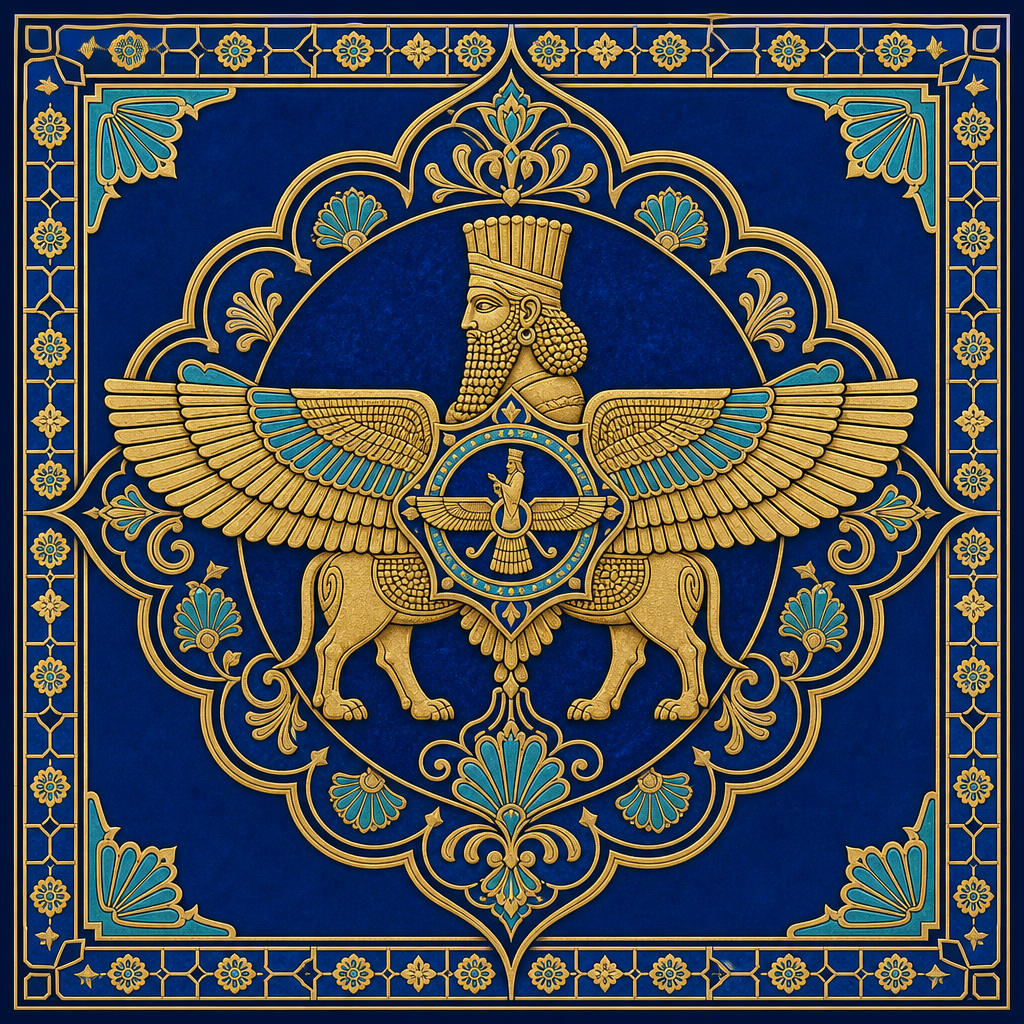

The Enduring Legacy of Persia
Of all the great cradles of civilization — Egypt, Sumer, the Indus, China, Mesoamerica — only one has continued to speak the same language, observe the same new year, and call itself by the same name for two and a half thousand years. This is the story of how Iran shaped the modern world, and how it survived every attempt to erase it.
The Only Ancient Civilization That Survived
Of the world's six pristine civilizations — Egypt, Mesopotamia, the Indus, China, Mesoamerica and Andean South America — every one but China was conquered, converted and culturally replaced. Egyptian hieroglyphs were forgotten for 1,400 years until Champollion. Sumerian and Akkadian were entirely dead languages by the time of Christ. The Indus script remains undeciphered; its descendants no longer write it. The Aztec and Inca were extinguished as states within a single generation of contact. Iran is the great exception.
The Iranian plateau has been overrun at least seven times by world-historical conquerors: Alexander the Great (330 BCE), the Arab caliphate (636 CE), the Seljuk Turks (1037), Genghis Khan (1219), Tamerlane (1380s), the Afghan Ghilzai (1722), and Anglo-Russian imperial interference (1813–1953). Each conquest could plausibly have ended Iran as a distinct civilization. None did.
Instead, an extraordinary pattern repeats. The conquerors arrive; within two generations they have adopted Persian as their court language, married into the local aristocracy, patronised Persian poets and built domes in the Iranian style. The Abbasid caliphate in Baghdad — though Arab in dynasty — was administered in the Sasanian tradition by Iranian viziers. The Mongol Ilkhanate wrote its great chronicle, Rashid al-Din's Jāmiʿ al-Tawārīkh, in Persian. The Ottoman court read Saʿdi and Hafez. The Mughal Empire of India conducted its official business in Persian until 1837. The conquerors became Persianised; Persia did not become anything else.
"The Persians are the first historical people; Persia was the first empire that passed away. While China and India remain stationary, and perpetuate a natural vegetative existence even to the present time, this land has been subject to those developments and revolutions, which alone manifest a historical condition."
Years of continuous identity — ancient civilizations compared
Length of unbroken cultural-linguistic continuity. Iran and China are the only two ancient civilizations that never lost their language or self-name.
The instruments of survival were three: a language too prestigious to abandon, a literary canon (the Shahnameh especially) that re-asserted Iranian memory at every crisis, and an administrative tradition so refined that every new dynasty needed Iranian bureaucrats to run their empire. As Ferdowsi wrote at the very moment Iran was being absorbed into the Islamic world: basī ranj burdam dar īn sāl sī / ʿajam zinda kardam badīn pārsī — "Much I have suffered in these thirty years / I have brought Persia to life again with this Persian tongue."
How Iran absorbed every conqueror
Macedonian conquest; Hellenistic Seleucid interlude.
Cyrus the Great and the First Charter of Human Rights

In October 539 BCE, the army of Cyrus the Great entered Babylon without a battle. What he did next was, by the standards of antiquity, almost incomprehensible. Instead of looting the temples, deporting the population and executing the elite — the standard practice of Assyrian, Babylonian and Egyptian conquerors — Cyrus issued a decree, recorded on a clay cylinder now in the British Museum, that:
- Abolished forced labour (corvée) in the conquered territories.
- Guaranteed freedom of religion to every people of the empire.
- Restored deported communities — including the Jews of the Babylonian Captivity — to their homelands.
- Authorised the rebuilding of destroyed temples at imperial expense, including the Second Temple in Jerusalem.
- Recognised the legitimacy of local rulers and customs under the imperial umbrella.
The Hebrew Bible records the same edict three times — Ezra 1:1–4, 2 Chronicles 36:22–23, and Isaiah 45, which goes so far as to call Cyrus God's "anointed" (māshīaḥ) — the only non-Israelite figure to receive that title. A replica of the Cyrus Cylinder is on permanent display at United Nations Headquarters in New York; in 1971, on the 2,500th anniversary of the Persian Empire, the Shah of Iran presented the original to UN Secretary-General U Thant, who called it "an ancient declaration of human rights."
The Achaemenid empire that followed translated this ethic into the world's first explicitly multi-ethnic, multi-religious state. The Apadana reliefs at Persepolis show delegations from twenty-three subject nations — Medes, Elamites, Babylonians, Egyptians, Lydians, Bactrians, Indians, Ethiopians, Scythians — bringing tribute not as captives, but as participating peoples, each in their own dress, weapons and offerings. There is no whip; there is no chain. It is the first time in the visual record of the human race that the conquered are shown with dignity.

The Moral Inheritance: Zoroaster, Mani, Mazdak

Around 1200 BCE — long before the Buddha, long before Confucius, two centuries before Homer — the Iranian prophet Zarathustra (Greek: Zoroaster) preached on the eastern plateau what is arguably the oldest revealed monotheism. Three doctrines of his teaching, set down in the Gāthās, spread outward through Persian-ruled Jewry into Judaism, Christianity and Islam, and from there into the moral vocabulary of the modern world:
- Free will and moral choice — the cosmos is the arena of an ethical struggle in which every individual must consciously side with truth (aša) against the lie (druj).
- Eschatology — bodily resurrection, individual judgement after death, the bridge of reckoning (Chinvat), heaven, hell, and a final renovation of the world (frashō.kərəti) at the end of time.
- A saviour to come — the future Saoshyant, born of a virgin mother, who will defeat evil and inaugurate the new age.
Modern scholars from Mary Boyce to Norman Cohn trace the entire apocalyptic tradition — Daniel, the New Testament Apocalypse, the Quranic Day of Judgement — to a Zoroastrian origin transmitted through the period of Persian rule over Judah (539–332 BCE). The everyday ethics of the religion are summarised in three Avestan words still spoken at Zoroastrian weddings: humata, hūxta, huvarshta — "good thoughts, good words, good deeds."
Persia also produced two further universal religions of the late ancient world: Manichaeism (3rd c. CE), the gnostic faith of the prophet Mani, which at its height stretched from Roman North Africa to Tang China; and the radically egalitarian movement of Mazdak (5th–6th c. CE) under Khosrow I's father, which preached communal property and the abolition of the privileges of the nobility a thousand years before the European peasants' wars.
Within the Islamic period, the Iranian inheritance produced Persian Sufism — the mystical theology of Bāyazid Bastāmī, ʿAttār, and above all Rūmī, whose poetry of universal love ("Come, come, whoever you are…") is now the best-selling verse in the United States. The verses of Saʿdi inscribed at the entrance to the United Nations Hall of Nations — "The children of Adam are limbs of one body, created from a single essence" — are the single most-quoted statement of human fraternity in modern international politics.

The Invention of the Multi-Ethnic State
Almost every administrative concept that the modern state takes for granted was first systematised by the Achaemenids and refined by the Sasanians:
- Provincial governance — twenty satrapies, each headed by a governor and audited independently by royal inspectors (the "King's Eyes and Ears") — the template for every later imperial bureaucracy.
- The state postal service — the 2,500-km Royal Road from Sardis to Susa, with relay stations every 25 km. Herodotus's tribute — "neither snow nor rain nor heat nor gloom of night stays these messengers" — is engraved on the New York General Post Office.
- Standardised coinage — the gold darīk and silver siglos of Darius I, the first widely-circulated state currency.
- A trilingual chancery — Old Persian, Elamite and Babylonian, with Aramaic as the working administrative language of the empire — an institutional accommodation of linguistic plurality without modern parallel until the 20th century.
- Land-tax cadastres — Khosrow I's 6th-century reform replacing arbitrary harvest collection with a fixed survey-based tax was adopted wholesale by the Umayyad and Abbasid caliphates.
- The vizierate — the very word vizier derives from Pahlavi vichīr, "decision-maker." Every Islamic dynasty for a thousand years staffed its chancery on the Iranian model.
When the founders of the United States quoted Cyrus's tolerance, when Thomas Jefferson kept two copies of Xenophon's Cyropaedia in his library (his annotations survive), when Hugo Grotius cited the Persian respect for treaty in the founding of international law — they were drawing on a tradition that had been working out the practical problems of pluralistic governance for two thousand years.

What Persia Gave to World Science
The map of modern science is dotted with Iranian names that few non-specialists recognise as Iranian. A short, far-from-exhaustive inventory:

Iranian vs. Greco-Roman contribution to medieval canon (relative index, 1–10)
Synthesis of Sezgin (GAS), Saliba (Islamic Science) and Pingree (history of astronomy). Iran's contribution to the medieval canon equals or exceeds the Greco-Roman inheritance in every major field except optics.
Persian — A Living Tongue Twenty-Six Centuries Old
Persian is one of only four languages on earth — alongside Greek, Chinese and Tamil — with an unbroken literary tradition extending back more than two and a half millennia. The chain runs:
Living-language vitality across 2,600 years
Persian (Old → Middle → New) has remained a thriving living language continuously since the 6th century BCE. English barely existed before 1000 CE.
- Old Persian (c. 600–300 BCE) — the language of Darius I's Behistun inscription, written in a partially-alphabetic cuneiform invented specifically for the Achaemenid royal monuments.
- Middle Persian / Pahlavi (3rd c. BCE – 10th c. CE) — the language of the Sasanian court and the Zoroastrian sacred texts.
- New Persian (9th c. CE – present) — written in a modified Arabic script, structurally continuous with Pahlavi, enriched with Arabic vocabulary but never grammatically arabised.
What makes Persian extraordinary is its conservatism. A literate Iranian today can read the 11th-century Shahnameh, the 13th-century Masnavī of Rūmī and the 14th-century Dīvān of Hafez with far less effort than an English speaker needs for Shakespeare — and with essentially no help to read 19th-century prose. By contrast, an English speaker cannot read the Beowulf manuscript at all, and modern Greeks need substantial training to read Homer.
For a thousand years — roughly 1000 to 1900 CE — Persian was the international high language of the eastern Islamic world, from the Ottoman court at Istanbul to the Mughal court at Delhi, from the Bosphorus to Bengal. The Ottoman sultan Mehmed II wrote Persian poetry. The Mughal emperor Akbar's chronicle, the Akbar-nāma, is in Persian. British colonial India conducted official business in Persian until 1837 — the East India Company's first language exam for officers was Persian, not Hindi or Urdu. The word pyjama, the word bazaar, the word khaki, the word caravan, the word tulip, the word spinach, the word chess — all reached English through Persian.
Today Persian is the official language of three countries — Iran (as Fārsī), Afghanistan (as Darī) and Tajikistan (as Tājīkī) — and is spoken natively by roughly 110 million people, with another 50 million as a second language. Across Central Asia, the Caucasus and parts of the Indian subcontinent, an educated person's library still includes the same six poets that an Iranian library does: Ferdowsi, Saʿdi, Hafez, Rumi, Khayyam and Nezāmī.
"The Persian language and its great poetic tradition are recognised as a vehicle of an immaterial heritage of humanity that has, for more than a thousand years, transcended political and religious frontiers."

The Visual Vocabulary the World Inherited

Several elements that the modern eye reads simply as "Islamic" or "Eastern" architecture are in fact Iranian inventions adopted across three continents:
- The double-shell brick dome — perfected by Seljuk masons in the 11th century, the direct structural ancestor of the domes of Mughal Agra, Ottoman Istanbul (Sinan's mosques) and ultimately Christopher Wren's St Paul's.
- The four-iwan courtyard plan — Sasanian in origin, codified by the Seljuks; the basic plan of every Friday mosque from Cairo to Lahore.
- The chahār-bāgh garden — the "four-fold garden" divided by water channels representing the four rivers of paradise. The Taj Mahal's garden, the Generalife at the Alhambra, the gardens at Humayun's tomb, and even — through the Mughal-Mongol intermediary — features of Versailles, all descend from this Iranian template.
- The Persian carpet — the Pazyryk carpet (5th c. BCE), preserved in Siberian ice and now in the Hermitage, is the world's oldest surviving knotted-pile carpet. The 26-million-knot Ardabil Carpet (1539) in the Victoria & Albert Museum is the masterpiece William Morris campaigned to acquire.
- The Persian miniature — the workshop tradition of Tabriz, Herat and Isfahan that produced the illustrations of the Shahnameh and shaped Ottoman and Mughal painting for four hundred years.


How Iran Shapes the World We Live In
UNESCO World Heritage Sites — top 10 nations
Iran ranks 10th globally — and first in the Middle East — with 29 inscribed sites and another dozen on the tentative list. Source: UNESCO WHC, 2025.
A short ledger of everyday inheritances most people never trace:
- Every time you write an algorithm or solve an equation in algebra, you are using the legacy of al-Khwārizmī.
- Every time the UN debates religious freedom as an inalienable right, it is in part the legacy of Cyrus.
- Every hospital in the world that combines patient care, teaching and research is the descendant of Gundishapur.
- Every postal service with its inviolability of the mails descends from Darius's couriers.
- Every chess game preserves the Sasanian game of chatrang, with its Persian terms shāh ("king") and shāh māt ("the king is dead") still echoing in the English "checkmate."
- Every formal garden in the Mughal, Persian or Andalusian style is a Persian chahar-bagh.
- Every reading of Rumi on a meditation app, every quotation of Khayyam in a graduation card, every tulip in a Dutch field (the bulb was first cultivated in Iran and carried to Holland from Istanbul in the 16th century) — Persia is in the texture of ordinary modern life.
- Nowruz, the Iranian new year at the spring equinox, is celebrated by some 300 million people in twelve countries; the UN declared 21 March International Nowruz Day in 2010.
- Iran has 29 UNESCO World Heritage Sites, the tenth-most of any country, and a further dozen on the tentative list.
"For thousands of years, Persians have been creating beauty. Sixteen centuries before Christ there went from these regions or near them a people called Kassites… and twelve centuries before Christ another people, the Hyksos, going westward, conquered Egypt and ruled it for two hundred years. The Persians, far from being defeated, were destined to give their literature and arts to their conquerors."
A Civilization That Refuses to Vanish
Five thousand years after the proto-Elamite scribes of Susa pressed the first reed-stylus into wet clay, ninety million Iranians still write — in a script different from cuneiform but in a tongue continuous with the language of Darius — letters to one another that begin with verses of Hafez. The Nowruz tablecloth is still spread at the spring equinox. The Shahnameh is still recited. The conquerors are studied in school as episodes in a longer story; Iran itself remains the protagonist.
It is this — not any single monument, not any single conqueror, not any single poet — that is the central fact about Persian civilization. In a world where almost everything else has been swept away and replaced, here is a people who have lived in the same country, spoken a recognisable form of the same language, celebrated the same new year and called themselves by the same name for more than two and a half thousand consecutive years. There is nothing else like it on earth.
Persian Words You Already Use
More English vocabulary descends from Persian than from any other Iranian or Asian language. A short, partial list: paradise (Old Persian pairi-daēza, "walled garden"), checkmate (shāh māt, "the king is dead"), magic and magi (the Median priestly class), tiger (Persian tīgra), jackal, lemon, orange, spinach, pistachio, pajamas, caravan, bazaar, shawl, khaki, turquoise, tulip, tambourine, kiosk, divan, sherbet, candy, scarlet, satrap. The very word Asia comes from the Assyrian word for "east" via Achaemenid administrative usage.
The First Codified Human Rights
The Cyrus Cylinder (539 BCE, now in the British Museum) records the Persian conquest of Babylon and the king's specific guarantees: freedom of religion for all subject peoples, abolition of slavery for those forcibly transported by previous regimes, restoration of cult statues to their proper temples, and a personal pledge against arbitrary deportation. In 1971 a replica was presented to the United Nations as the first known charter of human rights, and Secretary-General U Thant called it "the first declaration of human rights in history." Whether that maximalist reading is fair to its sixth-century context is debated by scholars; what is not in doubt is that the Hebrew Bible (Ezra 1, Isaiah 45:1) records the same edict from the perspective of its beneficiaries, calling Cyrus the only foreign king ever titled māshīaḥ ("anointed of the Lord").
Concepts the World Inherited from Zoroastrianism
Many ideas modern Westerners assume to be universal entered the Abrahamic mainstream from Iranian sources during the post-exilic period (after 539 BCE). A short list: a single supreme good God opposed by a single evil adversary; angels and archangels as named cosmic intermediaries; the bodily resurrection of the dead; a final cosmic battle followed by the renovation of the world (frashō-kǝrǝti); a Last Judgement weighing each soul's deeds; a heaven, a hell, and the bridge (Chinvat) between them; and a coming saviour-figure (Saoshyant) born of a virgin. The historian Mary Boyce (1920–2006) called Zoroastrianism "the most influential of all religions" precisely because so many of its distinctive ideas became invisible defaults of the religions that absorbed them.
A Plateau of Many Peoples
Modern Iran remains one of the most ethnically and religiously plural states in West Asia. Roughly 61% of the population are ethnic Persians; 16% are Azerbaijani Turks (concentrated in the northwest, with their own literary language and the second-largest urban population in Tabriz); 10% are Kurds (in Kurdistan, Kermanshah and Ilam provinces, mostly Sunni); 6% are Lurs and Bakhtiari (closely related Iranian-speaking groups of the Zagros); 2% are Arabs (in Khuzestan); 2% are Balochis (in the southeast); plus Turkmen, Qashqai, Armenian, Assyrian, Talysh, Mazandarani, Gilaki and Jewish minorities. The recognised religious minorities — Christians, Jews and Zoroastrians — hold constitutionally reserved seats in the Majles. Iran is home to the largest Jewish community in the Muslim Middle East and the only one with a sitting MP of its own.
References
- ↗ British Museum — The Cyrus Cylinder
- ↗ United Nations — Cyrus Cylinder on display
- ↗ Encyclopædia Iranica — Iran (Ehsan Yarshater)
- ↗ Encyclopædia Iranica — Persian Language
- ↗ George Saliba — Islamic Science and the Making of the European Renaissance (MIT Press)
- ↗ Mary Boyce — Zoroastrians: Their Religious Beliefs and Practices
- ↗ Norman Cohn — Cosmos, Chaos and the World to Come (Yale UP)
- ↗ Michael Axworthy — A History of Iran: Empire of the Mind
- ↗ UNESCO — Nowruz
- ↗ UNESCO — Persian Qanat
- ↗ Maryam Mirzakhani — Fields Medal 2014 (IMU)
- ↗ Cambridge History of Iran (7 vols.)
All imagery is sourced from Wikimedia Commons, public-domain museum collections (British Museum, Louvre, Metropolitan Museum of Art, National Museum of Iran), or UNESCO World Heritage records. No AI-generated images are used. Scholarly text is synthesized from Encyclopædia Iranica, the Cambridge History of Iran, and peer-reviewed publications.
Tolerance, Law and the Freed Exile: How Persia Ruled Differently
It is often said that all empires behaved alike — that conquest everywhere meant massacre, enslavement, forced religion and erased languages. The Achaemenid record contradicts that generalisation in writing. Between 550 and 330 BCE the Persian kings governed perhaps forty peoples across three continents, and the documents they left behind — the Cyrus Cylinder, the trilingual rock inscriptions, the Egyptian and Judean archives, thirty thousand administrative tablets from Persepolis — describe repatriation instead of deportation, subsidised local temples instead of imposed cults, and a paid workforce instead of a chattel-slave economy.
The evidence is not Persian propaganda alone. The Hebrew Bible, written by the beneficiaries and not by the court, calls Cyrus 'the Lord's anointed' — the only foreign king so named. The Babylonian priesthood, whose own city had just been taken, welcomed him in its temple chronicle. Greek writers who fought Persia, from Xenophon to Aeschylus, still portrayed its kings as bound by justice. Independent, sometimes hostile, sources converge.
| Practice | Assyria / Babylonia | Athens & Rome | Achaemenid Persia |
|---|---|---|---|
| Conquered populations | Mass deportation as standard policy; whole communities resettled to break identity | Cities razed and populations sold — Melos 416 BCE, Carthage 146 BCE, Jerusalem 70 CE | Repatriation of earlier deportees; peoples returned to ancestral lands (Cyrus Cylinder, lines 30–34) |
| Local religion | Cult statues carried off to Assur or Babylon as trophies | Roman triumph paraded captured gods; Jewish Temple treasure taken to Rome | Statues returned to their own shrines; temple rebuilding funded from the treasury (Ezra 6:8–10) |
| Language & law | Akkadian imposed as administrative language | Latin and Greek as the language of courts and citizenship | Trilingual inscriptions; Aramaic chancery; Egyptian, Babylonian and Judean law codified locally |
| Labour | War captives as forced labour on state building projects | Chattel slavery central: c. 20,000 in the Laurion mines; up to a third of Italy enslaved | Paid kurtaš workforce on rations; no large slave-worked estates recorded in the Persepolis archive |
| Women's standing | Property rights limited and largely dynastic | Athenian women legally minors under a male guardian for life | Women hold estates, run workshops, receive maternity rations, seal their own administrative orders |
| Rulers' self-presentation | Reliefs of flayings, impalements and heaped heads | Triumphs displaying chained captives | Bisotun and Persepolis show subject nations carrying the throne, in their own dress, unbound |
Two details are worth pausing on, because they are documentary rather than literary. The first is the Persepolis Fortification Archive, discovered in 1933 and comprising tens of thousands of Elamite and Aramaic tablets recording rations paid out between 509 and 493 BCE. It is an accounting record — nobody wrote it to be admired — and it shows women drawing wine and grain in their own names, mothers receiving a bonus ration after childbirth, and skilled female supervisors paid more than unskilled men. The second is the Elephantine papyri from a Judean garrison in Upper Egypt, whose soldiers wrote to the Persian satrap for permission to rebuild their temple and got it.
539 BCE
Babylon taken without a sack; the Cyrus Cylinder records the return of gods and peoples to their own cities.
538 BCE
Judean exiles permitted to return to Jerusalem; the Second Temple is completed in 516 BCE with Persian funding.
c. 518 BCE
Darius I commissions the codification of Egyptian law, in Egyptian and Aramaic, by Egyptian priests.
30,000+ tablets
The Persepolis Fortification Archive: a paid, rationed workforce — women included — not a slave register.
None of this makes the Achaemenid Empire a modern democracy. It was a monarchy that taxed hard, punished rebellion severely — Bisotun says so plainly — and knew household servitude and war captivity. Honest history does not need the myth. What it does show is that a large multi-ethnic state could be run, deliberately and for two centuries, on the principle that subject peoples keep their gods, their courts, their language and their homes. That principle was a choice, and other empires of the same centuries chose otherwise.
- Cyrus Cylinder (British Museum, BM 90920): the returned cult statues and the rebuilt sanctuaries of Ashur, Susa, Akkad and the cities of the Zagros.
- Ezra 6:8–10: Darius orders the cost of the Jerusalem Temple paid from the royal revenue of Beyond-the-River, with animals supplied for sacrifice.
- Isaiah 45:1: Cyrus called 'anointed' — the sole non-Jewish figure given that title in the Hebrew Bible.
- The Udjahorresnet inscription: Cambyses and Darius restore the temple of Neith at Sais and re-endow its priesthood after wartime damage.
- Elephantine papyri (5th century BCE): a Judean garrison in Egypt petitions the satrap Bagavahya and receives authorisation to rebuild its temple.
- Irdabama and Artystone: royal women with their own estates, seals, workshops and letter-carriers in the Persepolis tablets.
- Bisotun and the Apadana reliefs: twenty-three subject nations depicted upright, armed, in their own national dress — not chained, not kneeling.
Read alongside the Cyrus Cylinder, the Persepolis archive and the Judean and Egyptian documents, the conclusion is narrow but firm: not all empires were the same, and the difference was visible to the people who lived under them.
Persian legacy FAQ
Related reading
Inventions, governance, infrastructure — qanats, postal system, Charter of Rights.
Khwarizmi, Razi, Ibn Sina, Khayyam, Tusi — Persian contributions to math, medicine, and astronomy.
Achaemenid, Parthian, Sassanid, Safavid, Qajar — six successive Iranian empires.
Mirzakhani, Ebadi, Birkar, Vafa — Iranian winners of the world's highest scientific honours.
Ferdowsi, Hafez, Rumi, Saadi, Nizami, Khayyam — the masters of Persian verse.
Qanat, yakhchāl, windmill, algebra, distillation — twelve Persian inventions that shaped the world.