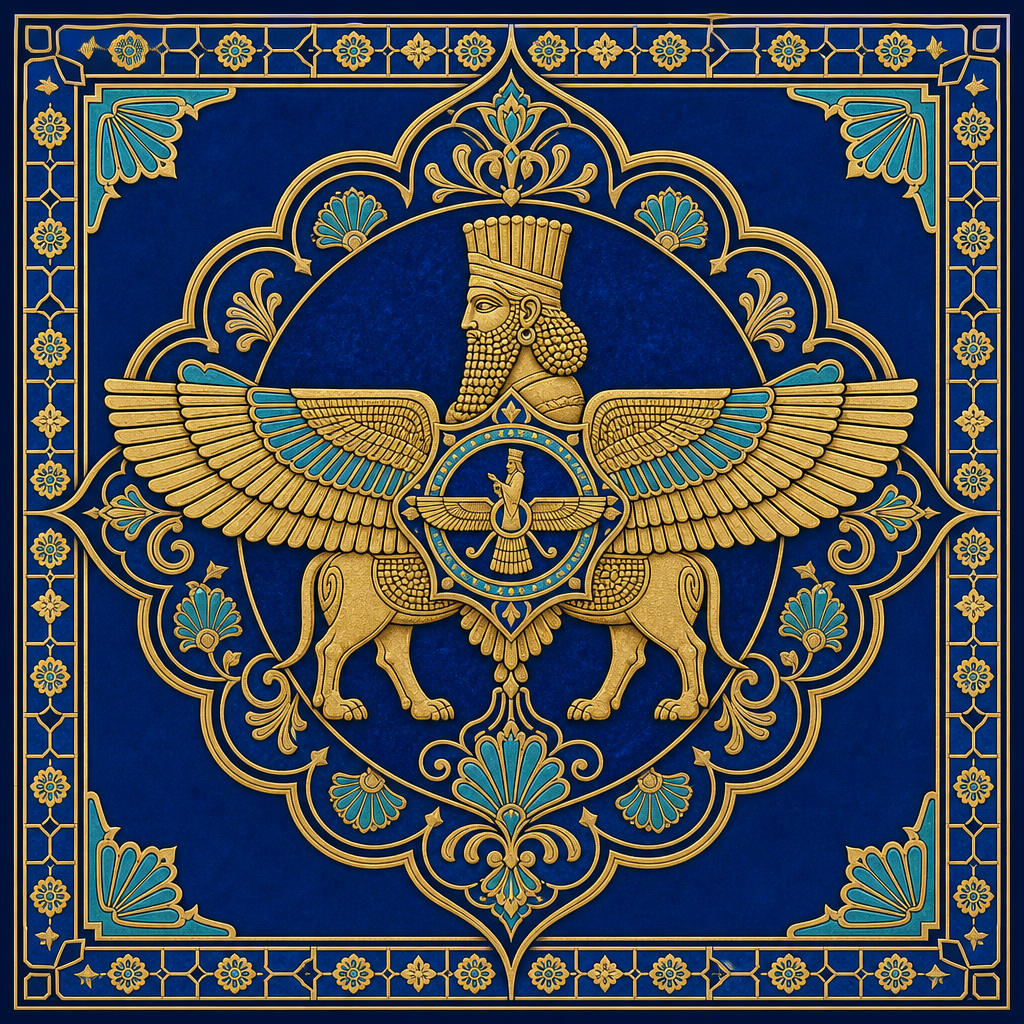
The Bisotun Inscription: Darius the Great's Proclamation in Stone
Unraveling the Achaemenid King's Rise to Power and the Decipherment of Cuneiform
Explore the monumental relief and trilingual text carved by Darius I on a mountain in western Iran. This article details its creation in the context of a contested throne, its intricate iconography, and its pivotal role in unlocking the secrets of ancient Mesopotamian scripts for the modern world.
Key takeaways
- The inscription was created circa 522 BCE to legitimize Darius the Great's controversial accession to the Achaemenid throne.
- It features three parallel texts in Old Persian, Elamite, and Babylonian, making it a 'Rosetta Stone' for cuneiform.
- Sir Henry Rawlinson famously risked his life to transcribe the texts, leading to their decipherment in the mid-19th century.
- The relief depicts a triumphant Darius I with his foot on the usurper Gaumata, followed by nine captive rebel leaders.
- The symbol of the Zoroastrian deity Ahura Mazda is shown giving his blessing to Darius from above.
- Designated a UNESCO World Heritage site in 2006, the monument is a key source for early Persian history.
The Bisotun Inscription is a monumental multilingual inscription and large rock relief commissioned by Darius the Great of the Achaemenid Persian Empire around 522 BCE. Located on Mount Bisotun in the Kermanshah Province of modern Iran, it documents the king's version of the events following the death of his predecessor, Cambyses II, and serves as a powerful declaration of his legitimacy to rule. The inscription, written in Old Persian, Elamite, and Babylonian, proved to be the single most important key in the 19th-century decipherment of cuneiform script, earning it the moniker 'the Rosetta Stone of Assyriology.' Its immense historical and linguistic value led to its designation as a UNESCO World Heritage Site in 2006, recognizing it as a masterpiece of ancient engineering, art, and political communication.
Historical Context: A Throne Seized in Turmoil
To understand the Bisotun Inscription, one must first understand the crisis it was created to resolve. In 522 BCE, the Achaemenid Empire, founded a generation earlier by Cyrus the Great, was thrown into chaos. Cyrus's son and successor, Cambyses II, died while returning from his campaign in Egypt. According to the inscription's narrative, a usurper had seized power in Persia during Cambyses's absence. Darius identifies this man as a Magian priest named Gaumata, who was impersonating Cambyses's deceased younger brother, Bardiya (known to the Greeks as Smerdis).
The text states: "Saith Darius the King: A man, a Magian, Gaumata by name... he lied to the people, saying 'I am Smerdis, the son of Cyrus, brother of Cambyses.' Then all the people became rebellious... he seized the kingdom." Darius, a member of a collateral branch of the Achaemenid royal family, describes how he, with the help of six other Persian nobles, confronted and killed this 'false Bardiya' and reclaimed the throne for the rightful dynastic line. However, his accession was not universally accepted. The empire erupted in a series of widespread revolts across Babylonia, Elam, Media, Parthia, and beyond. The bulk of the inscription is a detailed, almost monotonous, catalog of these rebellions and Darius's successful campaigns to crush them, with each defeated rebel leader branded a 'Liar King.'
This context is crucial: the Bisotun Inscription is not a dispassionate chronicle but a piece of masterful political propaganda. Darius lacked a direct, unimpeachable claim to the throne. His monument was a carefully crafted argument, broadcast in the empire's three official languages, designed to establish his legitimacy through three primary justifications: his Achaemenid lineage (which he traces back to a common ancestor with Cyrus), his prowess as a warrior who restored order from chaos, and, most importantly, the divine sanction of the Zoroastrian god, Ahura Mazda, whose will he claimed to be enacting.
The Monument: Propaganda Carved in Stone
Darius chose his canvas with strategic genius. The monument is carved approximately 100 meters (330 feet) up a limestone cliff face along a crucial ancient highway that would later be integrated into the Persian Royal Road, connecting the capitals of Babylonia and Media. For millennia, this route was trodden by caravans, armies, and royal emissaries, ensuring that Darius's message would be seen by countless influential people. The sheer inaccessibility of the relief and text also served a purpose: after its completion, Darius ordered the ledge used by the sculptors to be cut away, making it nearly impossible for his proclamation to be altered or defaced.
Iconography of the Relief
The visual narrative of the relief, measuring about 25 meters long and 15 meters high, is as potent as the text. At its center stands a life-sized Darius the Great, depicted with the regal beard and robe of a Persian king. He wears the royal crown and carries a bow, a symbol of both kingship and military might. His right hand is raised in a gesture of authority, while his left foot is planted firmly on the chest of a prone figure—the defeated usurper, Gaumata, who lies on his back with hands raised in supplication. Behind Darius stand two of his loyal co-conspirators, his bow-bearer Intaphrenes and his spear-bearer Gobryas. Floating above the entire scene is the winged symbol of Ahura Mazda, who extends a hand in blessing toward Darius, visually confirming the king's claim of divine right. Marching toward Darius is a procession of nine captive rebel leaders, roped together at the neck. Each figure is carved with distinct clothing and hairstyles to represent their different nations of origin, a visual catalog of the empire's diversity, now subjugated to Darius's will. Inscriptions carved above or below each captive name them and their crime of rebellion.
A Trilingual Key to a Lost World
For over two thousand years, the meaning of the cuneiform inscriptions that filled the ancient Near East was lost. The script, once used to record everything from epic poems like Gilgamesh to astronomical data, was an impenetrable mystery. The Bisotun Inscription, with its three parallel texts, would become the ultimate key to breaking the code. The genius of the monument was that it presented the same official story in Old Persian, Elamite, and Babylonian (a late form of Akkadian).
The story of its decipherment is one of academic brilliance and daring adventure. In the 1830s, Sir Henry Rawlinson, a British East India Company army officer stationed in Persia, became obsessed with the inscriptions. At great personal risk, he repeatedly scaled the cliff, dangling from ropes to meticulously transcribe the characters. He began with the Old Persian text, which was the simplest of the three. It was a semi-alphabetic script with only 41 characters. Building on preliminary work by the German scholar Georg Friedrich Grotefend, Rawlinson used the recurring names of kings mentioned by the Greek historian Herodotus—Darius, Xerxes, and Hystaspes—to assign phonetic values to the characters. By 1846, he had successfully translated the entire Old Persian section.
| Script | Type | Approx. Number of Signs | Primary Use in Empire |
|---|---|---|---|
| Old Persian | Semi-Alphabetic/Syllabic | 41 | Royal proclamations, language of the Persian elite. |
| Elamite | Syllabary | ~130 | Administrative language, particularly around Susa. |
| Babylonian (Akkadian) | Logosyllabic | ~600+ | Language of science, law, and culture in Mesopotamia. |
Legacy and Modern Significance
The Bisotun Inscription's legacy is immense. As a historical document, it provides the primary, if biased, narrative for a pivotal moment in the formation of the Achaemenid Empire. It offers a direct glimpse into the mind of one of antiquity's most effective rulers and the methods he used to consolidate power. The debate it fuels among historians—was Gaumata a genuine usurper or was he the real Bardiya, murdered by Darius?—continues to this day, highlighting the critical importance of questioning even the most monumental of sources. As a linguistic artifact, its role was revolutionary, opening the door to the rediscovery of the rich, complex civilizations of Sumer, Akkad, Babylonia, and Assyria.
Today, the monument faces threats from natural erosion and environmental factors. Its status as a UNESCO World Heritage site has brought international attention and resources for conservation, with ongoing projects aimed at documenting and preserving the delicate reliefs and inscriptions for future generations. The Bisotun Inscription remains an enduring symbol of power, identity, and the human quest to record history and unlock the secrets of the past.
Darius did not intend for his message to remain only on the cliff. Copies of the inscription's text, translated into Aramaic (the lingua franca of the empire) and written on papyrus, were disseminated across his domains. Fragments have been found as far away as Elephantine Island in Egypt.
After the monument's completion, Darius's engineers deliberately removed the lower sections of the ledge used for carving. This made the inscription unreadable from the ground and nearly impossible to reach, safeguarding it from vandalism or alteration by future rivals.
While the three cuneiform scripts are the most famous, there is evidence of a fourth version of the text at the site, written in Aramaic. This version has been almost completely lost to erosion but points to the empire's multilingual administrative practices.
The ancient name for the site, *Bagastāna* ('place of god'), was recorded by the Greek physician Ctesias. It evolved through Middle Persian to *Bohistun* and finally to the modern Persian *Bisotun*, showing remarkable linguistic continuity over 2,500 years.
Cambyses II dies. Darius and six conspirators overthrow the ruler Gaumata (the 'false Bardiya') and Darius I ascends to the Achaemenid throne, sparking widespread revolts.
References
- Encyclopaedia Iranica – Bisotun iii. The Achaemenid Inscription
- UNESCO World Heritage Centre – Bisotun
- The British Museum – The Behistun Inscription
- Livius.org – Behistun: The text ("DB")
- King, L. W., & Thompson, R. C. (1907). The Sculptures and Inscription of Darius the Great on the Rock of Behistûn in Persia.
- The Metropolitan Museum of Art – Achaemenid Empire
- Olmstead, A. T. (1948). History of the Persian Empire.
Frequently asked questions
Why is the Bisotun Inscription so important?
Its importance is twofold. Historically, it's Darius the Great's own account of his rise to power, offering invaluable insight into Achaemenid propaganda and politics. Linguistically, its trilingual text was the single most crucial element in deciphering cuneiform, unlocking the history and literature of ancient Mesopotamia and Persia.
Who deciphered the Bisotun Inscription?
British army officer and scholar Sir Henry Rawlinson is credited with the primary decipherment between 1835 and 1846. He began by cracking the simpler Old Persian script and then used it as a key to unravel the more complex Elamite and Babylonian cuneiform texts, a breakthrough for Assyriology.
What three languages are on the Bisotun Inscription?
The inscription is written in three different cuneiform scripts representing three major languages of the Achaemenid Empire. These are Old Persian (the language of the Persian elite), Elamite (the administrative language of the region), and Babylonian (a dialect of Akkadian used for culture and science throughout Mesopotamia).
What does the Bisotun relief depict?
The relief shows King Darius the Great, armed and life-sized, with his left foot on the chest of the defeated usurper Gaumata. Behind Gaumata are nine captive rebel leaders, bound by a rope around their necks. Two of Darius's loyal officials stand behind him, and the divine figure Ahura Mazda floats above, sanctioning Darius's rule.
Where is the Bisotun Inscription located?
The inscription is carved into a limestone cliff face on Mount Bisotun ('Place of the Gods') in Kermanshah Province, western Iran. The location was strategically chosen along a major ancient caravan route, the future Royal Road, connecting Babylonia with the Median highlands, ensuring maximum visibility for travelers.
How old is the Bisotun Inscription?
The monument dates to the beginning of the reign of Darius the Great. The main carving and inscriptions were completed around 520-519 BCE, just a few years after he seized the throne in 522 BCE. It is over 2,500 years old.
What does the name Bisotun mean?
The name Bisotun derives from the Old Persian *Bagastāna*, meaning 'the place of god' or 'land of god.' This underscores the site's ancient sanctity, which likely influenced Darius's decision to place his monument of divine justification there. It was known to the ancient Greeks as Bagistanon.
Is the Bisotun Inscription's account historically accurate?
This is a subject of scholarly debate. While the inscription provides an indispensable framework for the events of 522-519 BCE, it is undeniably a work of royal propaganda. Historians question whether the figure of 'Gaumata the Magian' was a real usurper or the genuine brother of Cambyses, Bardiya, whom Darius murdered and later vilified to justify his own claim to the throne.