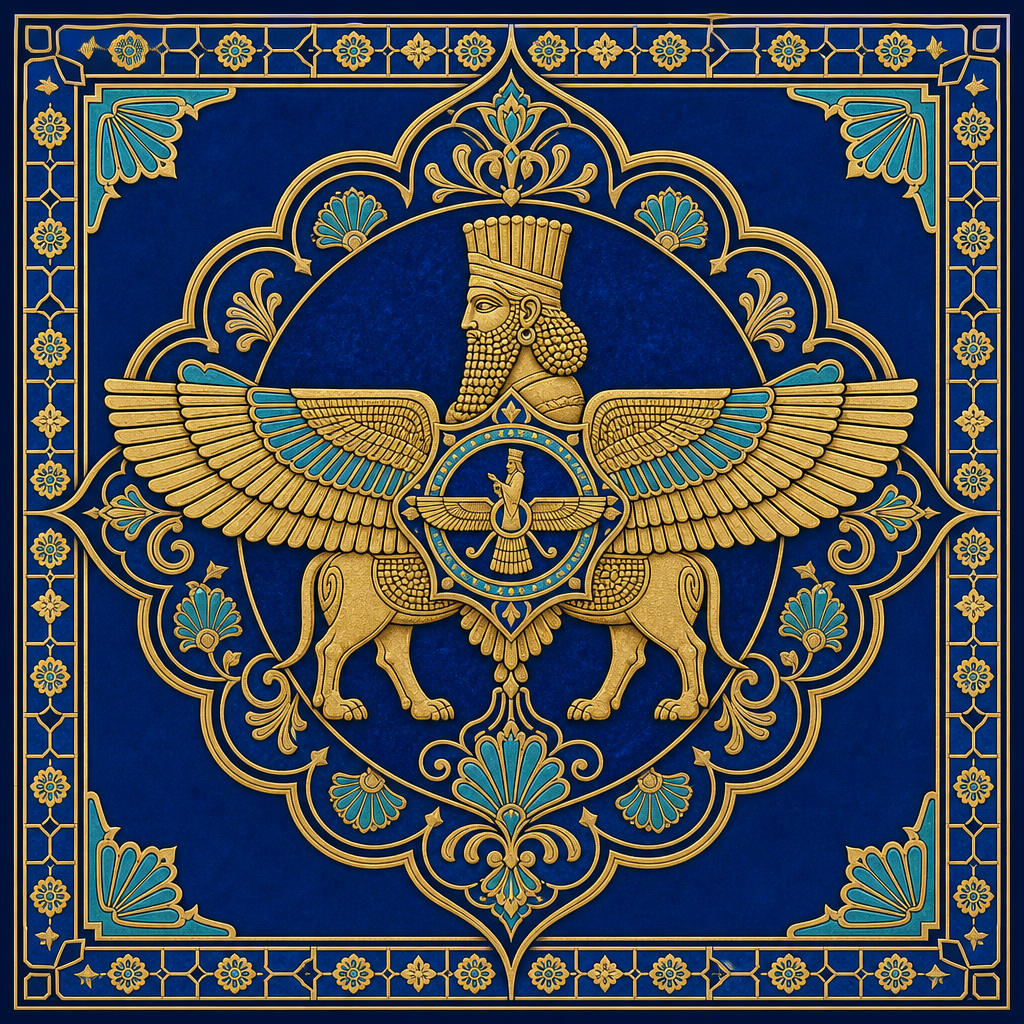

Religion & Philosophy of Iran
The Iranian plateau gave the world its first articulated monotheism, the cult of the unconquered sun, the dualism that haunted late antiquity, and the love-mysticism that still names mosques from Konya to Lahore. Iran has been not only a land of empires but a workshop of the spirit.
The spiritual layers of Iran
Iran is one of the oldest continuously religious cultures on earth. Long before the Hebrew Bible was complete, the prophet Zoroaster taught the Iranian tribes a moral monotheism that would profoundly influence Judaism, Christianity, and Islam in turn. After the rise of Islam, Iranian thinkers reformed the new faith from within — producing the mystical poetry of the Sufis, the speculative theology of the philosophers, and a rich syncretic ethics that endures to this day.
A comparative table
| Tradition | Founded | Core Idea | Sacred Text |
|---|---|---|---|
| Zoroastrianism | c. 1500 BCE | Cosmic struggle between Ahura Mazda (good) and Angra Mainyu (evil); each soul chooses | Avesta (incl. Gathas of Zoroaster) |
| Mithraism | Bronze Age cult, formalised 1st c. CE | Worship of Mithra, divinity of the contract, light, friendship; later a Roman mystery cult | Liturgical fragments only |
| Manichaeism | 3rd c. CE | Dualist universal religion synthesising Christian, Zoroastrian, and Buddhist elements | Mani's own scriptures, mostly lost |
| Mazdakism | 5th c. CE | Radical Sasanian-era egalitarian movement; communal ownership | Tradition preserved by Khurramites |
| Iranian Islam | 7th c. CE | Adopted after the Arab conquest; reshaped from within by Persian scholars and poets | Quran & vast Persian commentarial tradition |
| Sufism | 9th c. CE onward | Mystical path of love and union with the divine through self-effacement | Masnavi (Rumi), Mantiq al-Tayr (Attar), Divan (Hafez) |
| Illuminationist Philosophy | 12th c. CE | Suhrawardi's hikmat al-ishraq — knowledge as illumination, a synthesis of Plato and Zoroaster | Hikmat al-Ishraq |
| Transcendent Theosophy | 17th c. CE | Mulla Sadra's Asfar — being is gradational, ascending from non-existence to the divine | Al-Asfar al-Arba'a |
The first prophet

Zarathustra — Greek Zoroaster — lived somewhere on the steppes of eastern Iran or modern Afghanistan in the second millennium BCE. His teachings, preserved in seventeen hymns called the Gathas, present an austere ethical vision: there is one supreme creator, Ahura Mazda; the universe is the battlefield of truth (asha) and the lie (druj); each human soul is a free agent who must choose, and will be judged after death on the bridge of Chinvat.
پندار نیک، گفتار نیک، کردار نیک
"Good thoughts, good words, good deeds."
Eschatology
Zoroastrianism introduced heaven, hell, judgment after death, a final saviour (Saoshyant), and the renewal of the world — concepts that profoundly influenced later monotheisms.
Sacred Fire
Fire — pure, ever-rising, never polluted — is the most visible Zoroastrian symbol of divinity. The oldest still-burning sacred fire is at Yazd, kept since the 5th century.
Today
Around 100,000–200,000 Zoroastrians remain worldwide — primarily Parsis in India (descendants of 10th-century Iranian refugees) and a small native Iranian community concentrated in Yazd and Kerman.
Sufism and the love that names the divine

When Persian poetry rose to its golden age, much of it was Sufi mysticism in literary form. The Sufis taught that the divine is reached not through dogma but through love — that the soul, alienated from its origin, must annihilate its small self (fanā) and rejoin the One. The vocabulary of love-poetry — wine, the cup-bearer, the lover, the rose — became the natural Persian idiom for this annihilating love.
هرگز نمیرد آن که دلش زنده شد به عشق
"Never dies the one whose heart has come alive through love."
ای بسا هندو و ترک همزبان / ای بسا دو ترک چون بیگانگان
"Many a Hindu and Turk share a tongue, while many two Turks are strangers to each other."
The great shrines of Iran
Across the plateau, Iranians built — and still maintain — some of the most lyrical sacred architecture in the world: city-sized shrine complexes of mirrored halls, gilded domes and tiled courtyards that absorb millions of pilgrims a year. These places are living institutions of devotion, hospitality, charity and craft, and they remain among the most moving experiences any visitor to Iran can have.


Reason in the Iranian tradition
Iranian philosophy after Avicenna split into two great currents that have continued in dialogue ever since. Suhrawardi (1154–1191) revived Platonic and Zoroastrian themes in his Philosophy of Illumination, arguing that all knowledge is ultimately a form of light. Five centuries later in Safavid Isfahan, Mulla Sadra (1571–1640) synthesised Avicennian rationalism, Ibn Arabi's mysticism, and the illuminationist tradition into a comprehensive metaphysics of being — still the dominant frame of philosophical instruction in Iranian seminaries today.
"Existence is one reality which manifests itself in degrees of intensity, from the lowest to the highest, all the way to the necessary being itself."
The legionary cult that almost became Rome's religion

Long before it reached the Roman legions, Mithra was an Indo-Iranian divinity of contract, oath, friendship and the rising sun — already worshipped in the Vedas as Mitra and in the Avesta as Mithra. The Persian Mithra was a celestial witness to every agreement between humans; to swear by him was to bind the cosmos itself to the oath. The Achaemenids inscribed his name on royal seals from Susa; the Parthians built him a network of sun-facing shrines from Hatra to Nisa; under the Sasanians, Mithra's autumn festival of Mehragān ranked second only to Nowruz.
When Roman legionaries serving on the Parthian frontier carried the cult home, it changed shape: by the second century CE Mithraism had become one of the four major mystery religions of the Roman Empire, with hundreds of underground mithraea from Hadrian's Wall to the Danube. The image of Mithra slaying the cosmic bull — the tauroctony — is found across the empire; many scholars argue that the Christian iconography of the lamb, the date of Christmas (25 December — Sol Invictus, Mithra's day), and the orientation of churches toward the rising sun all carry a Mithraic inheritance.
The lost world religion
Mani (c. 216–277 CE), born near Ctesiphon, was the founder of what was, for three centuries, a serious candidate to be the universal religion of Eurasia. Manichaeism synthesised Zoroastrian dualism, Christian Gnosticism and Buddhist asceticism into a single missionary system whose scriptures were composed by the founder himself in seven elegant volumes and translated, during his lifetime, into Syriac, Middle Persian, Parthian, Greek and (via his disciples) Sogdian, Old Turkic and Chinese. At its peak the religion had churches from Carthage to Chang'an.
| Region | Period | Status |
|---|---|---|
| Sasanian Iran | c. 240 – 277 CE | Court protection under Shapur I; Mani executed under Bahram I |
| Roman North Africa | 3rd – 5th c. | Augustine of Hippo's faith for nine years before his conversion |
| Central Asia / Sogdiana | 4th – 10th c. | Sogdian merchants the principal missionaries on the Silk Road |
| Uyghur Khaganate | 763 – 840 | State religion of the Uyghur empire — the only one Manichaeism ever achieved |
| Tang & Song China | 8th – 14th c. | Surviving 'Religion of Light' (Mingjiao) in coastal Fujian |
| Cathar Languedoc | 12th c. | Dualism resembling Manichaeism re-emerges in southern France |
Yazd, Kerman, Mumbai, Karachi


The world's Zoroastrians today number perhaps 110,000–200,000 souls, divided between three communities: roughly 20,000–25,000 in the historic Iranian heartlands of Yazd and Kerman (where the eternal fire of the Ātash-e Bahram at Yazd has burned without interruption since the year 470 CE); 50,000–70,000 Parsis in India and Pakistan, descendants of the Iranian families who fled the Arab conquest by sailing to Gujarat between the 8th and 10th centuries; and an emerging diaspora of perhaps 30,000 in North America, Britain and Australia. Despite their small numbers, the Parsi community produced the Indian National Congress co-founder Pherozeshah Mehta, the conductor Zubin Mehta, the industrialists Tata and Godrej, and Queen's frontman Freddie Mercury (Farrokh Bulsara).
The genealogy of the masters
| Order | Founded | Founder | Major reach today |
|---|---|---|---|
| Kāzerūniyya | 10th c., Fars | Abū Isḥāq Kāzerūnī | Anatolia, Indonesia (via missionary lodges) |
| Kubrāwiyya | 12th c., Khwarazm | Najm al-Dīn Kubrā | Central Asia, Tatarstan, Kashmir |
| Suhrāwardiyya | 12th c., Baghdad | Shihāb al-Dīn Suhrāwardī | Punjab, Sindh, Iraq |
| Mevleviyya (Whirling) | 13th c., Konya | Sultan Walad (son of Rumi) | Turkey, Balkans, Egypt |
| Naqshbandiyya | 14th c., Bukhara | Bahāʾ al-Dīn Naqshband | From Morocco to Indonesia — the largest Sufi order |
| Niʿmatullāhiyya | 14th c., Kerman | Shāh Niʿmatullāh Walī | Iran's largest indigenous order; diaspora across the West |
| Khāksāriyya | Safavid era, Iran | Tradition of wandering dervishes | Iran, Indo-Pakistan |
| Qādiriyya (Sunni-Iranian branches) | 12th c., Baghdad | ʿAbd al-Qādir al-Jīlānī | Kurdistan, North Africa, West Africa |
گر تو ندانی صفت ماهی به آب / ای دل نادان تو چه دانی صواب
"If you do not know the fish's love of water, foolish heart, what would you know of right?"
Iran's nineteenth-century religious birth
In May 1844 in Shiraz, a young merchant calling himself the Báb ("Gate") declared himself the herald of a forthcoming universal manifestation of God. His movement spread rapidly across Qajar Iran; the Báb was executed in 1850 in Tabriz, but in 1863 in Baghdad one of his followers, Bahá'u'lláh (Mírzá Husayn-ʿAlí Núrí, 1817–1892), proclaimed himself that promised manifestation. The Bahá'í Faith that grew from his teachings holds the unity of God, the unity of religion, and the unity of humanity as its three foundational principles. With approximately 8 million adherents worldwide, it is today one of the most widely-distributed religions on earth, with elected councils in over 180 countries.
A timeline of Iranian philosophy
| Philosopher | Era | Tradition | Lasting Contribution |
|---|---|---|---|
| al-Kindī (Persian-Arab) | 9th c. | First Peripatetic | First Aristotelian in Arabic; theory of the intellect |
| al-Fārābī | 872–950, Khorasan | Peripatetic | Political philosophy; al-Madīna al-Fāḍila — the virtuous city; called 'the Second Teacher' after Aristotle |
| Ibn Sīnā (Avicenna) | 980–1037, Bukhara | Peripatetic synthesis | Distinction of essence and existence; floating-man argument; the canon of Islamic Aristotelianism |
| al-Ghazālī (partly Iranian-trained) | 1058–1111, Tus | Critique of Peripateticism | Tahāfut al-Falāsifa — challenged the philosophers and reopened the question of mysticism |
| Suhrawardī | 1154–1191, Aleppo | Illuminationist | Hikmat al-Ishrāq — knowledge as illumination; Plato meets Zoroaster |
| Naṣīr al-Dīn Ṭūsī | 1201–1274, Maragha | Shi'i Peripatetic / Ethics | Ethics of Naṣirī — the standard Shi'i ethical manual; also the great astronomer of Maragha |
| Mīr Dāmād | d. 1631, Isfahan | School of Isfahan | Founder of the Safavid philosophical revival; theory of 'perpetual creation' (ḥudūth-i dahrī) |
| Mullā Ṣadrā | 1571–1640, Shiraz / Qom | Transcendent Theosophy | Asfār al-Arbaʿa — primacy and gradation of existence; the dominant frame of Iranian seminary philosophy today |
| ʿAllāmeh Ṭabāṭabāʾī | 1903–1981, Tabriz | Modern Sadrian | Tafsīr al-Mizān; revival of Mullā Ṣadrā for the 20th century; teacher of Henry Corbin's Iranian colleagues |
Iran and the global history of religion
First articulated monotheism
Zoroaster's Gathas (c. 1500–1000 BCE) present the earliest known sustained ethical monotheism — predating the Hebrew Bible by centuries.
First explicit heaven and hell
The Zoroastrian Chinvat Bridge — judgment of each soul after death — is the earliest detailed eschatology in any tradition.
First freedom-of-religion charter
The Cyrus Cylinder (539 BCE) is read by historians as the first imperial charter guaranteeing religious freedom to all subject peoples.
Saviour figure (Saoshyant)
Zoroastrianism's expected world-renewer is the earliest articulation of the messianic-saviour figure that recurs in Judaism, Christianity, Islam and Bahá'í.
Mithraic week
The seven-day week of Mithra's astrological cycle was adopted by Rome and from there spread across the Christian world.
Sufism's literary heart
Every major figure of the classical Islamic mystical tradition — Hallāj, Sanāʾī, ʿAṭṭār, Rumi, Hafez — wrote primarily in Persian.
"It is from Iran that the West receives its messianism, its angelology, its eschatology and the very vocabulary of its mysticism. The history of European religion cannot be told without Iran at its source."
References
- ↗ Encyclopædia Iranica — Zoroastrianism
- ↗ Mary Boyce — Zoroastrians, Their Religious Beliefs and Practices
- ↗ Henry Corbin — En Islam Iranien
- ↗ Stanford Encyclopedia of Philosophy — Suhrawardi
All imagery is sourced from Wikimedia Commons, public-domain museum collections (British Museum, Louvre, Metropolitan Museum of Art, National Museum of Iran), or UNESCO World Heritage records. No AI-generated images are used. Scholarly text is synthesized from Encyclopædia Iranica, the Cambridge History of Iran, and peer-reviewed publications.
Religion & philosophy FAQ
Related reading
Ferdowsi, Hafez, Rumi, Saadi, Nizami, Khayyam — the masters of Persian verse.
Taarof, hospitality, festivals, music, and everyday life.
From Elam and the Medes to the modern era — a continuous 5,000-year story.
Inventions, governance, infrastructure — qanats, postal system, Charter of Rights.
Nowruz, Yalda, Mehregan, Sadeh, Tirgan — the ceremonial year.