
The Iranian Diaspora
Five to eight million Iranians live beyond the borders of Iran today — a global community of physicians, engineers, artists, scholars, and entrepreneurs who carry the language, the cuisine, and the Nowruz table wherever they settle.
Persia in the world
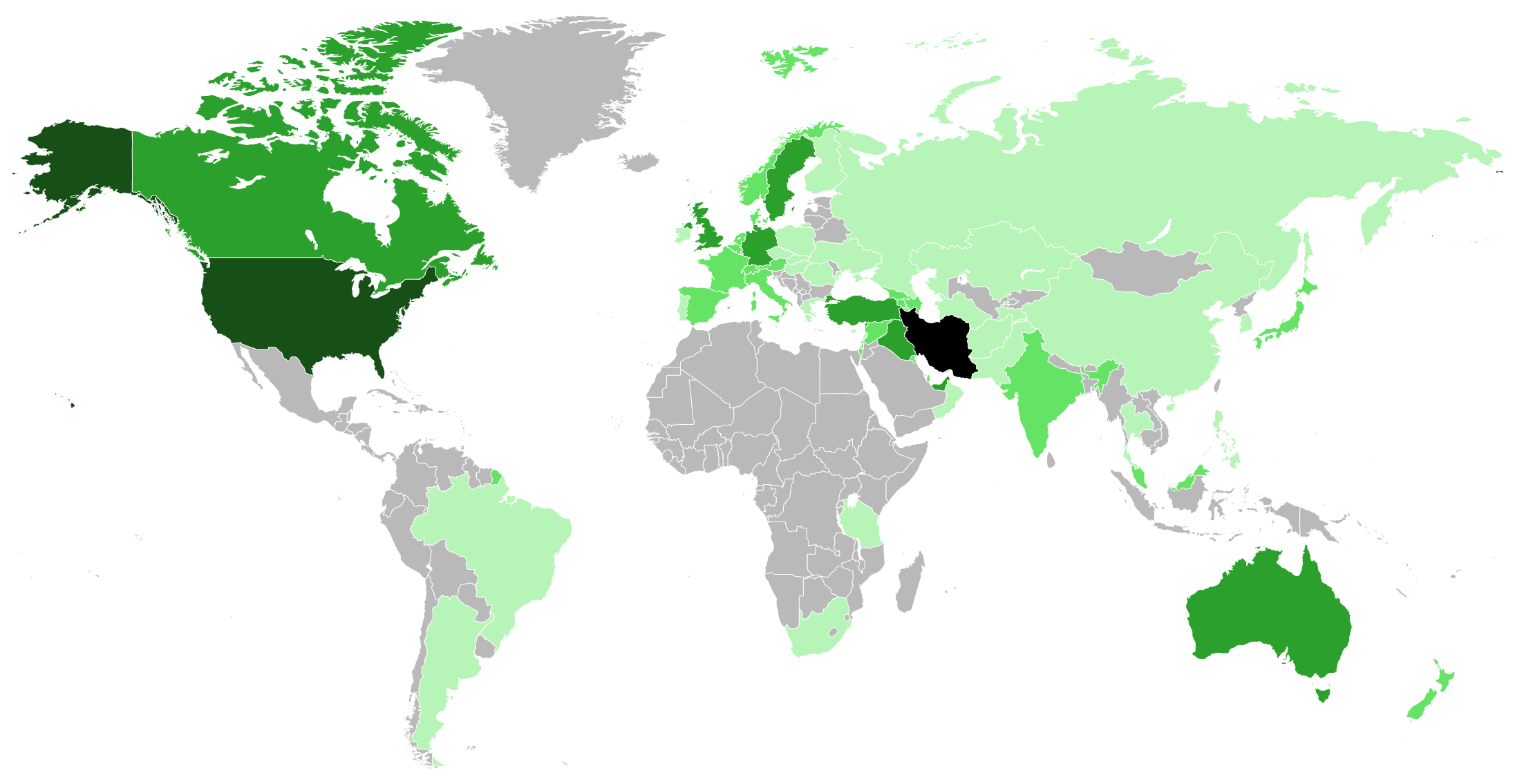
Waves of departure
| Period | Where to | Profile |
|---|---|---|
| 10th c. CE | Gujarat, India | Zoroastrian refugees from the Arab conquest — the ancestors of today's Parsi community |
| 19th c. | Caucasus & Central Asia | Merchants and labour migrants under late Qajar economic stress |
| 1860s–1890s | Ottoman Empire & Russia | Constitutionalist intellectuals, Babi-Bahá'í communities exiled to Istanbul, Baghdad, Acre |
| 1950s–70s | Western Europe & USA | Students sent by the Pahlavi state to acquire technical education |
| 1979–1985 | USA, France, UK, Germany | Post-revolutionary professional and intellectual emigration |
| 1980–1988 | Sweden, Germany, Netherlands | War-era refugees from the Iran–Iraq war; Sweden alone admitted 50,000 |
| 1990s–today | Canada, Australia, Scandinavia | Skilled-migration streams, especially engineers and physicians |
| 2009 & after | Turkey, UAE, Georgia | Post-Green Movement emigration; journalists, activists, artists, LGBTQ Iranians |
| 2022 & after | Anywhere accessible | Post-Mahsa Amini wave — students, doctors, IT workers; estimated 4,000+ academics in 2023 alone |

Profile of an Iranian-American community
The U.S. Census Bureau's American Community Survey consistently ranks Iranian Americans among the most highly educated ancestry groups in the country. According to the Migration Policy Institute and the Public Affairs Alliance of Iranian Americans (PAAIA), more than two-thirds of Iranian-American adults hold a bachelor's degree or higher — a rate roughly double the U.S. average. Median household income outpaces the national figure by about 30 percent.
By the numbers
- 67% hold at least a bachelor's degree (vs. 33% U.S. average)
- 35% hold a graduate or professional degree
- $110k median household income (vs. $74k U.S. median)
- 25% work in professional, scientific, or technical services
- 12% are self-employed business owners — twice the national rate
- 95% speak Persian at home; 88% also speak English "very well"
First generation (born in Iran)
- ◆Median arrival age: late twenties
- ◆Carry the literary canon — Hafez, Saadi, Ferdowsi quoted in daily speech
- ◆Strong attachment to Iranian holidays, food, music
- ◆Often founders of Persian-language media, restaurants, cultural centres
- ◆Sustain remittances and family ties to relatives in Iran
Second & third generation
- ◆Native speakers of the host-country language
- ◆Persian fluency varies — receptive bilingualism common
- ◆Higher rates of intermarriage with the host society
- ◆Reinvent Iranian identity through art, film, fashion, podcasts
- ◆Lead a new wave of Iranian-American politicians, judges, surgeons
Iranians on the world stage


Maryam Mirzakhani (1977–2017)
First woman ever to win the Fields Medal in mathematics (2014). Stanford professor; born in Tehran. Streets in Lyon, Tehran, and Stanford are named in her memory.
Pierre Omidyar
Iranian-born founder of eBay; later major philanthropist (Omidyar Network).
Anousheh Ansari
First Iranian and first Muslim woman in space (2006); co-founded the Ansari XPRIZE.
Abbas Kiarostami
Cannes Palme d'Or-winning director; one of the most influential filmmakers of the late 20th century.
Asghar Farhadi
Two-time Academy Award winner for Best International Feature (A Separation, The Salesman).
Shirin Ebadi
First Muslim woman and first Iranian Nobel Peace Prize laureate (2003).
Hassan Fathy & Nader Khalili
Pioneers of sustainable earth architecture inspired by Iranian vernacular tradition.
Lotfi Zadeh
UC Berkeley professor who invented fuzzy logic — foundational to modern AI.
Firoozeh Dumas
Bestselling memoirist of Funny in Farsi — translated into Persian, Dutch, Hebrew, Korean and taught in U.S. high schools.
Cyrus Habib
Former Lieutenant Governor of Washington State; later joined the Society of Jesus as a Jesuit.
Christiane Amanpour
Chief International Anchor at CNN; one of the most recognised foreign correspondents in the English-speaking world.
Goli Ameri
Former U.S. Assistant Secretary of State; one of the first Iranian-American women appointed to a senior diplomatic post.
The capital of the diaspora: Los Angeles

The largest Iranian community outside Iran is concentrated along Westwood Boulevard in the Westwood neighbourhood of Los Angeles, a corridor of bookstores, bakeries, kebab houses, music shops and satellite TV studios that locals call Tehrangeles. The City of Los Angeles formally recognised the stretch between Wilkins and Pico as Persian Square in 2010, and the district hosts the annual Mehregan autumn-equinox street fair.
Los Angeles is also the world capital of Persian-language satellite television: stations such as Manoto, Iran International, BBC Persian (London-based) and dozens of émigré music channels broadcast directly into Iranian living rooms, where they routinely outrate the state broadcaster. The city's record industry — Caltex Records, Avang, Taraneh Enterprises — produced the soundtrack of Iranian exile from the 1980s onward.
Population
Greater Los Angeles is home to an estimated 500,000–700,000 Iranian Americans — more than any city outside Tehran.
Persian Square
Officially designated by L.A. City Council in 2010; bilingual street signs along Westwood Blvd.
Mehregan Festival
Annual autumn-equinox street fair on Westwood Blvd. — music, food, and craft stalls, attended by tens of thousands.
Beverly Hills Mayors
Beverly Hills has elected several Iranian-American mayors and city council members since the 2000s.
Schools
The L.A. Unified School District teaches Persian as a foreign language in select campuses; the SAT II Persian test was launched in 1995.
Synagogue & Mosque
Westwood hosts both Nessah Synagogue — a major Iranian-Jewish congregation — and the Islamic Center of Beverly Hills.
Iran's oldest diaspora: the Zoroastrians of India

The deepest Iranian diaspora is also the oldest. When the Sasanian state collapsed under the Arab conquest in 651 CE, a community of Zoroastrians refused conversion and, over the following century, sailed from the Iranian coast around to Gujarat in north-western India. According to the Qissa-i Sanjan — a 16th-century chronicle of the migration — they landed at Sanjan in the 8th century and were granted refuge by the local Hindu king Jadi Rana on five conditions, including adopting the local language (Gujarati) and dress.
Their descendants, the Parsis, became one of the most influential business and intellectual communities of British India: the Tata industrial group, the Godrej conglomerate, the Wadia shipbuilders, and figures such as Dadabhai Naoroji (Britain's first Asian MP), conductor Zubin Mehta, and Queen guitarist Freddie Mercury (born Farrokh Bulsara) trace their ancestry to this 1,300-year-old exile. Today around 60,000 Parsis live in India and another 5,000 in Pakistan, alongside a smaller community of more recent Iranian-born Zoroastrians known as Iranis.

"In the year 716 of Vikrama [c. 716 CE] the dasturs and their fellows, sorely afflicted, set forth from Iran toward Hind, that they might preserve the holy fire and the religion of Zarathustra."
A Persian streetscape on every continent
Wherever Iranians have settled, certain institutions tend to appear within a generation: a Persian bookshop, a kebab house, a saffron-and-sumac grocer, a Nowruz committee, and — increasingly — a carpet showroom catering to local tastes. The Amsterdam Persian Carpet Shop photographed below is a typical example: family-run, three-generations deep, serving a clientele that is now largely Dutch.

| City | Neighbourhood | Anchor institutions |
|---|---|---|
| Los Angeles, USA | Westwood ('Tehrangeles') | Persian Square, Nessah Synagogue, Manoto TV |
| Toronto, Canada | North York ('Tehronto') | Tirgan Festival, Iranian-Canadian Congress, Khane Cinema |
| London, UK | Kensington, Finchley | BBC Persian, Iran International, Iran Heritage Foundation |
| Hamburg, Germany | St. Georg | Imam Ali Mosque (oldest Shi'a mosque in Europe, 1953) |
| Stockholm, Sweden | Tensta, Rinkeby, Solna | Iranska Riksförbundet — umbrella body for 40+ Iranian associations |
| Sydney, Australia | Hornsby, Ryde | Persian-language Saturday schools; Australian-Iranian Society |
| Dubai, UAE | Bur Dubai, Deira | 150,000+ residents, Iranian Business Council, Iranian Hospital Dubai (1972) |
| Istanbul, Turkey | Beyazıt, Aksaray | Largest transit community since 2009; carpet and tourism trades |
The poet at the door
For all the variety of routes and reasons that bring Iranians abroad, certain commonalities recur. Almost every diaspora household keeps a copy of Hafez and the Shahnameh; almost every family lays a Haft-Sin at Nowruz; almost every wedding finishes with a recitation of Saadi's "Bani Adam" — the same couplet that hangs, in Persian carpet form, in the entrance hall of the United Nations in New York.
بنیآدم اعضای یکدیگرند / که در آفرینش ز یک گوهرند
"Human beings are members of a whole, in creation of one essence and soul. If one limb is afflicted with pain, the other limbs cannot remain at rest."
References
- ↗ Migration Policy Institute — Iranian immigrants
- ↗ Iranian Studies Group at MIT
- ↗ PAAIA — Public Affairs Alliance of Iranian Americans
- ↗ Encyclopædia Iranica — Iranian Diaspora
- ↗ UNESCO — International Day of Nowruz
- ↗ U.N. General Assembly Resolution A/RES/64/253 (Nowruz)
- ↗ Parzor Foundation — UNESCO Parsi Zoroastrian project
All imagery is sourced from Wikimedia Commons, public-domain museum collections (British Museum, Louvre, Metropolitan Museum of Art, National Museum of Iran), or UNESCO World Heritage records. No AI-generated images are used. Scholarly text is synthesized from Encyclopædia Iranica, the Cambridge History of Iran, and peer-reviewed publications.
Persian diaspora FAQ
Related reading
Cinema, sports, science and cultural achievements of contemporary Iran.
Three thousand years of Persian — Old, Middle, New — and the Persian words in English.
Taarof, hospitality, festivals, music, and everyday life.
Mirzakhani, Ebadi, Birkar, Vafa — Iranian winners of the world's highest scientific honours.
Saffron, rice, kebab, stews, tea and sofreh — the Persian table.