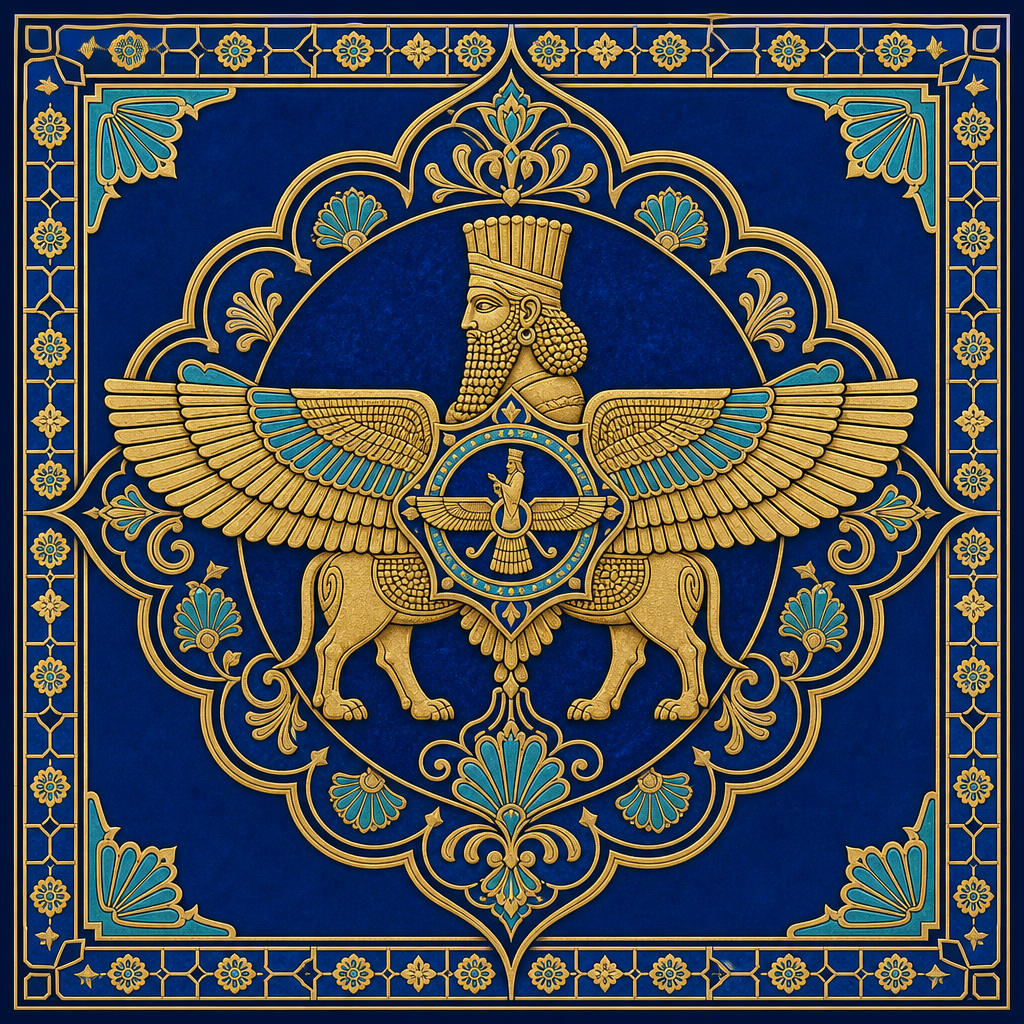
Ērānshahr: The Institutions, Society, and Culture of the Sasanian Empire
An examination of the last great pre-Islamic Persian empire, its complex statecraft, vibrant culture, and enduring legacy
The Sasanian Empire (224–651 CE) was a world power that defined the late antique Near East. This article explores the sophisticated institutions, state-sponsored Zoroastrian religion, economic foundations, and brilliant artistic and scientific achievements that characterized the four centuries of Sasanian rule, leaving an indelible mark on Persian civilization and the wider world.
Key takeaways
- The Sasanian Empire ruled for over four centuries, from the rise of Ardashir I in 224 CE to the Arab conquest in 651 CE.
- It established a state-sponsored form of Zoroastrianism, with a powerful priestly class and a codified version of the Avesta.
- The Sasanian state was a highly centralized bureaucracy governed by the Shāhanshāh (King of Kings) from the capital, Ctesiphon.
- Sasanian art is renowned for its magnificent rock reliefs, gilded silver plates, and grand architectural works like the Taq-e Kasra.
- The Academy of Gundeshapur became a major intellectual center, blending Persian, Greek, and Indian knowledge in medicine and science.

The Sasanian Empire was the last great pre-Islamic Persian empire, ruling from 224 to 651 CE. Arising from the province of Fars, the traditional Persian heartland, the Sasanians overthrew their Parthian predecessors and established a vast domain that stretched from the Euphrates to the Indus, frequently challenging the Roman and later Byzantine Empires for hegemony over the Near East. More than just a military power, the Sasanian state, which called itself *Ērānshahr* (the Dominion of the Iranians), engineered a sophisticated administrative apparatus, a revitalized state religion in Zoroastrianism, and a brilliant cultural renaissance whose influence extended far beyond its eventual collapse. This era represents a pivotal chapter in Iranian history, forming a crucial bridge between the ancient world of the Achaemenids and the medieval Islamic civilization that followed.
The Structure of Sasanian Statecraft and Society
At the apex of the Sasanian state was the king, the *Shāhanshāh* (King of Kings). His authority was not merely political but also divine, legitimized by the concept of *khwarrah*, a divine grace or glory that signified his rightful rule. This ideology, vividly depicted in royal art and investiture reliefs, positioned the monarch as the earthly counterpart to the supreme Zoroastrian deity, Ahura Mazda, tasked with maintaining order and justice in the world. The capital of this vast empire was Ctesiphon, on the Tigris River in modern-day Iraq, a sprawling metropolis that served as the administrative and royal heart of *Ērānshahr*.
To govern their extensive territory, the Sasanians developed a highly centralized and hierarchical bureaucracy, a significant departure from the more decentralized feudalism of the preceding Parthian Arsacids. The entire administration was overseen by the *wuzurg-framadār* (grand vizier), the king's chief minister. Beneath him, the state was organized into several key ministries, or *divans*, including those for finance, justice, the military, and a chancery responsible for official correspondence and records. This complex system relied on a professional class of scribes (*dabīrān*), who used the intricate Pahlavi script to manage the empire's affairs.
Sasanian society was officially conceptualized as being divided into four distinct estates or castes. This rigid social stratification was ideologically rooted in Zoroastrian tradition and served to maintain cosmic and social order. The highest class consisted of the priests (*āsrōnān*), followed by the warriors (*artēshtārān*), the scribes (*dabīrān*), and finally, the great mass of common people, including farmers, artisans, and merchants (*wāstaryōshān* and *hutukhshān*). While social mobility was limited, this structure provided a stable framework for the functioning of the empire, with each class fulfilling a divinely ordained role.
| Class (Middle Persian) | Description | Primary Role | Guiding Principle |
|---|---|---|---|
| Āsrōnān | Priestly Class | Spiritual guidance, religious ritual, justice, and education. | Preserving religious purity and cosmic order. |
| Artēshtārān | Warrior Nobility | Defending the empire, commanding the army. Included the king and high nobility. | Maintaining the security and integrity of Ērānshahr. |
| Dabīrān | Scribal Class | State administration, tax collection, record-keeping, and diplomacy. | Ensuring the efficient and orderly function of the bureaucracy. |
| Wāstaryōshān | Commoners | Agriculture, craftsmanship, and trade. The productive base of the empire. | Sustaining the material well-being of the state and its people. |
Zoroastrianism as the Pillar of the State
While Zoroastrianism had existed for centuries, it was under the Sasanians that it was transformed into a structured, state-sponsored religion with a powerful, organized church. The Sasanian kings saw the faith as an integral part of their Iranian identity and a key instrument of political unification. The head of the religious hierarchy was the *mowbedān mowbed* (chief of the priests), who held immense influence in the royal court and over matters of law and social policy. This fusion of throne and altar was a defining characteristic of the Sasanian polity.
A major achievement of the Sasanian priesthood was the codification and standardization of the Avesta, the holy scriptures of Zoroastrianism. Previously transmitted through oral tradition, the sacred texts were committed to writing using a newly invented Avestan alphabet. This process helped to create a unified orthodoxy and canon, which was then promulgated throughout the empire. Great fire temples were constructed in major cities, serving as centers of worship, scholarship, and community life. The Sasanian kings presented themselves as pious defenders of the 'Good Religion' against both external foes and internal heresy.
The empire's relationship with its minority religions was complex and varied over time. While Zoroastrianism was supreme, large communities of Jews, Christians (primarily Nestorians, or the Church of the East), and Buddhists (in the eastern territories) existed. Their treatment often depended on the political climate. Christians, for example, were sometimes tolerated but were fiercely persecuted during periods of war with the Christian Roman/Byzantine Empire, as they were suspected of harboring loyalties to the enemy. The prophet Mani, who attempted to synthesize Zoroastrian, Christian, and Buddhist teachings into a new faith, Manichaeism, was initially welcomed by Shapur I but was later executed under Bahram I due to pressure from the orthodox Zoroastrian clergy. Similarly, the radical social and religious movement of Mazdak in the late 5th century was brutally suppressed.
Economic Foundations: Agriculture, Trade, and Urbanism
The economic might of the Sasanian Empire rested on a robust agricultural base, sustained by sophisticated irrigation technology. The Sasanians maintained and expanded the ancient system of *qanāts* (subterranean aqueducts) and built new dams and canals to increase arable land, particularly in the fertile Mesopotamian plains (in Persian, *Del-e Ērānshahr*, the 'Heart of Iran'). The state's ability to produce large agricultural surpluses supported its large armies and growing urban populations. A comprehensive land tax, which was famously reformed under Khosrow I, was the primary source of imperial revenue.
Strategically positioned between the Mediterranean world and the Far East, the Sasanian Empire was a crucial hub for international trade. It controlled a significant portion of the overland Silk Road and also dominated maritime routes through the Persian Gulf. Sasanian merchants traded silk, glassware, and textiles for spices, gems, and other goods from India and China. To facilitate this commerce, the Sasanians minted a stable, high-purity silver coin, the drachm (Pahlavi: drahm), which became a dominant currency in international trade. These coins, featuring the king's bust and a Zoroastrian fire altar, have been found as far away as China and Scandinavia.
This economic vitality fueled the growth of numerous large cities. Besides the capital Ctesiphon, other major urban centers included Bishapur, founded by Shapur I, which featured a combination of Persian and Roman architectural elements; Ardashir-Khwarrah (modern Firuzabad), with its unique circular city plan; and Gundeshapur in Khuzestan. Gundeshapur became particularly famous not just as a commercial center but as the site of a great academy and hospital, which evolved into the most important medical center of the ancient world.
A Golden Age of Art, Architecture, and Science
The Sasanian era is widely regarded as a high point in the history of Persian art and architecture. Royal art was designed to glorify the monarch and convey the power and legitimacy of the dynasty. This is most spectacularly seen in the monumental rock reliefs carved into cliffsides at sites like Naqsh-e Rostam and Taq-e Bostan. These reliefs depict scenes of imperial investiture, where the king receives the ring of power from a deity, or triumphal scenes, such as Shapur I's famous victory over the Roman emperors Valerian and Philip the Arab.
Sasanian architecture is characterized by its grand scale and innovative use of the arch and dome. The crowning achievement is the palace at Ctesiphon, whose main hall, the Taq-e Kasra, possesses the largest single-span vault of unreinforced brickwork ever built. This enormous iwan (a rectangular, vaulted space open at one end) became a hallmark of Persian architecture for centuries to come. Palaces were often lavishly decorated with stucco reliefs, colorful wall paintings, and intricate mosaics. Sasanian luxury goods, especially gilded silver plates and bowls depicting royal hunts or courtly scenes, and finely woven silks, were highly prized throughout the ancient world and had a profound impact on Byzantine and later Islamic art.
The empire was also a vibrant center for intellectual and scientific activity. The Academy of Gundeshapur, in particular, stands out as a remarkable institution. After the closure of the Academy of Athens in 529 CE, Khosrow I welcomed the displaced Neoplatonist philosophers to his court. At Gundeshapur, Persian, Greek, Syriac, and Indian scholars came together to study medicine, astronomy, mathematics, and philosophy. They translated numerous important texts from Greek and Sanskrit into Pahlavi, preserving and synthesizing knowledge from different civilizations. It was through these Pahlavi translations that many classical works, such as the fables of *Kalīla wa Dimna*, were later transmitted to the Arab world and thence to Europe.
Ardashir I defeats the Parthian king Artabanus IV and establishes the Sasanian dynasty, naming his empire Ērānshahr.
The Sasanians consciously named their empire Ērānshahr (Dominion of the Iranians), forging a national identity linked to the ancient Avestan traditions and distinguishing themselves from their Parthian predecessors.
Sasanian law, documented in texts like the Mādayān ī Hazār Dādestān, granted women significant legal rights, including the ability to own and manage property, enter into contracts, and act as guardians for minors.
The main arch of the Taq-e Kasra palace in Ctesiphon, at over 37 meters high and 25 meters wide, remains the largest single-span vault of unreinforced brickwork in the world.
The Sasanian court sponsored the translation of numerous Greek and Indian texts into Middle Persian (Pahlavi), including fables like Kalīla wa Dimna and philosophical works by Plato and Aristotle.
The Sasanian Military and the Decline of an Empire
The Sasanian army was a formidable fighting force, centered on its elite heavy armored cavalry, the *aswārān*. These cataphracts, fully encased in mail or lamellar armor and riding armored horses, were drawn from the ranks of the nobility and lesser aristocracy (*dihqāns*). They were the decisive shock troops of the Sasanian battle line. The cavalry was supported by large numbers of infantry (*paygān*), often levied from the peasantry, as well as specialized units including archers, war elephants, and sophisticated siege engineers. The empire was defended by an extensive network of fortifications along its Roman and Central Asian frontiers.
Despite its immense power and cultural brilliance, the Sasanian Empire ultimately succumbed to a combination of internal decay and external pressure. The final, cataclysmic war with the Byzantine Empire (602–628), initiated by Khosrow II, brought the Sasanian state to the brink of total victory but ended in a disastrous defeat. The war exhausted the treasuries and manpower of both empires, leaving them fatally exposed. The overthrow and murder of Khosrow II in 628 plunged the empire into a devastating civil war, with a rapid succession of weak rulers unable to restore order. When the newly unified Arab armies, galvanized by the new faith of Islam, emerged from the Arabian Peninsula, they found a Sasanian state that was financially bankrupt, militarily depleted, and politically shattered. Following decisive defeats at the battles of al-Qādisiyyah (636 CE) and Nahavand (642 CE), the empire rapidly disintegrated. The last king, Yazdegerd III, fled eastward as a fugitive until his death in 651 CE, bringing an end to over four centuries of Sasanian rule and the last chapter of pre-Islamic Persia.
The fall of the Sasanian Empire was not, however, the end of its influence. Sasanian administrative practices, court etiquette, architectural styles, and scientific knowledge were absorbed by the succeeding Islamic caliphates. The Persian language and cultural identity, so strongly nurtured under the Sasanians, endured, eventually re-emerging in a new synthesis of Persian and Islamic culture. In this way, the legacy of *Ērānshahr* continued to shape the civilization of the Middle East for a millennium to come.
References
- Daryaee, Touraj. "Sasanian Empire." Encyclopaedia Iranica, online edition, 2009.
- "The Sasanian Empire." The British Museum.
- Harper, Prudence Oliver. "Art of the Sasanian Empire." The Metropolitan Museum of Art, Heilbrunn Timeline of Art History, October 2003.
- "Sasanian Archaeological Landscape of Fars Region." UNESCO World Heritage Centre.
- Daryaee, Touraj. Sasanian Persia: The Rise and Fall of an Empire. I.B. Tauris, 2009.
- Pourshariati, Parvaneh. Decline and Fall of the Sasanian Empire: The Sasanian-Parthian Confederacy and the Arab Conquest of Iran. I.B. Tauris, 2008.
- Skjærvø, Prods Oktor. "Introduction to Zoroastrianism." Iranian Studies at Harvard University, 2005.
- Canepa, Matthew P. The Two Eyes of the Earth: Art and Ritual of Kingship between Rome and Sasanian Iran. University of California Press, 2009.
- Kröger, Jens. "Ctesiphon." Encyclopaedia Iranica, online edition, 1993.
- Macuch, Maria. "JUDICIAL SYSTEM i. Sasanian Period." Encyclopaedia Iranica, online edition, 2014.
- Howard-Johnston, James. The Last Great War of Antiquity. Oxford University Press, 2021.
Frequently asked questions
Why was the Sasanian Empire important?
The Sasanian Empire was a political and cultural superpower that rivaled Rome and Byzantium, shaping the Near East for 400 years. Its statecraft, art, and religious identity profoundly influenced the later Islamic world and the formation of modern Iranian identity.
What religion did the Sasanians follow?
The official state religion was Zoroastrianism. A powerful priestly class organized the faith, standardized its holy book, the Avesta, and promoted it throughout the empire, though other faiths like Christianity and Judaism coexisted with varying degrees of tolerance.
Who was the most famous Sasanian king?
Khosrow I (r. 531-579 CE), known as Anushirvan ('of the Immortal Soul'), is often considered the most famous. His reign is regarded as a golden age for his military successes, sweeping tax and administrative reforms, and patronage of arts and sciences.
How was Sasanian society organized?
Sasanian society was officially structured into four estates: priests (āsrōnān), warriors (artēshtārān), scribes (dabīrān), and commoners (wāstaryōshān). This rigid hierarchy, ideologically rooted in Zoroastrianism, was meant to preserve social and cosmic order, with the Shāhanshāh (King of Kings) at the apex.
What made the Sasanian army so effective?
The Sasanian army's core strength was its elite heavy armored cavalry, known as the aswārān or cataphracts. These nobles, fully encased in armor on armored horses, served as devastating shock troops, supported by infantry levies, skilled archers, and siege engineers, making them a formidable rival to Rome.
What is the Taq-e Kasra?
Taq-e Kasra ('Arch of Khosrow') is the monumental ruin of a Sasanian palace in Ctesiphon, modern Iraq. It features the largest single-span vault of unreinforced brickwork in the world and symbolizes the architectural and engineering prowess of the empire.
What was the Academy of Gundeshapur?
The Academy of Gundeshapur was a renowned intellectual center in the Sasanian city of the same name. It became famous for its hospital and university, which brought together scholars from Greek, Syrian, Persian, and Indian traditions, making it a vital hub for medicine and philosophy.
How did the Sasanian Empire fall?
The empire was severely weakened by decades of devastating warfare with the Byzantine Empire. Exhausted militarily and financially, and facing internal strife after the overthrow of Khosrow II, it was unable to resist the swift and unified Arab conquests, which concluded by 651 CE.
What does Ērānshahr mean?
Ērānshahr, meaning 'Dominion of the Iranians (Aryans),' was the Sasanian Empire's official name for itself. The term reflected a new national consciousness and a deliberate effort to connect the dynasty to the Achaemenid past and the sacred history of the Avesta.