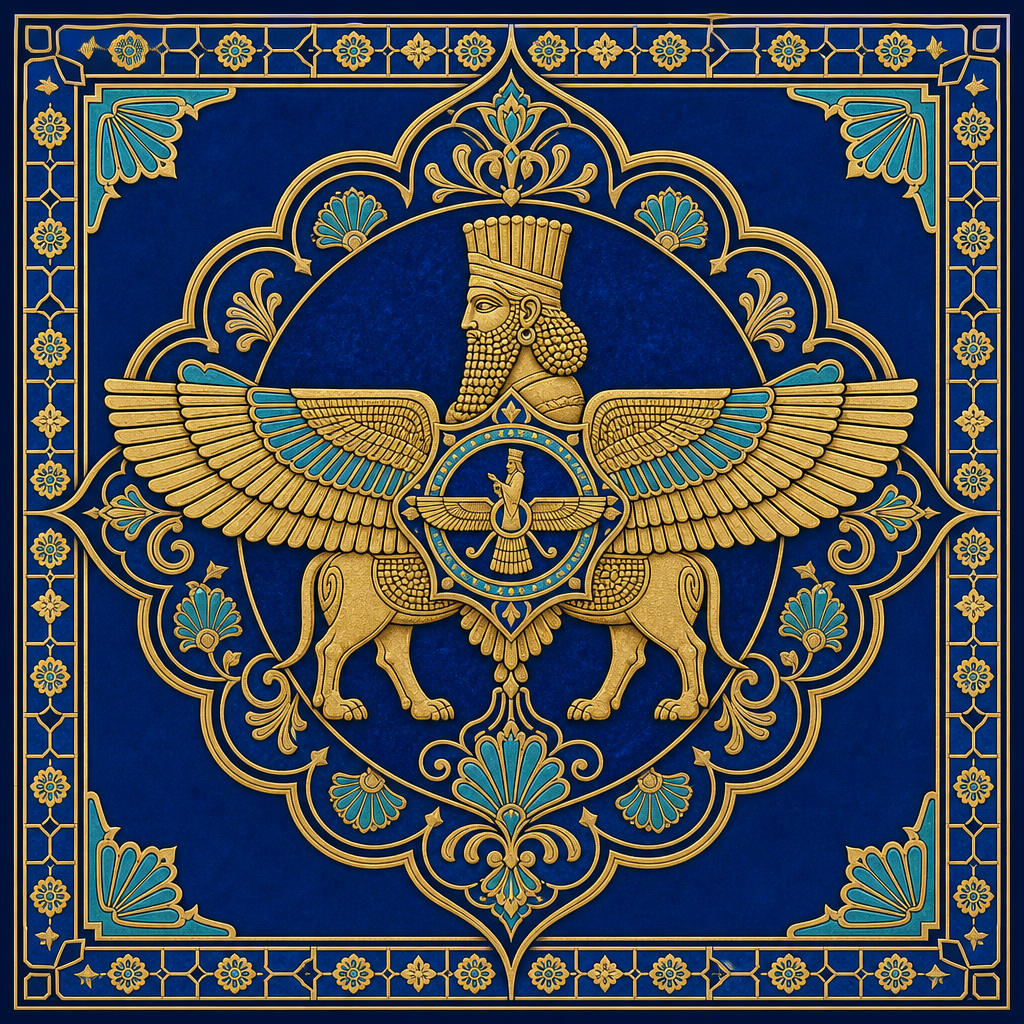
The Cyrus Cylinder: Achaemenid Proclamation and Global Symbol
An Examination of the Ancient Artifact and its Modern Interpretation
Discovered in 1879, the Cyrus Cylinder is a 6th-century BCE clay artifact bearing a declaration by Cyrus the Great after his conquest of Babylon. This article explores its historical context as a traditional Mesopotamian royal proclamation and examines its modern evolution into a celebrated, albeit debated, symbol of human rights and tolerance.

In the annals of archaeology, few objects have captured the global imagination quite like the Cyrus Cylinder. A modest, football-shaped barrel of baked clay, inscribed with Akkadian cuneiform, it was created following the conquest of Babylon in 539 BCE by the Persian king Cyrus the Great. Buried for nearly 2,500 years in the foundations of the ancient city, it was unearthed in 1879 by an expedition sponsored by the British Museum, where it remains a centerpiece collection item. The text on the cylinder is a royal proclamation, a declaration of intent by a new ruler to his new subjects. Yet, over the last century, this ancient artifact has been imbued with a powerful modern meaning, hailed by many as the world's first charter of human rights. This article seeks to navigate the complex identity of the Cyrus Cylinder, examining its original purpose within the long tradition of Mesopotamian statecraft and charting its remarkable journey to becoming a potent international symbol of freedom and tolerance.
Conquest and Context: The Fall of Babylon
To understand the Cyrus Cylinder's message, one must first understand the world into which it was introduced. The mid-6th century BCE was a period of profound geopolitical change in the Near East. The once-mighty Neo-Babylonian Empire, which had reached its zenith under Nebuchadnezzar II, was in a state of precipitous decline under its last king, Nabonidus (r. 556–539 BCE). Nabonidus was an unconventional ruler whose religious policies alienated the powerful and conservative priesthood of Babylon. He promoted the cult of the moon god Sîn, whose main temple was in Harran, over that of Marduk, the traditional patron deity of Babylon. Nabonidus spent a decade of his reign in self-imposed exile at the oasis of Tayma in Arabia, leaving his son Belshazzar as regent in Babylon. This prolonged absence and deviation from religious orthodoxy created widespread discontent among the Babylonian elite and populace, who viewed his actions as impious and neglectful.
Meanwhile, a new power was rising in the east. Cyrus II, known as Cyrus the Great, ascended the throne of the small Persian kingdom of Anshan, a vassal state of the Median Empire, around 559 BCE. Through a combination of brilliant military strategy and skilled diplomacy, Cyrus overthrew his Median overlord, Astyages, in 550 BCE, uniting the Medes and Persians under his rule and founding the Achaemenid Empire. Over the next decade, he expanded his domains dramatically, conquering the Lydian Kingdom in Anatolia and extending his control over much of Central Asia. By 539 BCE, Cyrus set his sights on the wealthy and strategically vital prize of Babylonia. The Achaemenid army advanced, and after a decisive battle at Opis on the Tigris River, the city of Babylon surrendered with little to no resistance. Ancient sources, including the cylinder itself and the contemporary Babylonian Chronicle, suggest that Cyrus was welcomed as a liberator by a population eager to be rid of the unpopular Nabonidus. This context of a 'peaceful' conquest, facilitated by internal dissent, is crucial for interpreting the cylinder as an instrument of political legitimation.
The Artifact: Inscription and Content
The Cyrus Cylinder is a remarkable document written in the formal, archaizing Akkadian language used for royal inscriptions in Babylonia. The text, structured as a first-person narrative in the voice of Cyrus, can be divided into several thematic sections. It begins with a scathing indictment of Nabonidus, portraying him as an incompetent and sacrilegious tyrant who brought ruin upon his own people. He is accused of imposing forced labor, neglecting the gods, and removing religious statues from their temples. This section functions as classic political propaganda, justifying the overthrow of the previous regime by cataloging its failures.
The narrative then pivots to present Cyrus as the divinely chosen instrument of salvation. It states that Marduk, the chief god of Babylon, scanned all the lands in search of a righteous ruler and, finding Cyrus, took him by the hand and called him by name to become the ruler of the world. According to the text, Marduk commanded Cyrus to march on Babylon and, like a friend and companion, walked at his side, allowing his army to enter the city without a battle. This divine endorsement was essential for Cyrus, a foreigner, to establish his legitimacy in the eyes of the conquered Babylonians. By casting himself as the chosen agent of their primary deity, he seamlessly inserted himself into their theological and political framework.
The Royal Decrees
The most significant portion of the cylinder details the policies Cyrus enacted upon taking power. These decrees form the basis for its modern interpretation as a human rights charter. Cyrus proclaims that he would guarantee the safety of the city of Babylon and its sanctuaries. He declared, 'I have ... sought the welfare of the city of Babylon and all its sacred centers.' Critically, he announces the repatriation of peoples who had been deported by previous Babylonian kings. He states, 'I gathered all their former inhabitants and returned them to their habitations.' Additionally, he ordered the return of the divine statues that Nabonidus had collected in Babylon to their original shrines throughout Mesopotamia and western Iran. The cylinder concludes with a description of Cyrus's building activities in Babylon and a prayer for him and his son Cambyses, solidifying its function as a foundation deposit commemorating the restoration of the city's walls.
Continuity and Tradition in Ancient Mesopotamia
While the scale of Cyrus's actions was unprecedented, the form and much of the content of his proclamation were not. The Cyrus Cylinder belongs to a long-established Mesopotamian literary genre of royal inscriptions and foundation deposits. For millennia, kings in Assyria and Babylonia had commissioned similar texts to commemorate their building projects, military victories, and pious deeds. These artifacts were typically buried in the foundations or walls of temples and palaces to be read by the gods and by future kings who might unearth them during later renovations.
Many of the rhetorical elements found in the Cyrus Cylinder have direct precedents. For example, Assyrian kings like Ashurbanipal (r. 668–631 BCE) and the Babylonian king Merodach-Baladan II (r. 722-710 & 703 BCE) also produced cylinder inscriptions that vilified their enemies, proclaimed their own divine selection, and detailed their restoration of temples. The practice of a conqueror portraying himself as a restorer rather than a destroyer was a common trope used to legitimize a change in dynasty. What distinguishes Cyrus's proclamation is the vast, multi-ethnic scope of his policies. While an Assyrian king might return the gods of a conquered city, Cyrus was decreeing the repatriation of numerous distinct peoples across a sprawling empire, a policy of a different magnitude that reflects the novel challenge of governing his vast new territories.
| Ideological Theme | Cyrus Cylinder (Achaemenid, 539 BCE) | Nabonidus Cylinder (Neo-Babylonian, c. 550 BCE) | Sennacherib Prism (Neo-Assyrian, c. 690 BCE) |
|---|---|---|---|
| Divine Mandate | Explicitly chosen by Marduk to restore order. | Chosen by Sîn and Ningal to restore temples. | Supported by Ashur and Ishtar in military campaigns. |
| Denunciation of an Opponent | Denounces the impiety of the previous king, Nabonidus. | Implicitly criticizes previous neglect of Sîn's temple. | Denounces the treachery of the king of Babylon. |
| Restoration of Temples | Pledges to restore sanctuaries in Babylon and other cities. | Details extensive restoration of the Ehulhul temple in Harran. | Describes the rebuilding of Nineveh and its temples. |
| Military Narrative | Emphasizes a peaceful, non-violent takeover of Babylon. | Focuses entirely on pious building works, no military content. | Provides a detailed, brutal account of military campaigns and sieges. |
| Return of Exiled Peoples | Explicitly states the gathering and return of deported peoples to their homes. | Absent. | Describes the mass deportation of peoples as a tool of state policy. |
| Return of Cult Statues | Orders the return of divine statues to their original shrines. | Absent. | Records the capture of enemy gods as spoils of war. |
The Modern Reinterpretation: A Charter of Human Rights?
The transformation of the Cyrus Cylinder from a piece of ancient political propaganda to a global icon of human rights is a distinctly 20th-century phenomenon. This interpretation largely began in the run-up to the '2,500-year celebration of the Persian Empire' organized by Iran's last monarch, Mohammad Reza Pahlavi, in 1971. The Pahlavi dynasty sought to construct a powerful narrative of Iranian national identity based on a continuous, glorious pre-Islamic history. The Cyrus Cylinder was presented as the cornerstone of this legacy, portraying Cyrus the Great not merely as a conqueror but as an enlightened ruler who established principles of religious freedom, ethnic tolerance, and the abolition of slavery.
During the 1971 celebrations, the cylinder was loaned to Iran and a replica was presented to the United Nations, where it is still displayed with a translation highlighting its 'human rights' aspects. This narrative has been immensely popular and influential. However, most historians of the ancient Near East view this interpretation as anachronistic. They argue that the modern concept of individual 'human rights' would have been unintelligible in the 6th century BCE. The cylinder's text does not, for instance, abolish slavery as an institution, but rather ends a specific forced labor project in Babylon, a common royal act of goodwill. Its religious toleration was a policy of statecraft aimed at co-opting local elites and deities, not a declaration of an individual's right to freedom of conscience. The strongest parallel is the policy of repatriation, famously corroborated by the biblical Book of Ezra, which credits Cyrus with allowing Jewish exiles to return to Judah from Babylonia and rebuild their Temple in Jerusalem. While a remarkable policy, it was framed as a collective right granted by the king, not an inalienable individual one.
The cylinder was discovered in March 1879 by Assyriologist Hormuzd Rassam.
It is made of baked clay and inscribed in Akkadian cuneiform script.
The cylinder's policy of repatriation is seen as independent confirmation of the events described in the Hebrew Bible (e.g., Ezra 1:1-4).
In 2010, two fragments from the British Museum's collection of cuneiform tablets were identified as belonging to the same inscription, adding several lines to the text.
Legacy in the 21st Century
Despite the academic debate, the power of the Cyrus Cylinder as a symbol has only grown. It has become a touchstone for Iranian identity, both inside Iran and in the diaspora, celebrated as proof of a long-standing cultural heritage of justice and tolerance. Its popular interpretation has transcended its original context. When the British Museum loaned the cylinder for exhibitions in the United States in 2013, it drew record crowds, demonstrating a widespread fascination with the object and the ideals it has come to represent. Speakers from Thomas Jefferson to former UN Secretary-General Ban Ki-moon have referenced it as a foundational document in the long story of human rights.
Ultimately, the Cyrus Cylinder occupies a unique dual space. For historians, it remains a primary source of immense value, a specific text from a specific time and place, offering unparalleled insight into Achaemenid ideology and the art of ancient imperial governance. For the wider world, it has become something more—a symbol whose meaning has evolved far beyond its creator's intent. While not a 'human rights charter' in the modern legal sense, its core message of a ruler choosing peace over destruction, restoration over oppression, and respect for diverse traditions over forced conformity, continues to resonate powerfully. It stands as a testament to the ability of an ancient object to inspire modern aspirations for a more just and tolerant world, proving that the legacy of an artifact is written not only by its creators but also by the generations who inherit and interpret it.
Cyrus II accedes to the throne of Anshan, beginning his rise to power.
Frequently asked questions
What is the Cyrus Cylinder?
The Cyrus Cylinder is a clay artifact from the 6th century BCE, inscribed with a declaration by Cyrus the Great of Persia. Discovered in the ruins of Babylon in 1879, it records his conquest of the city and outlines his policy of restoring temples and repatriating displaced peoples.
What does the text on the Cyrus Cylinder say?
The Akkadian cuneiform text describes Cyrus's victory over the previous Babylonian king, Nabonidus, whom it portrays as impious. It declares Cyrus's intent to respect the traditions of Babylon, restore religious cults, and allow deported populations to return to their homelands, presenting him as a just and divinely-supported ruler.
Is the Cyrus Cylinder the first declaration of human rights?
This is a popular but debated modern interpretation. Most historians view the cylinder as a traditional Mesopotamian proclamation intended to legitimize a new king's rule, not a universal declaration of rights. While its policies were tolerant for the era, the concept of individual 'human rights' did not exist in the ancient world.
Why is the Cyrus Cylinder important today?
The Cyrus Cylinder has evolved into a powerful global symbol of tolerance, multiculturalism, and just leadership. It is often cited in discussions about governance and human rights, even though scholars emphasize its primary function was as a piece of royal Achaemenid propaganda.
When and where was the Cyrus Cylinder discovered?
The Cyrus Cylinder was discovered in March 1879 by Assyriologist Hormuzd Rassam during a British Museum excavation. It was found in the foundations of the Esagila, the main temple of the god Marduk in the ancient city of Babylon (modern-day Iraq).
Where is the original Cyrus Cylinder located?
The original Cyrus Cylinder is permanently housed in the British Museum in London. It is a centerpiece of its collection and has occasionally been loaned for international exhibitions, underscoring its worldwide cultural significance.