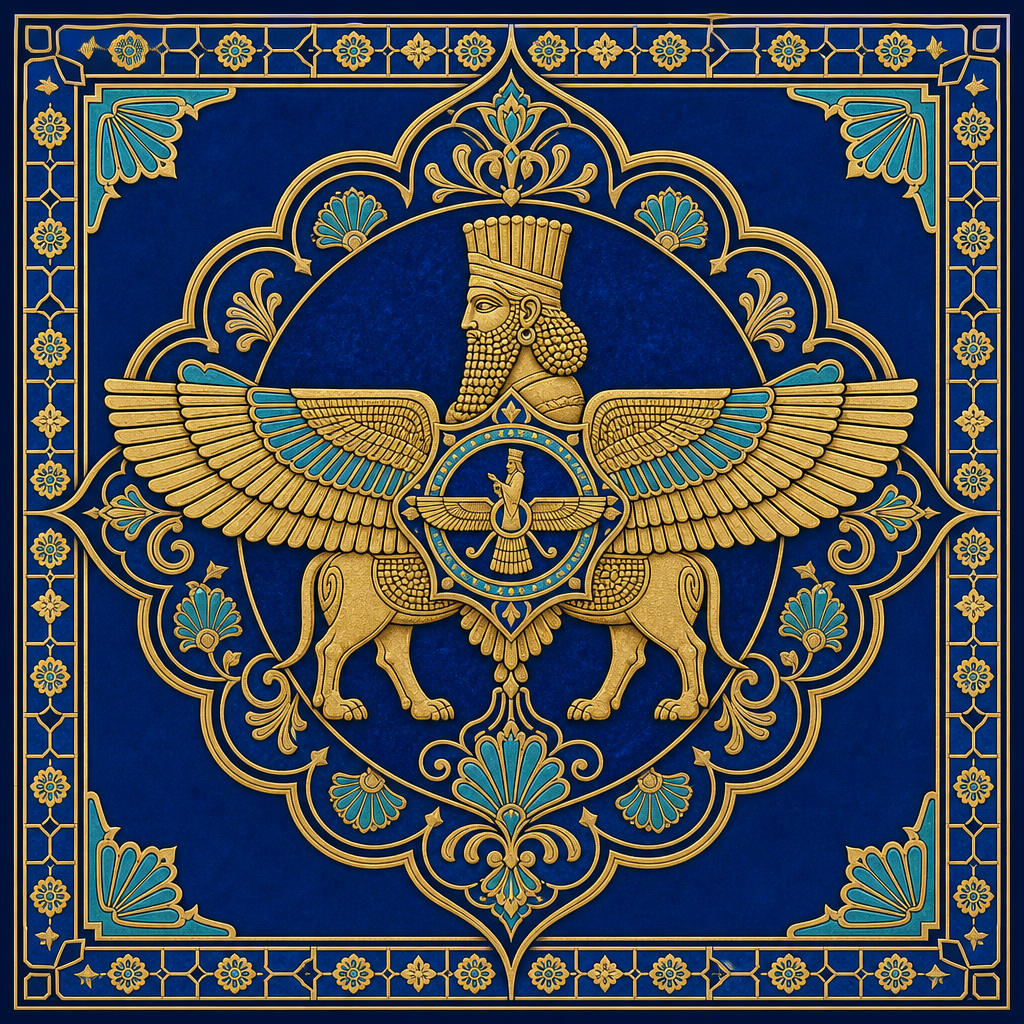

The Cyrus Cylinder
A clay barrel inscribed after Cyrus the Great's conquest of Babylon, declaring freedom of worship and the return of captive peoples — the world's first charter of rights.
A clay barrel from Babylon
The Cyrus Cylinder is a barrel-shaped object of baked clay, 22.5 cm long and 10 cm in diameter, inscribed in 45 lines of Akkadian cuneiform. It was buried as a foundation deposit in the wall of the temple of Marduk in Babylon shortly after the Persian conquest of the city in October 539 BCE, and unearthed by Hormuzd Rassam in 1879. It now sits in Room 52 of the British Museum as object number 90920.
Two further fragments of the same text were later identified on a clay tablet at Yale, confirming that the inscription was copied and circulated — the Cylinder is the surviving foundation copy of a public proclamation by the new Persian king.
What the Cylinder says
"I returned to these sacred cities on the other side of the Tigris, the sanctuaries of which had been in ruins for a long time, the images which used to live therein, and established for them permanent sanctuaries. I also gathered all their former inhabitants and returned to them their habitations."
The text presents Cyrus as chosen by Marduk to restore the cult of Babylon after the misrule of Nabonidus, and lists his policies: peoples deported to Babylonia are sent home; gods carried off as trophies are restored to their temples; sanctuaries from Assur and Susa to the cities of the Tigris are rebuilt; no army enters the city in violence.
The fall of Babylon, 539 BCE
| Date | Event |
|---|---|
| 550 BCE | Cyrus II defeats Astyages, founds the Achaemenid Empire |
| 547 BCE | Conquest of Lydia and capture of Croesus at Sardis |
| 12 Oct 539 BCE | Battle of Opis; Persian army enters Babylon without resistance |
| 29 Oct 539 BCE | Cyrus enters Babylon in person, hailed as liberator |
| 538 BCE | Edict of return: Jewish exiles authorised to rebuild Jerusalem (Ezra 1) |
| c. 538 BCE | Foundation deposit of the Cylinder placed in Esagila |
From Babylon to the United Nations
The Cylinder lay buried for 2,400 years. After Rassam's discovery in 1879 it became, for the 20th century, the most famous object of ancient Iran. In 1971 the Shah of Iran presented a replica to UN Secretary-General U Thant; it remains on display on the second floor of UN Headquarters in New York, labelled as an ancient declaration of human rights. The original travelled to Tehran on loan from the British Museum in 2010, drawing over half a million visitors in four months.
539 BCE
Cyrus the Great captures Babylon
22.5 cm
Length of the baked-clay barrel
45 lines
Of Akkadian cuneiform inscription
1879
Discovered by Hormuzd Rassam in Babylon
1971
UN displays a replica in New York
29 Oct
Cyrus the Great Day — observed by Iranians worldwide
The object in numbers
The Cylinder is a modest thing to have carried so much argument: a barrel-shaped lump of baked clay, broken in antiquity, and recovered in pieces over more than a century.
| Property | Detail |
|---|---|
| Material | Baked clay, foundation deposit type |
| Dimensions | 21.9 cm long, 10 cm maximum diameter |
| Script and language | Neo-Babylonian cuneiform, Akkadian |
| Lines of text | 45 surviving, of an estimated 45–50 |
| Found | Marduk temple mound, Babylon, March 1879, by Hormuzd Rassam |
| Held | British Museum, London (BM 90920), Room 52 |
| Fragment B | Yale Babylonian Collection, joined to the reading in 1970 |
| Duplicate tablet | Two fragments identified in the British Museum in 2010, proving wider circulation |
The 2010 identification mattered: it showed the text was not a one-off foundation deposit but a proclamation copied and distributed, closer to a public decree than a hidden dedication.
The text, section by section
| Lines | Content | Rhetorical purpose |
|---|---|---|
| 1–19 | Nabonidus condemned for neglecting Marduk and oppressing Babylon | Delegitimise the previous king |
| 20–22 | Marduk searches the lands and chooses Cyrus | Divine mandate |
| 22–34 | Cyrus enters Babylon peacefully; titles and genealogy back to Teispes | Legitimacy and continuity |
| 30–36 | Restoration of sanctuaries and return of divine statues to their cities | The famous 'tolerance' passage |
| 32–36 | Deported peoples returned to their settlements | Reversal of Assyro-Babylonian policy |
| 38–45 | Repair of Babylon's Imgur-Enlil wall; discovery of an Ashurbanipal inscription | Placing Cyrus in a royal building tradition |
Is it the first charter of human rights?
The claim was popularised in 1971, when Mohammad Reza Shah presented a replica to the United Nations for the 2,500th anniversary of the Persian Empire. Scholars have contested it ever since; the disagreement is worth stating in full rather than settling by slogan.
| Argument for | Argument against |
|---|---|
| Restores deported peoples to their homelands | Applies to specific Mesopotamian communities, not a universal principle |
| Restores sanctuaries and cult statues | A conventional act of Mesopotamian royal piety, paralleled by Assyrian kings |
| Frames rule as consent rather than conquest | Written by the conqueror's scribes as accession propaganda |
| Coincides with the biblical return from exile | The Cylinder never mentions Judah, Jerusalem or the Jews |
| Marks a policy of local religious autonomy | Achaemenid policy was pragmatic administration, not declared rights |
The British Museum's own position is measured: the Cylinder is not a human-rights charter in the modern sense, but it does record a genuine and unusually documented shift in imperial practice toward the peoples Cyrus absorbed.
The cylinder and its world
A baked-clay barrel of cuneiform from 539 BCE Babylon, today in Room 52 of the British Museum.


Photographs and museum plates reproduced from Wikimedia Commons and public-domain collections.
Tolerance, Law and the Freed Exile: How Persia Ruled Differently
Cyrus is remembered less for what he conquered than for what he chose not to destroy. Babylon fell in 539 BCE without a sack; its temples kept their priesthoods, its gods were carried home to the cities Nabonidus had emptied, and the deported communities held there — the Judeans among them — were told to go home and rebuild their sanctuaries at royal expense. Set that beside the Assyrian practice of mass deportation that preceded it, and the difference is not rhetoric but policy.
The evidence is not Persian propaganda alone. The Hebrew Bible, written by the beneficiaries and not by the court, calls Cyrus 'the Lord's anointed' — the only foreign king so named. The Babylonian priesthood, whose own city had just been taken, welcomed him in its temple chronicle. Greek writers who fought Persia, from Xenophon to Aeschylus, still portrayed its kings as bound by justice. Independent, sometimes hostile, sources converge.
| Practice | Assyria / Babylonia | Athens & Rome | Achaemenid Persia |
|---|---|---|---|
| Conquered populations | Mass deportation as standard policy; whole communities resettled to break identity | Cities razed and populations sold — Melos 416 BCE, Carthage 146 BCE, Jerusalem 70 CE | Repatriation of earlier deportees; peoples returned to ancestral lands (Cyrus Cylinder, lines 30–34) |
| Local religion | Cult statues carried off to Assur or Babylon as trophies | Roman triumph paraded captured gods; Jewish Temple treasure taken to Rome | Statues returned to their own shrines; temple rebuilding funded from the treasury (Ezra 6:8–10) |
| Language & law | Akkadian imposed as administrative language | Latin and Greek as the language of courts and citizenship | Trilingual inscriptions; Aramaic chancery; Egyptian, Babylonian and Judean law codified locally |
| Labour | War captives as forced labour on state building projects | Chattel slavery central: c. 20,000 in the Laurion mines; up to a third of Italy enslaved | Paid kurtaš workforce on rations; no large slave-worked estates recorded in the Persepolis archive |
| Women's standing | Property rights limited and largely dynastic | Athenian women legally minors under a male guardian for life | Women hold estates, run workshops, receive maternity rations, seal their own administrative orders |
| Rulers' self-presentation | Reliefs of flayings, impalements and heaped heads | Triumphs displaying chained captives | Bisotun and Persepolis show subject nations carrying the throne, in their own dress, unbound |
Two details are worth pausing on, because they are documentary rather than literary. The first is the Persepolis Fortification Archive, discovered in 1933 and comprising tens of thousands of Elamite and Aramaic tablets recording rations paid out between 509 and 493 BCE. It is an accounting record — nobody wrote it to be admired — and it shows women drawing wine and grain in their own names, mothers receiving a bonus ration after childbirth, and skilled female supervisors paid more than unskilled men. The second is the Elephantine papyri from a Judean garrison in Upper Egypt, whose soldiers wrote to the Persian satrap for permission to rebuild their temple and got it.
539 BCE
Babylon taken without a sack; the Cyrus Cylinder records the return of gods and peoples to their own cities.
538 BCE
Judean exiles permitted to return to Jerusalem; the Second Temple is completed in 516 BCE with Persian funding.
c. 518 BCE
Darius I commissions the codification of Egyptian law, in Egyptian and Aramaic, by Egyptian priests.
30,000+ tablets
The Persepolis Fortification Archive: a paid, rationed workforce — women included — not a slave register.
None of this makes the Achaemenid Empire a modern democracy. It was a monarchy that taxed hard, punished rebellion severely — Bisotun says so plainly — and knew household servitude and war captivity. Honest history does not need the myth. What it does show is that a large multi-ethnic state could be run, deliberately and for two centuries, on the principle that subject peoples keep their gods, their courts, their language and their homes. That principle was a choice, and other empires of the same centuries chose otherwise.
- Cyrus Cylinder (British Museum, BM 90920): the returned cult statues and the rebuilt sanctuaries of Ashur, Susa, Akkad and the cities of the Zagros.
- Ezra 6:8–10: Darius orders the cost of the Jerusalem Temple paid from the royal revenue of Beyond-the-River, with animals supplied for sacrifice.
- Isaiah 45:1: Cyrus called 'anointed' — the sole non-Jewish figure given that title in the Hebrew Bible.
- The Udjahorresnet inscription: Cambyses and Darius restore the temple of Neith at Sais and re-endow its priesthood after wartime damage.
- Elephantine papyri (5th century BCE): a Judean garrison in Egypt petitions the satrap Bagavahya and receives authorisation to rebuild its temple.
- Irdabama and Artystone: royal women with their own estates, seals, workshops and letter-carriers in the Persepolis tablets.
- Bisotun and the Apadana reliefs: twenty-three subject nations depicted upright, armed, in their own national dress — not chained, not kneeling.
Read alongside the Cyrus Cylinder, the Persepolis archive and the Judean and Egyptian documents, the conclusion is narrow but firm: not all empires were the same, and the difference was visible to the people who lived under them.
Frequently asked questions
Related reading
Founder of the Achaemenid Empire — conquest of Media, Lydia and Babylon, the Cyrus Cylinder, and the tomb at Pasargadae.
Achaemenid, Parthian, Sassanid, Safavid, Qajar — six successive Iranian empires.
Parsa, the ceremonial capital of the Achaemenid Empire — Apadana, Gate of All Nations, 23 satrapies, and Alexander's fire of 330 BCE.
From Elam and the Medes to the modern era — a continuous 5,000-year story.
How Persia shaped the modern world — quotes from Hegel, Nietzsche, Goethe.
Zoroastrianism, Mithraism, Manichaeism, Sufism, Bahá'í — historical heritage.
References
- ↗ British Museum — The Cyrus Cylinder (object 90920)
- ↗ Irving Finkel, The Cyrus Cylinder: The King of Persia's Proclamation from Ancient Babylon (I. B. Tauris, 2013)
- ↗ Encyclopædia Iranica — Cyrus Cylinder
All imagery is sourced from Wikimedia Commons, public-domain museum collections (British Museum, Louvre, Metropolitan Museum of Art, National Museum of Iran), or UNESCO World Heritage records. No AI-generated images are used. Scholarly text is synthesized from Encyclopædia Iranica, the Cambridge History of Iran, and peer-reviewed publications.