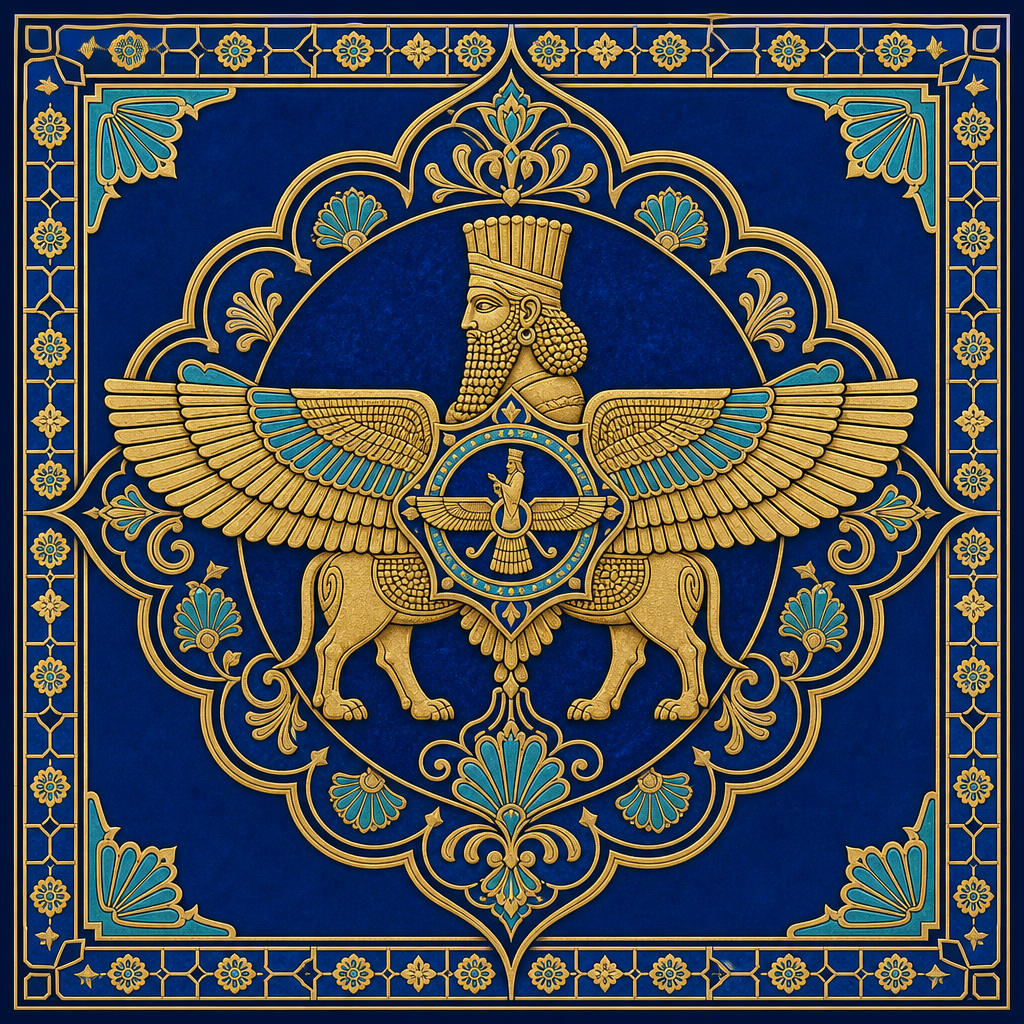

Ferdowsi
The poet who spent thirty years writing the 50,000-couplet Shāhnāmeh — the Book of Kings — and in doing so rescued the Persian language from extinction under Arabic.
The poet of Tus
Abu'l-Qāsem Ferdowsi was born around 940 CE in the village of Paj near Tus, then a flourishing city of greater Khorasan and a centre of the Iranian cultural revival under the Samanid dynasty. He was a dehqān, a member of the rural Persian landowning class that preserved the pre-Islamic national memory after the Arab conquest. He began work on the Shāhnāmeh around 977 CE, basing it on a now-lost prose Khwadāy-Nāmag tradition compiled under the late Sassanians.
He completed the poem in 1010 CE — thirty-three years later — and presented it to Sultan Mahmud of Ghazna. The reward was famously small; tradition holds that Ferdowsi gave the money to a bath attendant and a beer-seller and returned to Tus embittered. He died there around 1020 CE.
The Shāhnāmeh
The Shāhnāmeh — "The Book of Kings" — is the longest epic poem ever composed by a single author: roughly 50,000 couplets (bayt) in the motaqāreb metre. It tells the story of Iran across three ages: the mythological(Kayumars, Jamshid, Zahhak), the heroic (Rostam, Sohrāb, Esfandiār, Bīžan and Manīžeh), and the historical (the Sassanian kings from Ardashir to Yazdgerd III and the Arab conquest of 651 CE).
"I shall not die, for I have sown the seed of the word — whoever has reason, religion and faith will, after my passing, sing my praise."
| Section | Era | Key figures |
|---|---|---|
| Mythological | Creation → 1000s BCE | Kayumars (first king), Jamshid, Fereydun, Zahhak |
| Heroic | Pre-Achaemenid legendary past | Rostam, Sohrāb, Esfandiār, Siyāvash, Bīžan |
| Historical | Achaemenid → Sassanian (to 651 CE) | Alexander (Sekandar), Ardashir I, Khosrow Anushirvan, Yazdgerd III |
The language he saved
By Ferdowsi's lifetime, three centuries after the Arab conquest, Persian had been displaced from administration and high literature by Arabic. Ferdowsi made a deliberate decision: he composed the Shāhnāmeh almost entirely in pure Persian vocabulary, avoiding Arabic loanwords where a Persian word existed. The poem's prestige restored Persian as the literary language of Iran, and as the court language of every subsequent empire from the Ghaznavids and Seljuks to the Mughals of India and the Ottomans of Turkey.
50,000 couplets
Longest epic by a single author in any language
33 years
Of continuous composition (977–1010 CE)
62 stories
Across mythological, heroic and historical cycles
~5%
Arabic loanwords — extraordinarily low for the 10th century
1934
Monumental tomb built at Tus for the poet's millennium
15 May
Ferdowsi Day in Iran — Ordibehesht 25 in the Persian calendar
The three ages of the Shāhnāmeh
Ferdowsi's fifty thousand couplets are not a single narrative but three, arranged as a descent from myth into recorded history — a structure the poet inherited from the lost Sasanian Khwaday-Namag, the Book of Lords.
| Age | Span in the text | Content | Key figures |
|---|---|---|---|
| Mythical | ~2,100 couplets | The first kings, the invention of fire, weaving and law; the tyranny of Zahhak | Keyumars, Jamshid, Zahhak, Fereydun, Kaveh |
| Heroic | ~33,000 couplets | The Sistan cycle and the wars with Turan; roughly two-thirds of the poem | Rostam, Sohrab, Siyavash, Esfandiyar, Afrasiyab |
| Historical | ~15,000 couplets | Alexander to the Arab conquest, largely following Sasanian chronicle | Sekandar, Ardashir, Bahram Gur, Khosrow, Yazdegerd III |
The seam between the second and third ages falls at the death of Rostam. From that point the register changes: fewer marvels, more court intrigue, and a mounting sense of approaching catastrophe that ends with Yazdegerd III murdered in a mill.
Six episodes everyone in Iran knows
Zahhak and Kaveh
A serpent-shouldered tyrant overthrown when a blacksmith raises his leather apron as a banner — still an emblem of revolt.
Rostam and Sohrab
A father kills his son in single combat without recognising him; the Persian tragedy par excellence.
Siyavash
An innocent prince proves his chastity by riding through fire, then is murdered in exile; his blood grows a plant.
Bijan and Manijeh
A love story across the Iran–Turan border, the section Ferdowsi says he wrote first.
The Seven Trials
Rostam's seven labours, from lion to dragon to the White Div of Mazandaran.
Rostam and Esfandiyar
A duel between two men who both know it is unjust — Ferdowsi's darkest meditation on obedience.
From manuscript to naqqāli
The Shāhnāmeh has never been only a book. It was recited in coffee-houses by naqqāls — professional storytellers working from prompt-books and painted screens — and performed in the Zurkhaneh, the traditional Iranian gymnasium, where the drummer chants Rostam's exploits to set the rhythm of exercise.
| Form | Period | Note |
|---|---|---|
| Naqqāli storytelling | Safavid to present | Inscribed by UNESCO on the Urgent Safeguarding list, 2011 |
| Coffee-house painting | Qajar, 19th c. | Large narrative canvases of Rostam's battles |
| Zurkhaneh recitation | Safavid to present | Verses chanted over the zarb drum during ritual exercise |
| Ta'ziyeh crossover | Qajar | Epic metre and lament borrowed into religious passion plays |
| Translation | 1832 onward | Atkinson, Mohl, Warner, Levy, Davis; Dick Davis's verse-and-prose version is standard in English |
The Shahnameh in pictures
From the tomb at Tus to illuminated folios of the Bayasanghori, Baysunghur and Bahram cycles.


Photographs and museum plates reproduced from Wikimedia Commons and public-domain collections.
Frequently asked questions
Related reading
Ferdowsi, Hafez, Rumi, Saadi, Nizami, Khayyam — the masters of Persian verse.
Three thousand years of Persian — Old, Middle, New — and the Persian words in English.
The supreme lyric poet of Persian — 500 ghazals, the fāl-e Hafez tradition, and the poet Goethe called his twin.
Persian-language Sufi master of Konya, author of the Masnavi and Divan-e Shams, and the best-selling poet in the United States.
Mathematician, astronomer and poet of Nishapur — the Jalali calendar, the cubic equation, the Rubaiyat.
How Persia shaped the modern world — quotes from Hegel, Nietzsche, Goethe.
References
- ↗ Encyclopædia Iranica — Ferdowsi (Djalal Khaleghi-Motlagh)
- ↗ Dick Davis (tr.), Shahnameh: The Persian Book of Kings (Penguin Classics, 2006)
- ↗ The Shahnama Project, University of Cambridge
All imagery is sourced from Wikimedia Commons, public-domain museum collections (British Museum, Louvre, Metropolitan Museum of Art, National Museum of Iran), or UNESCO World Heritage records. No AI-generated images are used. Scholarly text is synthesized from Encyclopædia Iranica, the Cambridge History of Iran, and peer-reviewed publications.