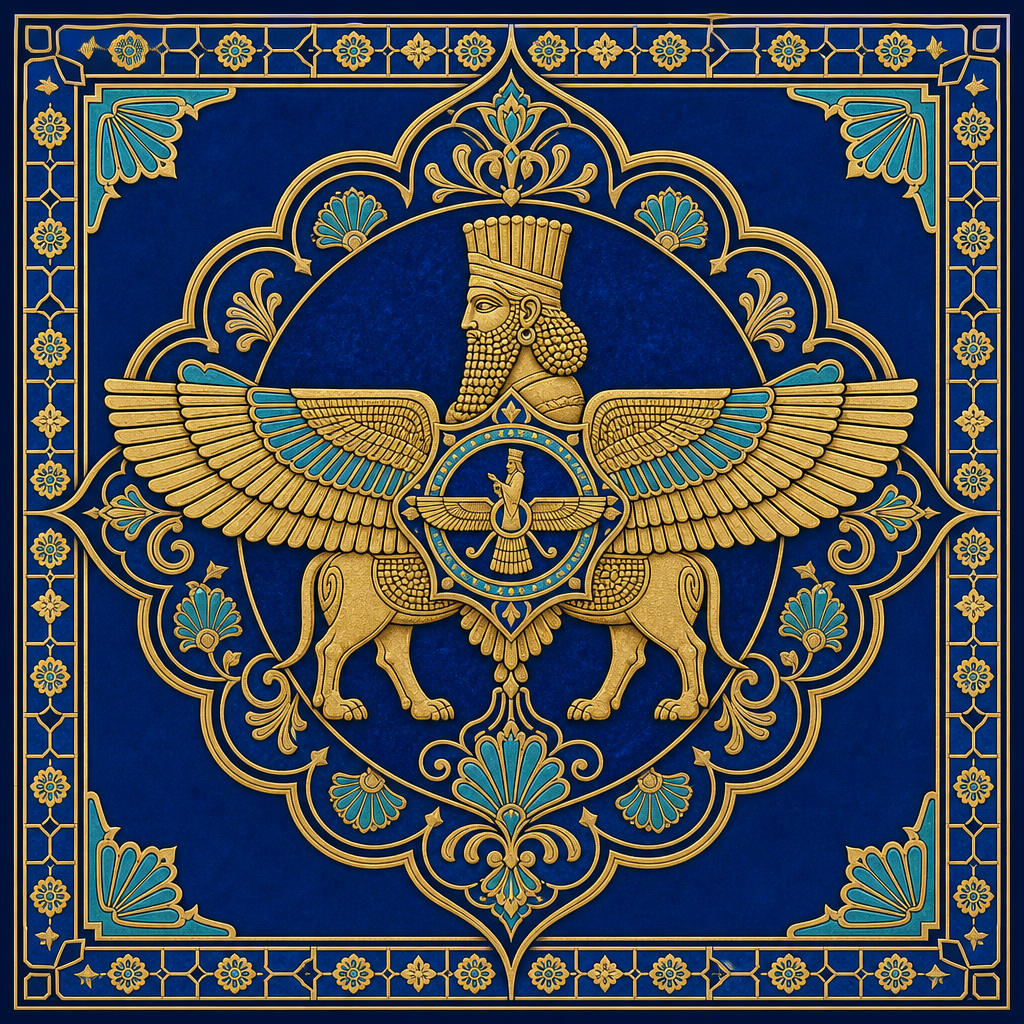
Persian Arts & Crafts
Persian art is overwhelmingly an art of surface and pattern: the carpet, the tiled dome, the illuminated page and the inlaid box all solve the same problem of covering a plane with disciplined, infinitely extendable geometry.
Read this hub in PersianTwo constraints shaped the tradition. First, the workshop system: a royal kitābkhāna employed paper-makers, gilders, painters, calligraphers and binders under one master, so a single manuscript is a collective object. Second, the modular grid: knot counts, tile shapes and script proportions were standardised, letting patterns scale from a book page to a courtyard.
The performing tradition follows the same logic — the radif is a memorised repertoire of modal figures the musician recombines rather than a fixed score.
Quick answers
- What makes a Persian carpet valuable?
- Knot density (fine Isfahan and Qom silk carpets exceed a million knots per square metre), natural dyes, wool or silk quality, and the coherence of the design school.
- What is nastaʿlīq?
- The hanging, cursive script developed in 14th-century Iran and considered the bride of Persian calligraphy; it is the standard script for Persian poetry.
- What is a Persian miniature?
- A painting made for a manuscript page, in opaque watercolour and gold, with no linear perspective and a high viewpoint — the Herat and Tabriz schools are the classic centres.
- What is the radif?
- The canonical repertoire of Persian classical music: some 250 short modal pieces organised into twelve dastgāh, memorised in full by every serious musician.
Explore the hub
Craft
The applied arts and their workshops.
Performance and image
Music, photography and the visual record.
Frequently asked questions
Which city makes the best carpets?
There is no single answer — Tabriz, Kashan, Isfahan, Qom, Kerman and Nain are each canonical schools with distinct palettes, knots and motifs; Qom and Isfahan silk carpets are the finest by knot count.
Why are there few Persian figurative sculptures?
Monumental relief carving thrived in the pre-Islamic period (Persepolis, Naqsh-e Rostam, Taq-e Bostan); after the Islamic conquest, artistic energy moved into two-dimensional pattern, architecture and the book arts.
Are these crafts still practised?
Yes. Carpet weaving, tilework, khatam marquetry, mina enamel and calligraphy are all living professions, several with UNESCO intangible-heritage status.
What are the Persian instruments?
Tār, setār, santur, kamāncheh, ney and tombak form the core of the classical ensemble.