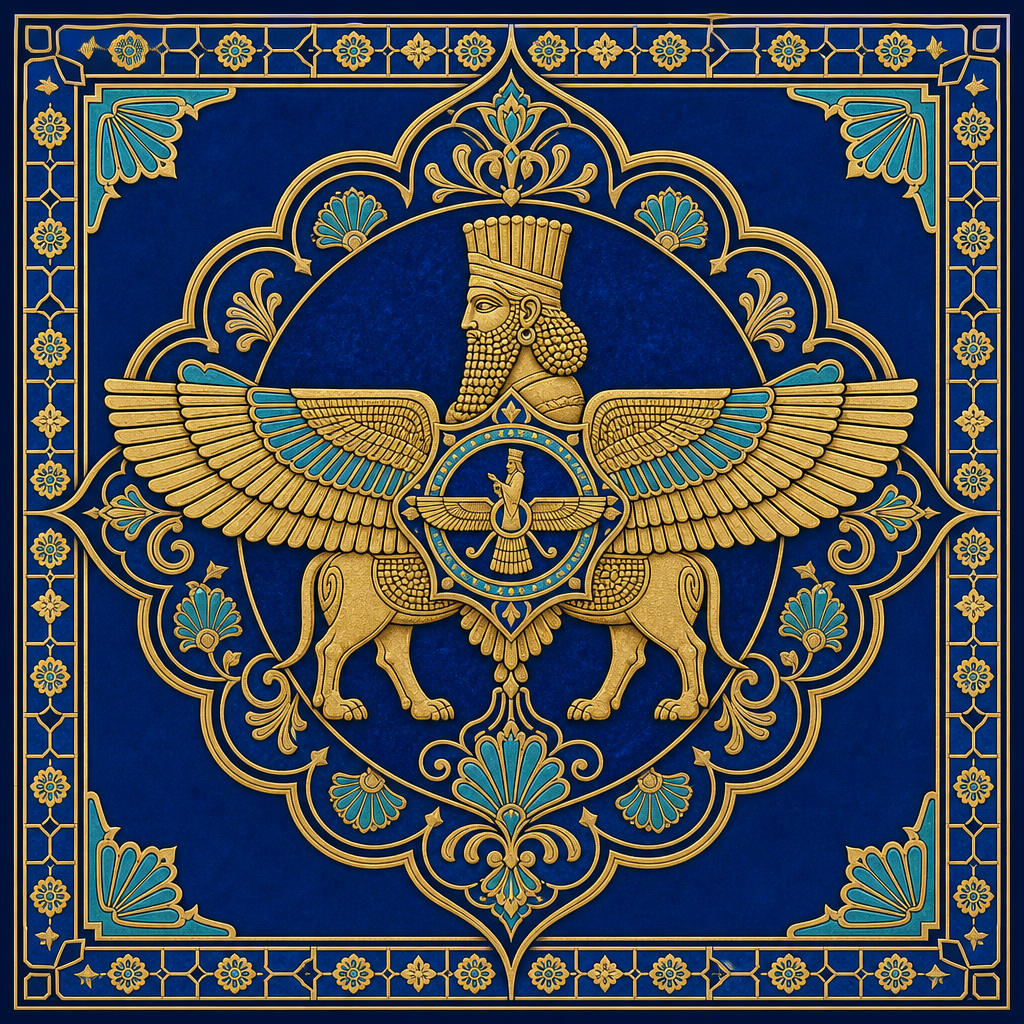

Pasargadae
The first capital of the Achaemenid empire and the resting place of its founder, Cyrus the Great.
On the plain of Morghab
Cyrus the Great founded Pasargadae on the plain of Morghab in Fars after defeating the Median king Astyages c. 550 BCE. The archaeological park stretches across more than 1.6 km² of open steppe at 1,900 m elevation and contains the tomb of Cyrus, the Tall-e Takht citadel, the gatehouse known as Palace R, the audience hall (Palace S), the residential Palace P, two royal pavilions and the remains of the first formally surveyed Persian garden.
"The tomb of Cyrus was in the royal park at Pasargadae… upon it stood this inscription in Persian letters: "O man, whosoever thou art and whencesoever thou comest, I am Cyrus, who founded the empire of the Persians. Grudge me not, therefore, this little earth that covers my body.""
What survives
| Monument | Function | Notes |
|---|---|---|
| Tomb of Cyrus | Royal burial | Freestanding limestone gabled tomb, six stepped tiers, c. 11 m tall |
| Tall-e Takht | Citadel platform | Massive ashlar terrace on a north hill, comparable to Persepolis |
| Palace R (Gate House) | Ceremonial gateway | Site of the four-winged 'Cyrus' relief |
| Palace S | Audience hall | Hypostyle with bull-protome capitals |
| Palace P | Royal residence | Open colonnaded portico facing the garden |
| Royal Garden | Chahar-bagh | World's earliest known four-fold garden plan |
| Tomb of Cambyses (Zendan-e Soleyman) | Tower-tomb | Stone-built tower, function debated |
A capital before Persepolis
After Cyrus's death in 530 BCE, Pasargadae remained the ceremonial site for the coronation of Achaemenid kings even after Darius I shifted the imperial centre to Persepolis. The plain was looted by Alexander's troops in 330 BCE; Alexander himself, according to Arrian, ordered the desecrated tomb of Cyrus repaired.
c. 546 BCE
Cyrus founds Pasargadae after defeating Astyages
1.6 km²
Area of the archaeological park
6 tiers
Of the stepped tomb of Cyrus
330 BCE
Alexander visits and orders the tomb restored
UNESCO 2004
Inscribed as a World Heritage Site
29 Oct
Annual gathering at the tomb for Cyrus the Great Day
From ruin to World Heritage
For centuries after the Arab conquest the tomb of Cyrus was venerated locally as the "Mother of Solomon" (Mashhad-e Mādar-e Soleymān), a folk attribution that unwittingly preserved the monument through the medieval period. European travellers from Pietro della Valle (1621) to Robert Ker Porter (1818) described and drew the ruins, but scientific excavation only began with Ernst Herzfeld in 1928 and was carried to systematic conclusion by David Stronach for the British Institute of Persian Studies between 1961 and 1963. Stronach's stratigraphic work established the plan of the royal garden, dated the palaces by their masons' marks, and identified the four-fold hydraulic layout as the earliest chahar-bagh anywhere.
1621
Pietro della Valle publishes the first European drawing of the tomb
1818
Robert Ker Porter documents Palace R's four-winged relief
1928
Ernst Herzfeld begins scientific survey of the site
1961–63
David Stronach's excavations map the garden and palaces
2004
UNESCO World Heritage inscription (site #1106)
2011
Included in the serial 'Persian Garden' listing
Pasargadae \u2014 Cyrus's first capital
The earliest Achaemenid capital, founded c. 546 BCE on the plain of Morghab in Fars; UNESCO World Heritage since 2004.


Photographs and museum plates reproduced from Wikimedia Commons and public-domain collections.
Tolerance, Law and the Freed Exile: How Persia Ruled Differently
Cyrus is remembered less for what he conquered than for what he chose not to destroy. Babylon fell in 539 BCE without a sack; its temples kept their priesthoods, its gods were carried home to the cities Nabonidus had emptied, and the deported communities held there — the Judeans among them — were told to go home and rebuild their sanctuaries at royal expense. Set that beside the Assyrian practice of mass deportation that preceded it, and the difference is not rhetoric but policy.
The evidence is not Persian propaganda alone. The Hebrew Bible, written by the beneficiaries and not by the court, calls Cyrus 'the Lord's anointed' — the only foreign king so named. The Babylonian priesthood, whose own city had just been taken, welcomed him in its temple chronicle. Greek writers who fought Persia, from Xenophon to Aeschylus, still portrayed its kings as bound by justice. Independent, sometimes hostile, sources converge.
| Practice | Assyria / Babylonia | Athens & Rome | Achaemenid Persia |
|---|---|---|---|
| Conquered populations | Mass deportation as standard policy; whole communities resettled to break identity | Cities razed and populations sold — Melos 416 BCE, Carthage 146 BCE, Jerusalem 70 CE | Repatriation of earlier deportees; peoples returned to ancestral lands (Cyrus Cylinder, lines 30–34) |
| Local religion | Cult statues carried off to Assur or Babylon as trophies | Roman triumph paraded captured gods; Jewish Temple treasure taken to Rome | Statues returned to their own shrines; temple rebuilding funded from the treasury (Ezra 6:8–10) |
| Language & law | Akkadian imposed as administrative language | Latin and Greek as the language of courts and citizenship | Trilingual inscriptions; Aramaic chancery; Egyptian, Babylonian and Judean law codified locally |
| Labour | War captives as forced labour on state building projects | Chattel slavery central: c. 20,000 in the Laurion mines; up to a third of Italy enslaved | Paid kurtaš workforce on rations; no large slave-worked estates recorded in the Persepolis archive |
| Women's standing | Property rights limited and largely dynastic | Athenian women legally minors under a male guardian for life | Women hold estates, run workshops, receive maternity rations, seal their own administrative orders |
| Rulers' self-presentation | Reliefs of flayings, impalements and heaped heads | Triumphs displaying chained captives | Bisotun and Persepolis show subject nations carrying the throne, in their own dress, unbound |
Two details are worth pausing on, because they are documentary rather than literary. The first is the Persepolis Fortification Archive, discovered in 1933 and comprising tens of thousands of Elamite and Aramaic tablets recording rations paid out between 509 and 493 BCE. It is an accounting record — nobody wrote it to be admired — and it shows women drawing wine and grain in their own names, mothers receiving a bonus ration after childbirth, and skilled female supervisors paid more than unskilled men. The second is the Elephantine papyri from a Judean garrison in Upper Egypt, whose soldiers wrote to the Persian satrap for permission to rebuild their temple and got it.
539 BCE
Babylon taken without a sack; the Cyrus Cylinder records the return of gods and peoples to their own cities.
538 BCE
Judean exiles permitted to return to Jerusalem; the Second Temple is completed in 516 BCE with Persian funding.
c. 518 BCE
Darius I commissions the codification of Egyptian law, in Egyptian and Aramaic, by Egyptian priests.
30,000+ tablets
The Persepolis Fortification Archive: a paid, rationed workforce — women included — not a slave register.
None of this makes the Achaemenid Empire a modern democracy. It was a monarchy that taxed hard, punished rebellion severely — Bisotun says so plainly — and knew household servitude and war captivity. Honest history does not need the myth. What it does show is that a large multi-ethnic state could be run, deliberately and for two centuries, on the principle that subject peoples keep their gods, their courts, their language and their homes. That principle was a choice, and other empires of the same centuries chose otherwise.
- Cyrus Cylinder (British Museum, BM 90920): the returned cult statues and the rebuilt sanctuaries of Ashur, Susa, Akkad and the cities of the Zagros.
- Ezra 6:8–10: Darius orders the cost of the Jerusalem Temple paid from the royal revenue of Beyond-the-River, with animals supplied for sacrifice.
- Isaiah 45:1: Cyrus called 'anointed' — the sole non-Jewish figure given that title in the Hebrew Bible.
- The Udjahorresnet inscription: Cambyses and Darius restore the temple of Neith at Sais and re-endow its priesthood after wartime damage.
- Elephantine papyri (5th century BCE): a Judean garrison in Egypt petitions the satrap Bagavahya and receives authorisation to rebuild its temple.
- Irdabama and Artystone: royal women with their own estates, seals, workshops and letter-carriers in the Persepolis tablets.
- Bisotun and the Apadana reliefs: twenty-three subject nations depicted upright, armed, in their own national dress — not chained, not kneeling.
Read alongside the Cyrus Cylinder, the Persepolis archive and the Judean and Egyptian documents, the conclusion is narrow but firm: not all empires were the same, and the difference was visible to the people who lived under them.
Frequently asked questions
Related reading
Founder of the Achaemenid Empire — conquest of Media, Lydia and Babylon, the Cyrus Cylinder, and the tomb at Pasargadae.
Parsa, the ceremonial capital of the Achaemenid Empire — Apadana, Gate of All Nations, 23 satrapies, and Alexander's fire of 330 BCE.
The 539 BCE clay barrel from Babylon — often called the world's first charter of human rights.
Achaemenid, Parthian, Sassanid, Safavid, Qajar — six successive Iranian empires.
Chahar bagh geometry and the nine UNESCO gardens.
Capital of Fars, the Zand royal seat, and home to the tombs of Hafez and Saadi — gateway to Persepolis and Pasargadae.
References
- ↗ UNESCO — Pasargadae (2004)
- ↗ Encyclopædia Iranica — Pasargadae
- ↗ David Stronach, Pasargadae: A Report on the Excavations (Oxford, 1978)
All imagery is sourced from Wikimedia Commons, public-domain museum collections (British Museum, Louvre, Metropolitan Museum of Art, National Museum of Iran), or UNESCO World Heritage records. No AI-generated images are used. Scholarly text is synthesized from Encyclopædia Iranica, the Cambridge History of Iran, and peer-reviewed publications.