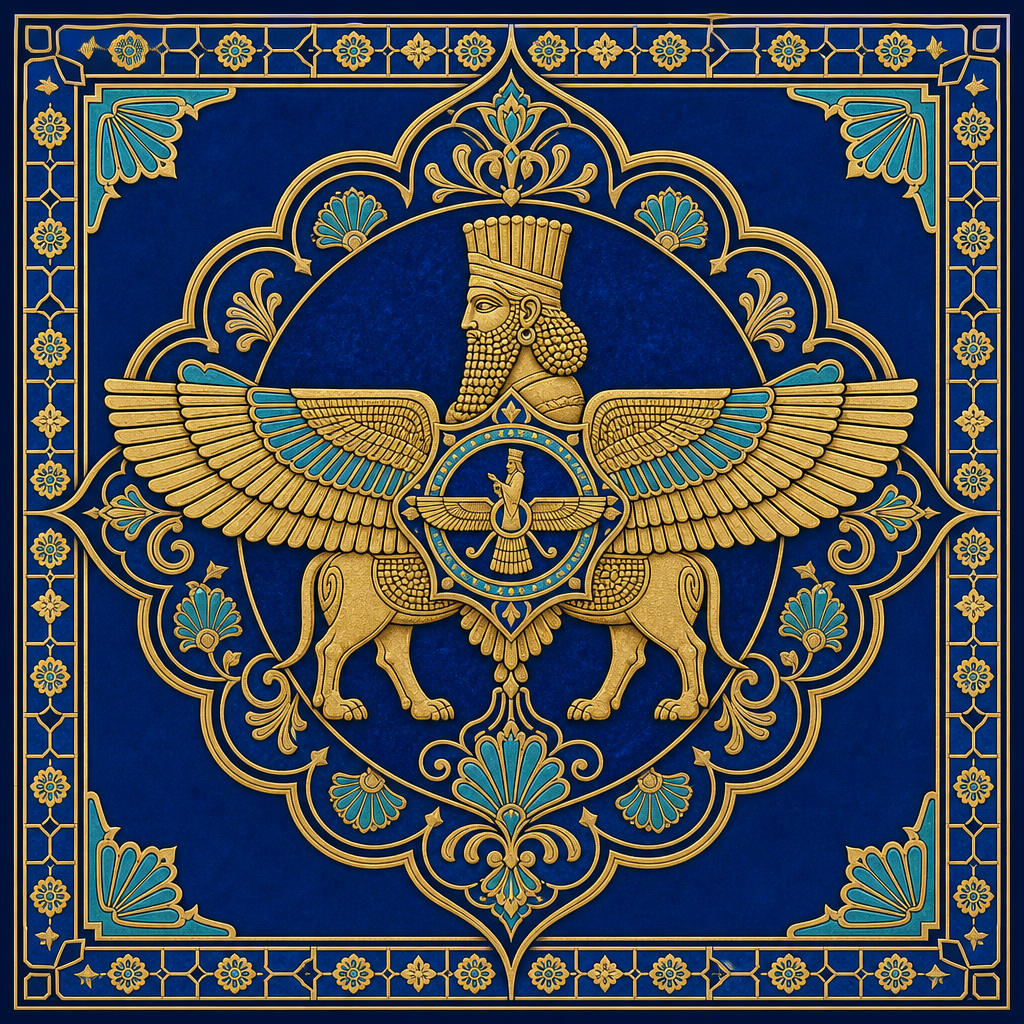

Yalda — The Longest Night
The Iranian winter solstice. Families gather around a kursi heater, eat pomegranate and watermelon, and read Hafez until midnight — when the sun is reborn and the days begin to lengthen again.
Mithra and the rebirth of the sun
Yalda is the Iranian celebration of the winter solstice — the longest night of the year, after which the sun begins its return. In pre-Islamic Iran this was the birthday of Mithra, the Zoroastrian yazata of light, covenant and the rising sun. The night was kept awake in vigil so that good would triumph over the dark, and so the newborn sun would be welcomed at dawn. The Roman feast of Sol Invictus on 25 December, and by extension Christmas, descend from the same solstice tradition.
The word yaldā is Syriac for "birth", borrowed into Persian from the Christian communities of Mesopotamia, who used it for the Nativity. The older Persian name is Shab-e Chelleh — "the night of the forty" — referring to the first night of the forty-day Persian winter season.
The Yalda table
| Item | Meaning |
|---|---|
| Anār (pomegranate) | Red as the colour of dawn — symbol of fertility and life |
| Hendevāneh (watermelon) | Summer fruit eaten in winter to ward off illness |
| Ājīl-e shab-e Chelleh | Mixed nuts and dried fruit — pistachio, almond, mulberry, apricot |
| Anjīr (figs) | Sweetness for the new sun |
| Sweet rice and stew | A late, warm meal eaten by candlelight |
| Dīvān-e Hāfez | The collected ghazals of Hafez — opened at random for fāl |
| Korsī or fireplace | A low covered table with a heat source underneath — the family gathers around it |
Fāl-e Hāfez at midnight
The night turns on a single ritual: the fāl-e Hāfez. The eldest of the family takes the Divan of Hafez, asks the poet for guidance on a question kept silent in the heart, and opens the book at random. The first ghazal on the right-hand page is read aloud — and interpreted as the poet's answer. The custom is unbroken in Iranian homes from 14th-century Shiraz to the diaspora today.
"The night of separation is long, but with the morning of union comes a thousand cures — be patient, my heart, the night of the lover is the longest of all nights."
21 Dec
Astronomical winter solstice — the longest night
UNESCO 2022
Inscribed as Intangible Cultural Heritage
Iran + Afghanistan + Tajikistan
Joint Persian-cultural observance
Shab-e Chelleh
'Night of the forty' — first of 40-day winter (chelleh)
Hafez
Read aloud by fāl at midnight in every home
3,000 yrs
Estimated age of the solstice celebration in Iran
When is Yalda? Solstice dates 2026–2031
Yalda always falls on the night of the December solstice, so the Gregorian date shifts between 20 and 22 December depending on the year and the time zone. In the Iranian solar calendar it is fixed: the last night of the month of Āzar, the eve of the first of Day.
| Year | Night of | Iranian date | Solstice (Tehran) |
|---|---|---|---|
| 2026 | 21–22 December | 30 Āzar 1405 | 21 Dec, 18:20 |
| 2027 | 21–22 December | 30 Āzar 1406 | 22 Dec, 00:12 |
| 2028 | 20–21 December | 30 Āzar 1407 | 21 Dec, 06:02 |
| 2029 | 21–22 December | 30 Āzar 1408 | 21 Dec, 11:44 |
| 2030 | 21–22 December | 30 Āzar 1409 | 21 Dec, 17:39 |
| 2031 | 21–22 December | 30 Āzar 1410 | 21 Dec, 23:26 |
The forty-day chelleh-ye bozorg ("great forty") runs from that night to 30 Bahman-eve — 30 January — after which the chelleh-ye kuchak, the small forty, carries the calendar to the eve of spring and Nowruz.
How Yalda is kept across the Persian world
Yalda is not a single national holiday but a shared solstice rite across the Persianate world, and each region keeps it with its own foods, poems and names.
| Region | Local name | Distinctive practice |
|---|---|---|
| Iran (nationwide) | Shab-e Chelleh / Yaldā | Fāl-e Hāfez at midnight; pomegranate, watermelon, ājil-e shab-e chelleh |
| Afghanistan | Shab-e Yaldā | Shab-e Chelleh gatherings with Bīdel and Hāfez recitation; dried fruit and qābeli |
| Tajikistan | Shab-e Yaldo | Solstice supper with Rūdakī and Ḥāfeẓ read in Cyrillic-script Tajik |
| Iranian Kurdistan | Şeva Yeldayê | Storytelling and daf music; walnut and dried-fig plates |
| Iranian Azerbaijan | Chilla Gejasi | Watermelon carved for guests; ashiq bards perform through the night |
| Zoroastrian Yazd & Kerman | Shab-e Chelleh | Fire kept burning until dawn; Avestan prayers at first light |
| Diaspora (LA, Toronto, London) | Yalda Night | Public poetry nights, concerts and community sofrehs in rented halls |
A Yalda night, hour by hour
The evening has a recognisable shape in most households — a sequence families follow without ever writing it down.
| Hour | What happens |
|---|---|
| Late afternoon | The sofreh is laid: red fruit, seven-nut ājil, sweets, tea samovar, the Divan of Hafez, and a mirror or candle |
| Sunset | Elders arrive first; younger families visit the oldest member of the extended family, never the reverse |
| Early evening | Dinner — usually a herb-heavy rice such as sabzi polo or a hearty āsh, followed by tea |
| Mid-evening | Watermelon is cut and shared; pomegranate is seeded communally into a bowl with angelica powder and salt |
| Late evening | Storytelling, riddles, and Shāhnāmeh recitation (naqqālī) around the korsī |
| Midnight | Fāl-e Hāfez: each person makes a silent wish; the eldest opens the Divan and reads the ghazal aloud |
| Before dawn | The family stays awake as late as it can — the longest night is not to be slept through |
Shab-e Yalda in pictures
The longest night of the year, kept since Achaemenid times with pomegranate, watermelon, and the Divan of Hafez.


Photographs and museum plates reproduced from Wikimedia Commons and public-domain collections.
Frequently asked questions
Related reading
Nowruz, Yalda, Mehregan, Sadeh, Tirgan — the ceremonial year.
Spring equinox, Haft-Sin, Chaharshanbe Suri and Sizdah Bedar — Iran's 3,000-year-old UNESCO new year.
Zarathustra, Ahura Mazda and the fire — the ancient Iranian faith that shaped Judaism, Christianity and Islam.
Taarof, hospitality, festivals, music, and everyday life.
Ferdowsi, Hafez, Rumi, Saadi, Nizami, Khayyam — the masters of Persian verse.
The supreme lyric poet of Persian — 500 ghazals, the fāl-e Hafez tradition, and the poet Goethe called his twin.
References
- ↗ UNESCO — Yaldā/Chella (2022)
- ↗ Encyclopædia Iranica — Čella
- ↗ Mary Boyce, A History of Zoroastrianism vol. II (Brill)
All imagery is sourced from Wikimedia Commons, public-domain museum collections (British Museum, Louvre, Metropolitan Museum of Art, National Museum of Iran), or UNESCO World Heritage records. No AI-generated images are used. Scholarly text is synthesized from Encyclopædia Iranica, the Cambridge History of Iran, and peer-reviewed publications.