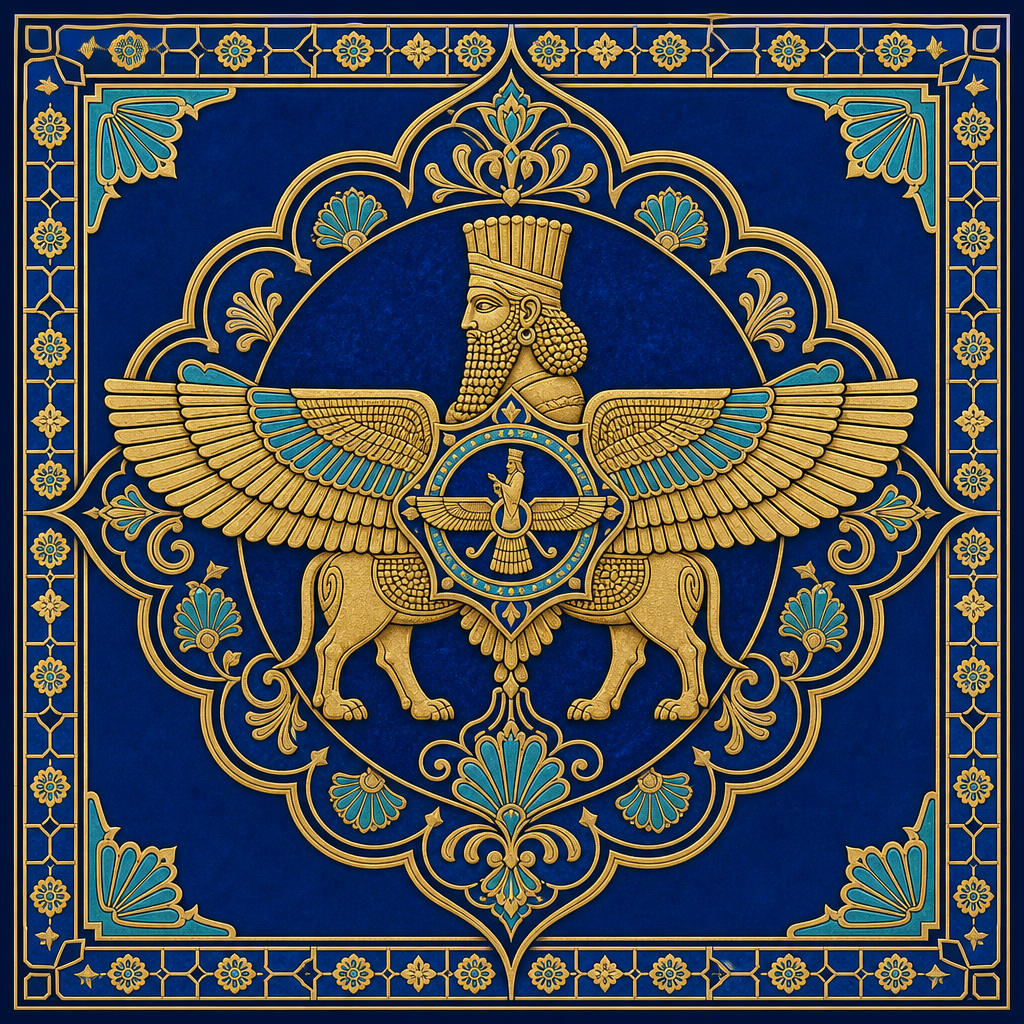
Khosrow I Anushirvan: Architect of the Late Sasanian Empire
An Analysis of the Fiscal, Military, and Administrative Reforms that Defined a Golden Age
Khosrow I Anushirvan's reign marked the zenith of Sasanian power, not just through conquest, but through a profound and systematic reorganization of the state. His sweeping reforms to taxation, military structure, and social hierarchy created a centralized empire that would influence administrative practices for centuries, even beyond its own existence.
Key takeaways
- Khosrow I replaced variable in-kind taxes with a fixed land tax (kharag) based on a comprehensive survey of all cultivable land in the empire.
- He abolished the single, powerful office of commander-in-chief (Eran-spahbed) and divided military command among four regional generals.
- His reforms created a new class of state-supported cavalry gentry, the dehqanan, who became the backbone of the Sasanian army and bureaucracy.
- Khosrow I's reign is considered a golden age, marked by military success, architectural marvels like the Taq-e Kasra, and intellectual flourishing at the Academy of Gondishapur.
- The reforms, while strengthening the central government, were later adopted and adapted by the early Islamic caliphates after their conquest of Persia.
- He reigned from 531 to 579 CE, one of the longest and most impactful reigns in the Sasanian dynasty's history.
Khosrow I (r. 531–579 CE), known to posterity as Anushirvan or 'The Immortal Soul,' was a Sasanian king of kings (shahanshah) whose reign represents a pivotal era in Iranian history. His legacy is defined by a series of profound and systematic administrative reforms that fundamentally restructured the Sasanian state, creating a highly centralized and powerful empire that stood as the equal of Byzantium. Inheriting a kingdom destabilized by social unrest and dominated by a powerful landed aristocracy, Khosrow implemented transformative fiscal, military, and social policies that would not only define the late Sasanian period but also provide a blueprint for statecraft for the succeeding Islamic caliphates.
The Crisis of the Sixth Century: An Empire on the Brink
To understand the magnitude of Khosrow’s achievement, one must first grasp the precarious state of the Sasanian Empire in the early sixth century. His father, Kavad I (r. 488–496 and 498–531), had presided over a period of intense turmoil. The empire was strained by costly wars with the Byzantines in the west and the Hephthalites in the east. Internally, the great noble families, or *wuzurgan*, wielded immense power, often challenging the authority of the monarch and controlling vast swathes of land and resources with little oversight from the central government.
The most significant challenge, however, was the rise of the Mazdakite movement. Led by the charismatic prophet Mazdak, this socio-religious doctrine advocated for radical egalitarianism, including the redistribution of wealth and the holding of property (and, according to hostile sources, women) in common. This message resonated deeply with the peasantry and lower classes who were burdened by debt and aristocratic oppression. Kavad I initially supported the Mazdakites to curb the power of the nobility and clergy, but the movement soon spiraled out of his control, leading to widespread social chaos and the near collapse of the traditional hierarchical order. Although Kavad eventually turned on the Mazdakites, the damage was done: the foundations of Sasanian society had been shaken to their core.
Khosrow is born to King Kavad I. His youth is shaped by the political turmoil of his father's reign.
The Great Reforms: Rebuilding the State
It was upon this chaotic stage that Khosrow entered. His first act as king was to ruthlessly eliminate the Mazdakite leadership, a move that signaled the restoration of the traditional social order and earned him the support of the Zoroastrian clergy and the relieved nobility. This consolidation of power was not an end in itself but the necessary prelude to his ambitious reform program, which targeted the two pillars of the state: its finances and its military.
Frontier Fortifications and Territorial Defense
To safeguard the newly surveyed agrarian base and secure the four military zones governed by the spahbeds, Khosrow I executed an unprecedented program of linear fortifications. Rather than relying solely on mobile cavalry to intercept incursions, the imperial treasury funded massive brick and stone barriers across vulnerable invasion corridors. In the northeast, confronting the Hephthalites and rising Gokturks, the Sasanians reinforced the Great Wall of Gorgan—a fired-brick barrier extending nearly two hundred kilometers between the Caspian Sea and the Kopet Dag mountains—alongside the auxiliary Wall of Tammisha.
In the northern Caucasus, Khosrow fortified the strategic pass of Derbent with monumental ashlar stone ramparts, effectively sealing the Caspian Gates against Eurasian steppe confederations such as the Alans and early Khazar factions. Parallel defensive works, including the ditch and rampart network known in Middle Persian tradition as the War-e Tazigan, shielded lower Mesopotamia from nomadic raids originating in the Arabian Peninsula. These linear defense systems transformed Sasanian border control from reactive frontier fighting into a structured, proactive defense doctrine, preserving the agricultural revenues essential to imperial administration.
Fiscal Reform: The Land Survey and the Kharag
Prior to Khosrow, the empire’s primary revenue, the land tax, was a disaster of inefficiency and corruption. It was levied as a percentage of the harvest (ranging from one-third to one-sixth), which meant that state income was unpredictable and varied wildly with weather and crop success. Furthermore, tax assessors, often in collusion with local landowners, had ample opportunity for graft. The system empowered the landed nobility, who controlled the collection process, and starved the central treasury.
Khosrow's solution was revolutionary. Initiated under his father but executed and perfected by him, he commissioned a comprehensive survey of all arable land within the empire. This monumental undertaking involved measuring every plot and assessing its productive capacity based on factors like soil quality, water source (e.g., rain-fed or irrigated), and the type of crop grown (e.g., date palms, olive trees, grain). Based on this cadaster, the variable tax was abolished and replaced with a fixed annual tax, the *kharag*, paid in cash installments. This gave the state a predictable, stable revenue stream, insulated from bad harvests. It also dramatically reduced the power of the old aristocracy by bringing tax collection under the control of a central bureaucracy loyal to the king. In parallel, a poll tax (*gizit*) was levied on most of the adult male population who were not part of the Zoroastrian clergy, military, or nobility.
Military Reform: The Four Spahbeds and the Dehqanan
The Sasanian military was similarly flawed. Ultimate authority rested with a single commander-in-chief, the *Eran-spahbed*, who was traditionally a member of one of the great noble houses. This concentration of power was a constant threat to the throne. To neutralize this, Khosrow abolished the single office and divided the empire into four military districts (kusts): Khurasan (East), Khwarbaran (West), Nimruz (South), and Adurbadagan (North/Northwest). Each district was assigned its own *spahbed*, or general, reporting directly to the king. This distributed military power and prevented any one individual from accumulating enough authority to challenge the crown.
Even more significantly, Khosrow created a new class of warrior. The old system relied on the great nobles to supply knights and retainers from their own lands. Khosrow used his new tax revenues to create and equip a standing army and, crucially, to foster a new class of landed gentry known as the *dehqanan*. These were smaller landowners who were granted land and status in exchange for military service. They formed the backbone of the new Sasanian cataphract (heavy cavalry) force. Their equipment—armor, horse, and weapons—was often supplied by the state, and their loyalty was directed to the king who was their ultimate patron, not to a local magnate. This new *dehqan* class became the bedrock of the late Sasanian state, serving not only as soldiers but also as local administrators and tax collectors.
| Feature | Pre-Reform System (Before c. 531 CE) | Khosrow I's Reformed System (After c. 531 CE) |
|---|---|---|
| Land Tax Basis | Variable percentage of annual harvest (in-kind) | Fixed rate based on land survey (kharag), paid in cash |
| Tax Collection | Administered by great noble families; high potential for corruption | Managed by a central bureaucracy and the dehqan class; more direct state control |
| State Revenue | Unpredictable and fluctuating year-to-year | Stable, predictable, and significantly increased |
| Military Command | One supreme commander-in-chief (Eran-spahbed), usually from a great noble family | Four regional commanders (spahbeds) for North, South, East, and West |
| Cavalry Recruitment | Relied on levies from the seven great clans and their retainers | State-funded and equipped dehqan cavalry, loyal to the king |
| Social Base of Power | The seven great Parthian-era noble families (wuzurgan) | The monarch, supported by the new dehqan gentry and a central bureaucracy |
A Golden Age of Culture and Intellect
Khosrow's reign was not merely one of administrative reorganization; it was also a period of extraordinary cultural and intellectual vitality. He cultivated the image of a philosopher king, a ruler who was not only a conqueror and administrator but also a patron of wisdom. His court at Ctesiphon became a magnet for scholars from across the known world.
The most famous institution associated with him is the Academy of Gondishapur in Khuzestan. Already a center for learning, Khosrow expanded it into the premier intellectual hub of its time. When the Byzantine Emperor Justinian I closed the Neoplatonic Academy of Athens in 529, Khosrow famously welcomed the displaced pagan philosophers to his court. He sponsored a massive translation movement, commissioning the rendering of Greek, Syriac, and Sanskrit texts on medicine, astronomy, philosophy, and history into Middle Persian. Indian medical texts and treatises like the *Panchatantra* (which became the Persian *Kalilah wa Dimnah*) were translated, and the game of chess (*chatrang*) was introduced from India during his reign. This intellectual openness and synthesis of Hellenistic, Iranian, and Indian traditions created a vibrant cultural milieu.
Khosrow famously engaged in philosophical debates. He welcomed Greek Neoplatonist philosophers exiled by Justinian, though they eventually grew homesick and were allowed to return to Byzantium under a treaty guaranteeing their safety.
The game of chess is widely believed to have been introduced to Persia from the Gupta Empire in India during Khosrow I's reign. It was known as 'chatrang' and was considered a game for the wise and strategic.
After sacking the Byzantine city of Antioch in 540, Khosrow deported its population to a new city he built near Ctesiphon called 'Weh Antiok Khosrow' (Khosrow's Better Antioch), which he designed with Roman-style baths and colonnades.
Khosrow I commissioned the compilation of the official history of the Iranian kings, the *Khwaday-Namag* (Book of Lords). Though now lost, this work served as the primary source for Ferdowsi's epic 11th-century poem, the Shahnameh.
Legacy and Conclusion
Khosrow I Anushirvan died in 579 after a reign of nearly half a century. He left behind an empire that was wealthier, more centralized, and militarily more formidable than the one he had inherited. His reforms created a model of efficient, absolutist monarchy. The architectural grandeur of his palace at Ctesiphon, the Taq-e Kasra, symbolized the power and majesty of his reign.
However, the legacy of his administrative structure proved remarkably durable. The Arab conquerors who toppled the Sasanian dynasty in the mid-seventh century were deeply impressed by the Persian system of governance. They retained the *kharag* land tax, the poll tax, the chancellery (*diwan*), and many other administrative practices. In this way, the reforms of Khosrow I not only defined the Sasanian golden age but also cast a long shadow, shaping the administrative DNA of the Islamic Caliphates and influencing statecraft in the Middle East for centuries to come. He remains, in both history and legend, the archetypal 'Just King' of Iranian civilization.
References
- Encyclopaedia Iranica – KOSROW I
- Encyclopaedia Iranica – DEHQĀN in the Sasanian Period
- Sasanian Crowns, The British Museum
- Daryaee, Touraj. 'Sasanian Persia: The Rise and Fall of an Empire.' I.B. Tauris, 2009.
- The Metropolitan Museum of Art – Plate with a King Hunting Boars
- Rubin, Zeev. 'The Reforms of Khusro Anushirwan.' In The Cambridge History of Iran, Vol. 3(2), edited by Ehsan Yarshater, Cambridge University Press, 1983.
- Pourshariati, Parvaneh. 'Decline and Fall of the Sasanian Empire: The Sasanian-Parthian Confederacy and the Arab Conquest of Iran.' I.B. Tauris, 2008.
Frequently asked questions
Why is Khosrow I called Anushirvan?
Khosrow I is famously known as 'Anushirvan' (Anōšag-ruwān), which translates from Middle Persian to 'of the Immortal Soul.' This epithet was bestowed upon him in later tradition to reflect his reputation as a just, wise, and philosophically inclined ruler who brought stability and prosperity to the empire.
What were Khosrow I's most important reforms?
His most critical reforms were twofold. Fiscally, he replaced a chaotic, in-kind tax with a fixed, predictable land tax (kharag) based on a massive survey. Militarily, he dismantled the single supreme command, creating four regional commanders (spahbeds) to prevent rebellion, and established a new class of state-funded knights (dehqanan).
What was the Academy of Gondishapur?
The Academy of Gondishapur was a major intellectual center in the Sasanian Empire, heavily patronized by Khosrow I. It became a hub for learning in medicine, philosophy, astronomy, and science, attracting scholars from across the world, including Neoplatonist philosophers from Athens and Indian physicians.
How did Khosrow I deal with the Mazdakites?
Upon his accession to the throne, Khosrow I brutally suppressed the Mazdakite movement. He orchestrated a massacre of Mazdak and his followers, viewing their radical, egalitarian, and property-sharing doctrines as a grave threat to the social order, the nobility, and the stability of the Zoroastrian state.
What is the Taq-e Kasra?
The Taq-e Kasra, or Arch of Khosrow, is the monumental remnant of a Sasanian palace complex in Ctesiphon, the imperial capital. Its massive catenary arch, the largest single-span vault of unreinforced brickwork in the world, was part of the palace's main audience hall and stands as a testament to the engineering prowess and grandeur of Khosrow's reign.
Did Khosrow I interact with the Byzantine Empire?
Yes, Khosrow I's reign was defined by near-constant interaction, alternating between intense warfare and periods of negotiated peace with the Byzantine Empire, particularly under Emperor Justinian I. He famously sacked the Byzantine city of Antioch in 540 but also engaged in diplomacy, such as the 'Eternal Peace' of 532.