Fal-e Hafez: Asking Hafez on Yalda Night
At midnight on Yalda, Iranian families make a silent wish, open the Divan of Hafez at random and read the poem that appears as the poet's answer. This guide explains how to take a fal, what to say, where the custom comes from and how people interpret the reply.
Fal-e Hafez: Asking Hafez on Yalda Night
What is Fal-e Hafez?
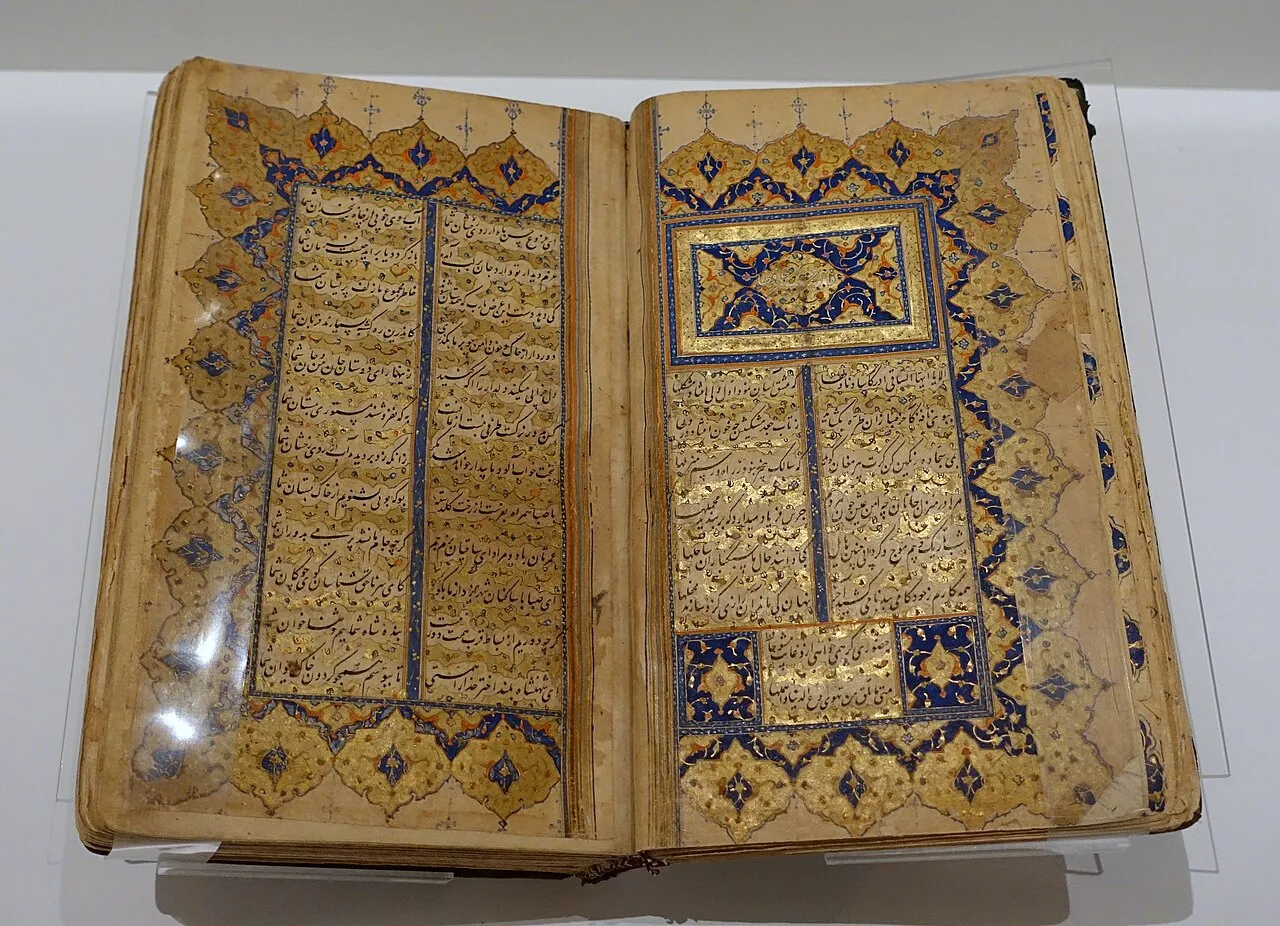
A fal is an omen or a reading. Fal-e Hafez is a form of bibliomancy: you hold a question or wish in your mind, open the Divan of the fourteenth-century Shirazi poet Hafez at random, and treat the ghazal you find as his reply. Hafez is called Lisan al-Ghayb, 'the Tongue of the Unseen', because his verses seem to speak to every situation.
The fal is taken all year round, but it is the central ritual of Yalda night and is also common at Nowruz. Almost every Iranian home owns a Divan, and many families keep one copy just for fal.
How to take a fal from Hafez
Families differ in the details, but most follow this order:
- Hold the Divan with both hands and form a single clear wish or question in your mind. Do not say it aloud.
- Recite the customary invocation to Hafez (see below), or simply ask him silently for guidance.
- Open the book at random, often by sliding a finger between the pages with your eyes closed.
- Read the first ghazal that begins on the right-hand page, or continue the poem that is already under way there.
- Many readers also read the following ghazal, called the shahed or 'witness', to confirm the answer.
- Interpret the poem's mood: hope, patience, warning or joy. The wish itself stays secret.
How to interpret a Hafez fal
Hafez rarely gives a plain yes or no. His ghazals move between wine and prayer, separation and union, despair and patience, so the reader looks at the overall tone. A poem that speaks of the dawn, the return of a beloved or the end of sorrow is read as a good omen. A poem about patience suggests waiting; one about deceit or hypocrisy can be read as a warning.
One of the best-loved answers is the ghazal that begins 'Yusuf-e gomgashte baz ayad be Kan'an, gham makhor': 'Lost Joseph will return to Canaan; do not grieve. The house of sorrow will one day become a rose garden; do not grieve.'
"Lost Joseph will return to Canaan; do not grieve. The house of sorrow will one day become a rose garden; do not grieve."
| Theme in the ghazal | Typical reading |
|---|---|
| Morning, dawn, the sun rising | Hardship is ending; the wish is favoured |
| Patience, waiting, the long night | Be patient; the outcome needs time |
| Union with the beloved | A relationship or reunion will go well |
| Hypocrisy, the false preacher | Beware of a person or plan that is not what it seems |
| Wine, the tavern, the cupbearer | Let go of worry and trust joy and openness |
Where the custom comes from
Hafez lived in Shiraz in the fourteenth century, and his Divan was collected after his death, traditionally dated to 1390. A well-known legend says that when some clerics objected to his burial, the matter was settled by opening his own Divan at random, and the verse that appeared supported a proper funeral.
The practice is well attested by the sixteenth and seventeenth centuries. The Mughal emperor Jahangir recorded in his memoirs that he consulted the Divan of Hafez for omens. In Europe, Goethe's West–Eastern Divan (1819) was inspired by Hafez in Joseph von Hammer-Purgstall's German translation.
Fal-e Hafez in Shiraz and online
At the Hafezieh, the poet's tomb garden in Shiraz, visitors lay a hand on the tombstone and take a fal. Street sellers outside offer printed fal cards, sometimes picked out of a box by a trained canary or parakeet. Online, the Ganjoor poetry library offers a random-ghazal fal, and many Persian apps do the same. On Yalda night the tomb is open late and crowded with families.
More Yalda guides
Frequently asked questions
Related reading
Iran's winter-solstice festival — pomegranate, watermelon and Hafez on the longest night of the year. UNESCO 2022.
Yalda Night 2026 falls on Monday 21 December, the eve of 30 Azar 1405. The solstice arrives at 20:50 UTC, 00:20 in Tehran. Times by city and how to celebrate.
What goes on a Yalda table and why: watermelon, pomegranate with golpar, seven-nut ajil, persimmons, dinner dishes and sweets, with a shopping list and plant-based options.
Nowruz, Yalda, Mehregan, Sadeh, Tirgan — the ceremonial year.
The supreme lyric poet of Persian — 500 ghazals, the fāl-e Hafez tradition, and the poet Goethe called his twin.
Saffron, rice, kebab, stews, tea and sofreh — the Persian table.