Yalda Food and Table Guide
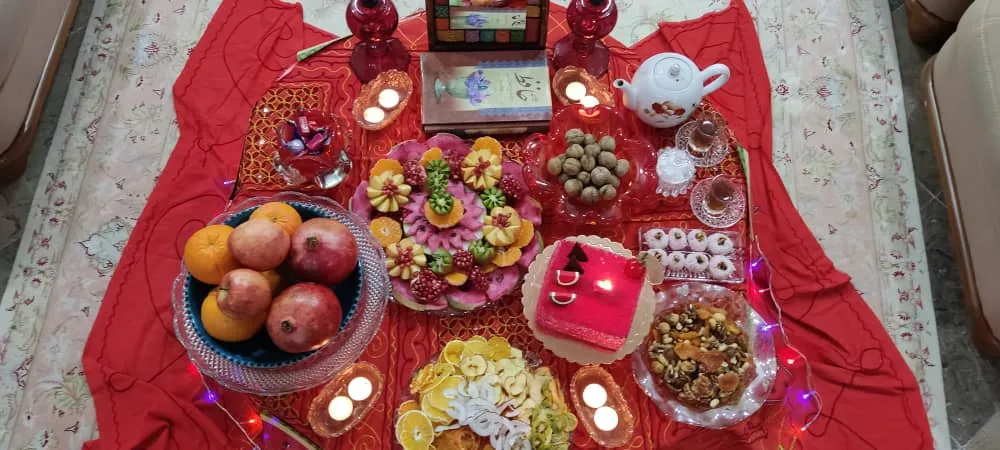
A Yalda table is red: watermelon, pomegranate and persimmon, set beside nuts, sweets and a pot of tea. Here is what each food means, what to cook for dinner, how to lay the table, and a shopping list for a first Yalda.
Yalda Food and Table Guide
Why the Yalda table is red
Yalda celebrates the return of light after the longest night, and the foods on the table carry that idea. Red fruits stand for the glow of dawn and the warmth of life. Fresh summer fruit kept until midwinter shows that the household has been provident, and folk belief holds that eating it protects against the cold and illness of the forty days ahead.
None of this is fixed by scripture. The table varies from family to family and region to region, but a few foods appear almost everywhere.
| Food | Persian | How it is served | Meaning |
|---|---|---|---|
| Watermelon | هندوانه (hendevāneh) | Cut into wedges or carved; kept since late summer | Health through the winter; the warmth of summer |
| Pomegranate | انار (anār) | Seeded into a bowl with golpar (angelica powder) and a pinch of salt | Life, fertility, the red of dawn |
| Ajil | آجیل شب چله | A mix of nuts, seeds and dried fruit in a large dish | Plenty and the sharing of the harvest |
| Persimmon | خرمالو (khormālu) | Whole or sliced; a modern favourite | Autumn's last sweet fruit |
| Sweets | شیرینی | Gaz, sohan, baslogh, halva | A sweet year and a sweet night |
| Tea | چای | From a samovar or teapot, all night long | Keeping the vigil awake |
The Shab-e Chelleh nut mix
Ajil-e shab-e chelleh is the nut and dried-fruit mix sold in every Iranian market in December. Many families say it should contain seven items, echoing the number seven that also shapes the Nowruz Haft-Sin table. A typical mix includes almonds, walnuts, hazelnuts, pistachios, roasted chickpeas, raisins and pumpkin seeds; dried figs, dried mulberries and dried apricots are common additions.
Ajil is eaten slowly, by hand, through the hours of storytelling. Shelling pistachios and pumpkin seeds is part of the evening's rhythm.
What to cook for Yalda dinner
There is no single national Yalda dish. Families usually serve a festive rice or a hearty stew before the fruit comes out. Common choices are:
| Dish | What it is | Why it suits the night |
|---|---|---|
| Fesenjan | A stew of ground walnuts and pomegranate molasses, often with chicken or meatballs | Dark red and rich, it brings the pomegranate into the main course |
| Albaloo polo | Rice layered with sour cherries | Jewel-red rice that matches the colour of the table |
| Zereshk polo | Saffron rice with tart barberries | Bright red berries on golden rice |
| Ash-e reshteh | A thick soup of beans, herbs and noodles topped with kashk and fried mint | Warming and filling for a cold night |
| Kuku sabzi | A baked herb frittata | Easy to prepare ahead and serve at room temperature |
Regional Yalda customs
In Iranian Azerbaijan and other regions, a newly engaged young man traditionally sends a decorated tray of fruit, sweets and gifts to his fiancée's family on Yalda, a custom known as chelleh-bari or the Yalda khoncha. In Shiraz, many people spend part of the night at the tomb of Hafez. In Afghanistan the night is kept as Shab-e Chelleh with dried fruit and poetry, and in Tajikistan as Shab-e Yaldo.
A Yalda table without meat or dairy
Most of a Yalda table is already plant-based: fruit, nuts, dried fruit, tea and many sweets contain no animal products. For dinner, fesenjan works well with roasted squash, mushrooms or aubergine instead of chicken, and ash-e reshteh can be topped with a cashew or walnut cream in place of kashk. Herb rice with broad beans (baghali polo without meat) and kuku made with chickpea flour round out the meal.
How to lay a Yalda table: a shopping list
For a first Yalda for six to eight people, this list covers the essentials:
- One medium watermelon and three or four pomegranates
- A jar of golpar (ground angelica) and salt for the pomegranate
- About one kilogram of mixed ajil, or its separate nuts and dried fruit
- Persimmons, oranges or red apples for colour
- Sweets such as gaz, sohan or baklava
- Loose black tea, with cardamom or rock sugar (nabat)
- A red or patterned tablecloth, candles, and a copy of the Divan of Hafez
More Yalda guides
Frequently asked questions
Related reading
Iran's winter-solstice festival — pomegranate, watermelon and Hafez on the longest night of the year. UNESCO 2022.
Yalda Night 2026 falls on Monday 21 December, the eve of 30 Azar 1405. The solstice arrives at 20:50 UTC, 00:20 in Tehran. Times by city and how to celebrate.
Fal-e Hafez is the Persian custom of opening the Divan of Hafez at random for guidance. How to do it step by step, the opening invocation, its history and how to read the answer.
Nowruz, Yalda, Mehregan, Sadeh, Tirgan — the ceremonial year.
The supreme lyric poet of Persian — 500 ghazals, the fāl-e Hafez tradition, and the poet Goethe called his twin.
Saffron, rice, kebab, stews, tea and sofreh — the Persian table.