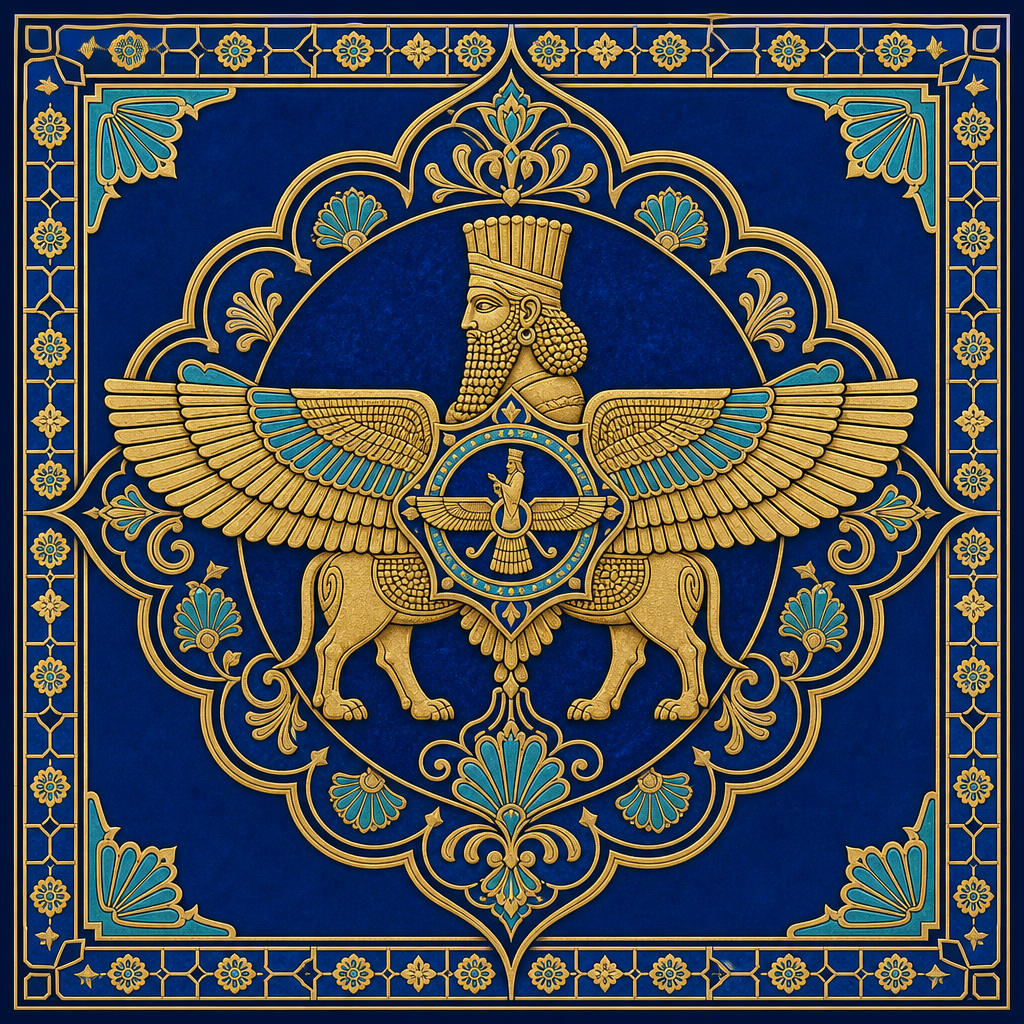

Cyrus the Great
In twenty years he took Media, Lydia and Babylon and built the largest empire the world had yet seen. What made it last was not the conquest but the settlement: local law, local gods, local elites — an empire governed by consent where its rivals governed by deportation.
Who was Cyrus the Great?
Cyrus II — Kūruš in Old Persian, Kourosh in modern Persian — was the founder of the Achaemenid Empire and its king from roughly 559 to 530 BCE. Born to the small vassal kingdom of Anshan in what is now Fars, he overthrew his Median overlord Astyages around 550 BCE, absorbed the Lydian kingdom of Croesus in 547–546 BCE, and entered Babylon in October 539 BCE. At his death the empire ran some 5,000 kilometres from the Aegean coast to the edge of Central Asia and held perhaps a sixth of the world's population.
His lasting significance is administrative and ethical rather than purely military. Where the Assyrians had ruled by mass deportation and the erasure of local cults, Cyrus restored temples, returned deported communities and their sacred images to their homelands, and left existing legal and religious institutions intact. That policy is recorded in his own words on the Cyrus Cylinder, and independently in the Hebrew Bible.
Twenty years that made an empire
| Date | Event | Consequence |
|---|---|---|
| c. 559 BCE | Accession as king of Anshan | A Persian vassal within the Median confederation |
| c. 550 BCE | Defeat of Astyages of Media at Pasargadae | Median empire absorbed; Ecbatana becomes a Persian capital |
| 547–546 BCE | Campaign against Croesus of Lydia; fall of Sardis | Persian rule reaches the Aegean and the Ionian Greek cities |
| c. 545–540 BCE | Eastern campaigns — Bactria, Sogdiana, Gandhara | Frontier pushed to the Oxus and the Hindu Kush |
| 12 October 539 BCE | Battle of Opis; Babylon entered without a siege | The Neo-Babylonian Empire ends; Mesopotamia becomes Persian |
| 538 BCE | Decree permitting the Judean return | Rebuilding of the Jerusalem Temple begins |
| c. 530 BCE | Death on the north-eastern frontier | Succession of his son Cambyses II |
"He ruled over these nations, though they did not speak the same language as he, nor one nation the same as another; yet he was able to extend the fear of himself over so great a part of the world that he astonished all."
The Cylinder and the policy behind it
The Cyrus Cylinder is a barrel-shaped clay document, about 22 cm long, excavated at Babylon in 1879 and now in the British Museum. Written in Akkadian cuneiform in the established idiom of Babylonian royal proclamations, it presents Cyrus as chosen by Marduk to end the impieties of Nabonidus, and records that he returned cult images to their sanctuaries and allowed displaced peoples to go home.
Two readings compete. The popular one, promoted from the 1960s and reinforced by the replica displayed at the United Nations, calls it the first charter of human rights. The scholarly one — argued most clearly by Amélie Kuhrt — reads it as a conventional Mesopotamian accession text whose content nonetheless reflects a real and unusual imperial policy. Both agree on the substance: restoration in place of deportation.
How the empire was actually run
Cyrus's settlement, refined by Darius I a generation later, established the machinery every subsequent Iranian empire reused: a provincial governor (satrap) drawn where possible from the local aristocracy, a separate military commander and royal secretary as checks on him, fixed tribute in place of arbitrary plunder, and imperial roads with relay stations carrying the king's correspondence.
c. 5.5m km²
Approximate extent of the empire at Cyrus's death
3 kingdoms
Media, Lydia and Babylonia absorbed in eleven years
539 BCE
Babylon entered; the Cylinder deposited in its walls
23 peoples
Nations later listed as subject on Darius's Behistun inscription
2004
Pasargadae inscribed as a UNESCO World Heritage Site
22 cm
Length of the Cyrus Cylinder, British Museum ME 90920
The tomb, and what came after
Cyrus built his capital at Pasargadae on the Morghab plain: a dispersed royal park of pavilions, watercourses and gardens — the earliest known chahar bagh, ancestor of every Persian garden. His tomb stands there still, a gabled limestone chamber on six receding steps, deliberately modest beside the later terraces of Persepolis. Alexander of Macedon, who had it restored after finding it plundered in 324 BCE, is said to have treated the visit as an act of homage.
The dynasty Cyrus founded ruled for two more centuries. His memory outlasted it: Xenophon made him the model prince of the Cyropaedia, a text read by Machiavelli, Montesquieu and Jefferson, who owned two copies. In Iran the tomb remains a place of gathering, and his name a shorthand for rule without cruelty.
Cyrus in stone and clay
The surviving material record: the tomb at Pasargadae, the winged relief of the palace gate, and the cylinder from Babylon.


Photographs and museum plates reproduced from Wikimedia Commons and public-domain collections.
Tolerance, Law and the Freed Exile: How Persia Ruled Differently
Cyrus is remembered less for what he conquered than for what he chose not to destroy. Babylon fell in 539 BCE without a sack; its temples kept their priesthoods, its gods were carried home to the cities Nabonidus had emptied, and the deported communities held there — the Judeans among them — were told to go home and rebuild their sanctuaries at royal expense. Set that beside the Assyrian practice of mass deportation that preceded it, and the difference is not rhetoric but policy.
The evidence is not Persian propaganda alone. The Hebrew Bible, written by the beneficiaries and not by the court, calls Cyrus 'the Lord's anointed' — the only foreign king so named. The Babylonian priesthood, whose own city had just been taken, welcomed him in its temple chronicle. Greek writers who fought Persia, from Xenophon to Aeschylus, still portrayed its kings as bound by justice. Independent, sometimes hostile, sources converge.
| Practice | Assyria / Babylonia | Athens & Rome | Achaemenid Persia |
|---|---|---|---|
| Conquered populations | Mass deportation as standard policy; whole communities resettled to break identity | Cities razed and populations sold — Melos 416 BCE, Carthage 146 BCE, Jerusalem 70 CE | Repatriation of earlier deportees; peoples returned to ancestral lands (Cyrus Cylinder, lines 30–34) |
| Local religion | Cult statues carried off to Assur or Babylon as trophies | Roman triumph paraded captured gods; Jewish Temple treasure taken to Rome | Statues returned to their own shrines; temple rebuilding funded from the treasury (Ezra 6:8–10) |
| Language & law | Akkadian imposed as administrative language | Latin and Greek as the language of courts and citizenship | Trilingual inscriptions; Aramaic chancery; Egyptian, Babylonian and Judean law codified locally |
| Labour | War captives as forced labour on state building projects | Chattel slavery central: c. 20,000 in the Laurion mines; up to a third of Italy enslaved | Paid kurtaš workforce on rations; no large slave-worked estates recorded in the Persepolis archive |
| Women's standing | Property rights limited and largely dynastic | Athenian women legally minors under a male guardian for life | Women hold estates, run workshops, receive maternity rations, seal their own administrative orders |
| Rulers' self-presentation | Reliefs of flayings, impalements and heaped heads | Triumphs displaying chained captives | Bisotun and Persepolis show subject nations carrying the throne, in their own dress, unbound |
Two details are worth pausing on, because they are documentary rather than literary. The first is the Persepolis Fortification Archive, discovered in 1933 and comprising tens of thousands of Elamite and Aramaic tablets recording rations paid out between 509 and 493 BCE. It is an accounting record — nobody wrote it to be admired — and it shows women drawing wine and grain in their own names, mothers receiving a bonus ration after childbirth, and skilled female supervisors paid more than unskilled men. The second is the Elephantine papyri from a Judean garrison in Upper Egypt, whose soldiers wrote to the Persian satrap for permission to rebuild their temple and got it.
539 BCE
Babylon taken without a sack; the Cyrus Cylinder records the return of gods and peoples to their own cities.
538 BCE
Judean exiles permitted to return to Jerusalem; the Second Temple is completed in 516 BCE with Persian funding.
c. 518 BCE
Darius I commissions the codification of Egyptian law, in Egyptian and Aramaic, by Egyptian priests.
30,000+ tablets
The Persepolis Fortification Archive: a paid, rationed workforce — women included — not a slave register.
None of this makes the Achaemenid Empire a modern democracy. It was a monarchy that taxed hard, punished rebellion severely — Bisotun says so plainly — and knew household servitude and war captivity. Honest history does not need the myth. What it does show is that a large multi-ethnic state could be run, deliberately and for two centuries, on the principle that subject peoples keep their gods, their courts, their language and their homes. That principle was a choice, and other empires of the same centuries chose otherwise.
- Cyrus Cylinder (British Museum, BM 90920): the returned cult statues and the rebuilt sanctuaries of Ashur, Susa, Akkad and the cities of the Zagros.
- Ezra 6:8–10: Darius orders the cost of the Jerusalem Temple paid from the royal revenue of Beyond-the-River, with animals supplied for sacrifice.
- Isaiah 45:1: Cyrus called 'anointed' — the sole non-Jewish figure given that title in the Hebrew Bible.
- The Udjahorresnet inscription: Cambyses and Darius restore the temple of Neith at Sais and re-endow its priesthood after wartime damage.
- Elephantine papyri (5th century BCE): a Judean garrison in Egypt petitions the satrap Bagavahya and receives authorisation to rebuild its temple.
- Irdabama and Artystone: royal women with their own estates, seals, workshops and letter-carriers in the Persepolis tablets.
- Bisotun and the Apadana reliefs: twenty-three subject nations depicted upright, armed, in their own national dress — not chained, not kneeling.
Read alongside the Cyrus Cylinder, the Persepolis archive and the Judean and Egyptian documents, the conclusion is narrow but firm: not all empires were the same, and the difference was visible to the people who lived under them.
Cyrus the Great — frequently asked questions
Related reading
The 539 BCE clay barrel from Babylon — often called the world's first charter of human rights.
First Achaemenid capital and burial place of Cyrus the Great — the world's earliest chahar-bagh garden. UNESCO 2004.
Achaemenid, Parthian, Sassanid, Safavid, Qajar — six successive Iranian empires.
A dated timeline of every Persian dynasty — Median, Achaemenid, Parthian, Sassanid, Safavid, Qajar — with rulers, battles and territorial extent.
Parsa, the ceremonial capital of the Achaemenid Empire — Apadana, Gate of All Nations, 23 satrapies, and Alexander's fire of 330 BCE.
From Elam and the Medes to the modern era — a continuous 5,000-year story.
References
- ↗ Encyclopædia Iranica — Cyrus II the Great
- ↗ British Museum — The Cyrus Cylinder
- ↗ UNESCO World Heritage Centre — Pasargadae
All imagery is sourced from Wikimedia Commons, public-domain museum collections (British Museum, Louvre, Metropolitan Museum of Art, National Museum of Iran), or UNESCO World Heritage records. No AI-generated images are used. Scholarly text is synthesized from Encyclopædia Iranica, the Cambridge History of Iran, and peer-reviewed publications.